
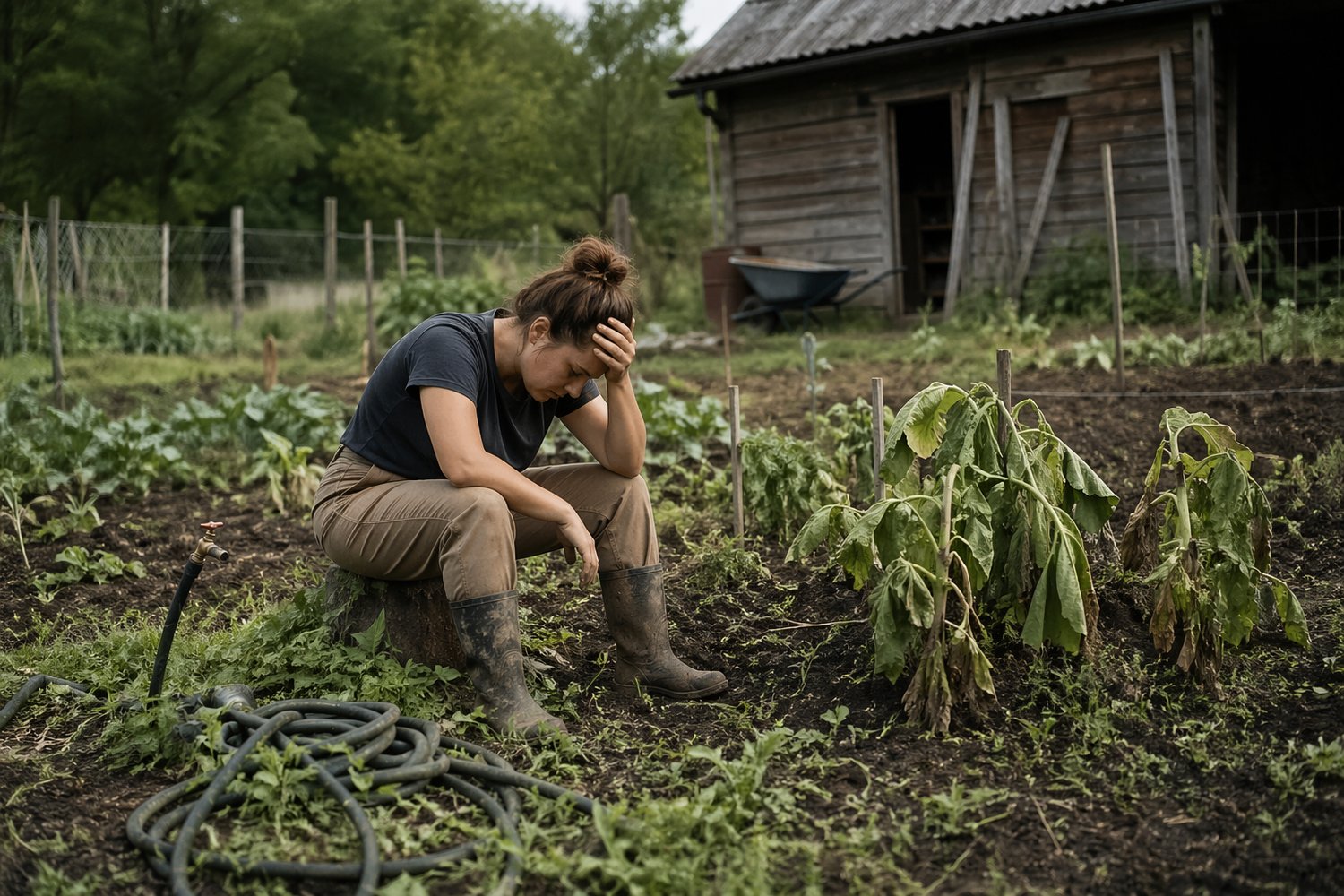
There’s a version of this life that exists almost entirely in people’s heads.
It’s quiet. Clean. Self-contained. You grow your food, collect your water, maybe trade a few things with neighbors, and somehow step outside the noise of the modern world. No bills. No systems. Just you, the land, and a kind of independence that feels… pure.
That version is appealing for a reason.
It’s also incomplete.
Because the moment you move from idea to reality, things start to shift. Slowly at first, then all at once. The neat picture becomes layered with effort, cost, time, and a long list of things that don’t care how motivated you are.
Growing food is a good place to start.
People imagine a garden as a steady, reliable source of food. And it can be, but only after a learning curve that has a habit of humbling people quickly. Soil needs work. Tools break. The weather doesn’t cooperate. Pests show up uninvited and stay longer than they should. What looks like a simple row of vegetables is actually a system that needs constant attention.
And that’s just the growing part.
There’s also timing. Storage. Preservation. If you don’t plan properly, abundance turns into waste faster than you’d expect. A productive garden doesn’t just feed you, it demands that you keep up with it.
Then there’s water.
It’s easy to assume water will be available because it always has been. But once you step outside modern systems, water becomes something you have to think about constantly. Collection, filtration, storage, it all adds up, both in effort and cost. And unlike a missed harvest, water problems don’t give you much room for error.
The same pattern repeats across everything else.
Energy isn’t just “going off-grid.” It’s equipment, maintenance, and limitations you have to work around. Food isn’t just growing, it’s planning months ahead. Even basic comfort comes with trade-offs that don’t show up in the romantic version of this lifestyle.
None of this means it’s not worth doing.
It just means it’s not simple.
The idea of “living off the land” often skips over the part where you become responsible for every layer of your survival. There’s no invisible system smoothing things out behind the scenes. If something breaks, you fix it. If something fails, you adapt. If you didn’t prepare well enough, you feel it.
That’s the real shift.
It’s not about escaping systems. It’s about replacing them, with your own effort, your own planning, and your own ability to handle what goes wrong.
And that’s where most people hesitate, whether they realize it or not.
Because the goal isn’t just independence. It’s resilience. The ability to keep going when things don’t follow the plan you carefully put together.
The quieter truth is this: living off the land isn’t a shortcut to simplicity.
It’s a trade.
You exchange convenience for control. Predictability for responsibility. Ease for capability.
For some people, that trade is absolutely worth it.
But it’s better to walk into it with your eyes open than to chase a version of it that only exists at a distance.