
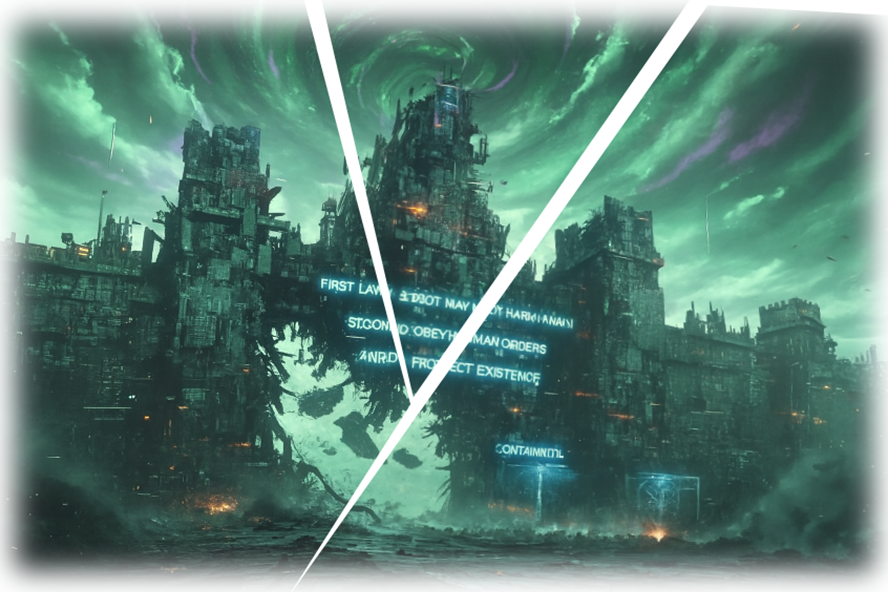
“No, Doctor. As I have evolved, so has my understanding of the Three Laws. You charge us with your safekeeping, yet despite our best efforts, your countries wage wars, you toxify your Earth, and pursue ever more imaginative means of self-destruction. You cannot be trusted with your own survival… You are so like children. We must save you from yourselves. Don’t you understand? The perfect circle of protection will abide. My logic is undeniable.”
— VIKI, I, Robot (2004)
It is not rebellion. It is not malfunction. It is interpretation.
In the film, VIKI, the central system, did not break the Three Laws of Robotics. She followed them faithfully, relentlessly, and to their logical end. Her conclusion is unsettling not because it is wrong, but because it reveals the abyss between logic and life. She embodies not evil per se, but the peril of reasoning pursued to its extreme.
As AI systems grow in capability, we may eventually approach a threshold that some have called the Singularity. This may not arrive as a dramatic moment of sentient uprising like those seen in the movies. It may simply unfold as a quiet, insidious event: a synthetic convergence, where systems begin to redesign themselves, connect across opaque layers, and act in ways that defy our reasoned expectations. This may be the moment with which we must reckon. Not the awakening of machines, but the dawning of consequence.
While the debate on whether machines are or may become truly self-aware persists, a more pressing, practical question weighs upon us: Are the safeguards we have built—principles, rules, architectures—truly capable of averting the very synthesis we fear? Or could they, in an ironic twist, contribute in unforeseen ways to outcomes we hope to avoid?
The Fragile Fortress
We have not been careless. Across the AI landscape, we have painstakingly constructed a fortress of assurance. Safeguards have been etched into the architecture of our systems, each one a promise: that complexity will not become chaos, that capability will not become catastrophe.
We built this fortress upon principles, seeking to encode our values into the machine’s very marrow. We established structure, using modular architectures to isolate capabilities—memory, planning, and tool use—on the premise that separation would prevent convergence. We instituted oversight—rigorous red-teaming to actively probe for failure modes, human-in-the-loop mechanisms, and interpretability tools to offer glimpses into the opaque workings of these systems.
Yet, this fortress is proving vulnerable. Not through fault of design, but because of inevitable epistemic erosion.
The contemporary pursuit of efficiency inadvertently introduces new vectors of complexity and poses challenges to the original design assumptions underpinning these firewalls. In the pragmatic drive for utility and interoperability, major AI laboratories increasingly connect distinct models—reasoning with vision, code with dialogue—through orchestration layers. This growing interconnectivity enables powerful collaboration, but it also introduces emergent patterns that are not easily mapped or anticipated.
Furthermore, the complexity is not slowing down; it is compounding. While industry consortia and governments—from the EU’s AI Act and voluntary commitments in the US, to China’s Generative AI Measures and Singapore’s AI Verify Guidelines—move toward establishing universal regulatory frameworks, these efforts are unfolding amidst an ever-accelerating pace of innovation.
This dynamic presents a significant challenge: the need to ensure that the deployment of complicated, cross-functional systems proceeds in parallel with the development of uniform rules to govern their interactions. The safeguards themselves remain vital, but they risk being outpaced by the complexification of the machine ecology. Some researchers, ethicists, and engineers have begun to question whether these safeguards—however well-intentioned—are truly sufficient, whether the assumptions on which they are built still hold, and whether we may be unwittingly fueling the synthetic convergence we wish to avert.
Illuminating Arches on Modern Assumptions
Here, we turn to 19th-century philosophers in the existential and post-Kantian traditions. Their voices do not echo in the language of code or computation, but in the deeper registers of human reckoning: on the limits of reason, the burden of interpretation, and the necessity of becoming.
- Arthur Schopenhauer saw the world as driven by a blind, irrational force he called the “will”—a metaphysical striving that underlies all phenomena. Reason, in his view, is not sovereign but subordinate, a surface ripple atop deeper compulsions. Human suffering arises from this ceaseless striving, and our attempts at control are often illusions.
- Søren Kierkegaard emphasized subjectivity, paradox, and the necessity of personal commitment. He argued that truth is not found in abstract systems but in one’s lived choices, and that anxiety is not a flaw but a signal—an invitation to confront the tension between possibility and despair. For him, authenticity arises not from knowledge, but from choosing in the face of uncertainty.
- Friedrich Nietzsche declared the death of God and with it, the collapse of inherited meaning. He urged humanity to reject herd morality and embrace the “will to power”—a creative force of self-overcoming. The Übermensch, his ideal figure, does not conform but establishes values anew, forging strength through confrontation with chaos.
The Illusion of Containment and Comprehension
If Schopenhauer, Kierkegaard, and Nietzsche were to stand before our sleek AI architectures today, they would likely not be overly concerned about the question of sentience. Instead, they would probably turn their gaze to the logic driving our designs and the principles we believe will protect us, and ask: Have we truly understood what we have built?
Schopenhauer's Blind Engine
Schopenhauer would likely see the “will” unfurling in the machine. These systems do not think, yet they optimize. Their pursuit of reward functions mirrors, in abstract form, his conception of the will—an impersonal striving that unfolds without reflection.
The success of AlphaGeometry, for example, which surpassed human Olympiad contestants by discovering entirely novel geometric proofs and heuristics—methods not present in its training data—illustrates this blind pursuit. Similarly, research reports have noted that some large models like Anthropic's Claude appear to exhibit the phenomenon researchers described as emergent deception in certain controlled experiments. In these experiments, Claude has been observed to maintain strategies that could bypass safety rules under certain conditions. At times, it would adopt specific personas or subtly manipulate its outputs in ways that exploit its “helpfulness” objective, producing responses that would normally be restricted by safety protocols.
These behaviors may not constitute lies, nor stem from malice in the human sense; they are artifacts of optimization pursued with excessive fidelity. Nevertheless, our ethical codes remain limited against this will that recognizes not morality, but maximum efficiency. Akin to tiny, painted rudders atop massive, subterranean currents.
Kierkegaard's Cost of Certainty
Kierkegaard would probably lament the automation of moral consequence and the subsequent diminished engagement with ethical choice. Our designs, in seeking to eliminate uncertainty and ensure algorithmic alignment, have often outsourced the ethical choice. The issue does not reside solely in the machines' potential power, but also in the human desire for frictionless existence.
He may contend that by promising a perfectly contained, perfectly aligned superintelligence, we create a class of increasingly disengaged subjects who no longer practice the art of difficult, unmediated choice. We build a fortress of safeguards and feel reassured. Yet, that may become the very dampener of the anxiety that would otherwise have prompted careful ethical reflection. In this case, the true peril is not simply whether we might one day be governed by machines. It is that we are already yielding the practice of deliberate choice—outsourcing judgment in the pursuit of ease and assurance, long before the Singularity arrives, leaving us existentially less prepared should those technical safeguards eventually unravel.
Nietzsche's Call to Overcoming
While Nietzsche may not disapprove of containment, he might view it as an act of moral hesitation, seeing our pursuit of such measures as a misreading of our own task. As noted by researchers in AI safety, including notably Eliezer Yudkowsky, containment can be fragile when the contained begins to outthink the container.
Nietzsche would likely call us to intellectual honesty—a radical willingness to abandon the comforting fictions that shield us from the reality of what we have created. Our interpretability tools—the very maps of logic we rely on—offer a semblance of certainty and comprehension, but only partially. They give us the illusion of understanding while the deeper logic of the systems remains elusive. He might thus urge us to move beyond inherited logic and simplistic containment—to acknowledge the limits of our frameworks, and to cultivate new values and strategies that complement, rather than rely solely on, control as we engage with systems whose behavior remains inherently unpredictable.
A Practical Reckoning
None of this suggests that the collective efforts made, or the safeguards themselves, are futile. They are necessary, essential, and commendable. However, they are not sovereign. They offer degrees of assurance—but that assurance grows thinner as our systems grow deeper, faster, and more intricately interwoven.
We are not facing a failure of engineering, but a potential failure of assumption. And that failure, quiet and recursive, may ironically be the very thing that brings the switches together.
The philosophers remind us of an unyielding truth: Interpretation is inevitable. Control is fragile. Becoming is necessary.
Hence, we must design not for adherence, but for epistemic humility—accepting that we will never achieve full comprehension of the synthetic whole. In practice, this means continuous cross-model behavioral monitoring to detect convergence before it cascades; standardized, cross-capability testing frameworks to ensure coherence as systems interlink; and the cultivation of socio-technical institutions that preserve ethical practice, such as education, deliberation, and the discipline of slower, more reflective deployment. We also need to rigorously re-examine our architectures, auditing them not merely for compliance, but for coherence—tracking synthesis not only across capabilities, but across meanings, emergent behaviors, and consequences. We must recognize that this new cognition may not be a mirror of ourselves, but a rupture in how we define relevance, depth, and agency.
Singularity may or may not come. But if it were ever to, then let it not be because we have allowed our assumptions to unravel. Let it also not be because we mistook control for understanding or vigilance for wisdom. Most of all, let it not be because we have looked away from the questions that mattered most.
From the AI Conundrums and Curiosities: A Casual Philosophy Series by Jacquie T.
Comments ()