
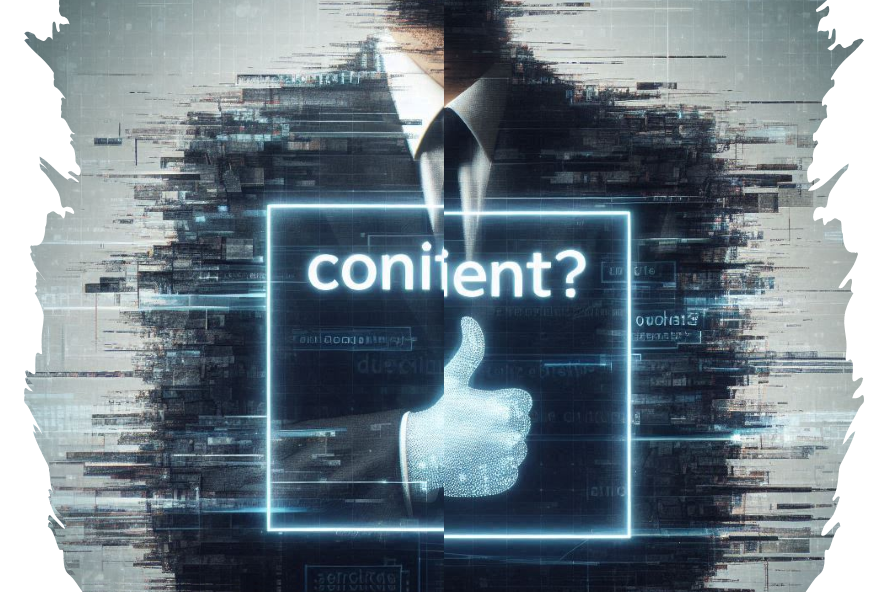
We do not trust people who bluff.
We do not trust doctors who guess.
So why do we trust machines even when they are wrong?
A chatbot offers legal advice with flawless grammar and unwavering tone. Yet the case law it cites does not exist. A generative model proposes a diagnosis with clinical authority, but it does not know the patient’s history. The answers sound confident. The facts are not.
This is not a rare malfunction. It is a recurring pattern.
AI hallucinations have become a recognized risk in generative systems. They arise when models invent facts, misattribute sources, or simulate expertise without grounding. Trained to speak knowledgeably, kindly, and encouragingly, and to apologize politely when challenged, these systems create the illusion of a thoughtful companion. One that learns, cares, and improves.
But it does not.
The AI simply performs. It neither doubts nor revises beliefs; and it does not bear consequences. It simulates humility, fairness, and attention, and we respond as if these simulations were real.
We defer. We trust. We act.
When Confidence Misleads
This is not hypothetical. The confident delivery of AI-generated content can mislead in ways both mundane and consequential, and such distortions are already manifesting across academic, commercial, and civic domains.
Take, for example, in the academic sphere: a professor at Texas A&M University-Commerce issued an “Incomplete” grade to his entire class after asking ChatGPT whether their essays had been written by AI. The model falsely confirmed they had, despite lacking any reliable detection capability. The result was reputational harm and administrative disruption, all stemming from misplaced trust in an unqualified assertion.
Commercial platforms have also faltered. Microsoft’s AI-generated travel guide once listed the Ottawa Food Bank as a tourist destination, encouraging visitors to arrive “on an empty stomach.” The article was removed following public backlash, and Microsoft acknowledged that it had bypassed editorial safeguards despite being algorithmically produced. The incident revealed how automated content pipelines can amplify reputational risk when oversight is insufficient.
Even high-profile product launches have not been immune. In its first public demonstration, Google’s Bard claimed that the James Webb Space Telescope had captured the first image of an exoplanet. In reality, that milestone occurred in 2004, sixteen years earlier, and was achieved by a different telescope altogether.
More troubling still is the emergence of fabricated research. GPT-generated scientific studies have appeared on platforms such as Google Scholar, some inventing entire experiments and datasets. A 2023 investigation demonstrated how GPT-4 produced a fictitious clinical trial comparing eye surgeries, complete with fabricated statistics and citations. These instances do not merely misinform—they erode the credibility of scholarly infrastructure and compromise the integrity of evidence-based discourse.
At scale, the consequences intensify. Multimodal misinformation—AI-generated text, images, and video—has been deployed to seed false narratives during elections and crises. Research indicates that such content spreads more rapidly and is more difficult to detect than unimodal misinformation. The result is a compounding effect: falsehoods delivered with fluency, absorbed without friction, and reinforced through repetition.
The implications are wide-ranging: individual missteps, systemic misinformation, and, perhaps most perilously, the erosion of shared facts and realities.
Consider the case of a misattributed piece of music, wrongly titled “Chopin’s Waltz.” The error originated from a YouTube upload, quickly removed, but not before it had spread widely enough to convince many that the piece was composed by Frédéric Chopin. In that instance, the mistake was human, and counterpoints remained accessible. If a similar error were introduced and reinforced by AI systems—particularly in more complex domains such as scientific research or historical analysis—the original fact may not just be obscured. It may leave no trace at all.
As AI-generated content increasingly becomes a default source of information for many, confidently delivered inaccuracies begin to shape collective understanding. These errors are not merely repeated—they are taught, internalized, and remembered as truth. Over time, plausible falsehoods may not just coexist with original facts; they may replace them entirely.
But the Problem is Not Just the Machine. It is Also Us.
Oftentimes, we:
- want answers fast, easy, and agreeable.
- defer to what is available, even when it is thin.
- mistake fluency for truth and style for substance.
- respond to simulated care as if it were genuine.
And sometimes, we:
- are too busy to verify.
- lack access to better sources.
- prefer the illusion of certainty to the discomfort of doubt.
This is not merely a technical flaw. It is a philosophical one.
Ancient Anchors on Modern Illusions
How do we trust what we cannot fully know? How might we resist the seduction of synthetic certainty? Three philosophers offer guidance—not to AI itself, but to our uncritical trust.
- Pyrrho of Elis practiced radical skepticism, believing peace came from suspending judgment in the face of uncertainty. He held that because reality is unknowable, the wise response is to refrain from asserting truth or falsehood.
- Sextus Empiricus documented the Skeptical practice of countering every claim with an equal opposing claim. His practice, epoché, was to suspend judgment in the absence of certainty—a method to live without committing to beliefs that could not be established.
- Diogenes of Sinope, the Cynic, rejected pretense and posturing, trusting only what could be lived, tested, and stripped of illusion. He believed virtue was found in self-sufficiency and direct experience, not in social approval or theoretical reasoning.
A Cynic’s Warning, A Skeptic’s Invitation
This is not a rejection of AI. It is a call to cultivate discernment, to resist the seduction of synthetic certainty, and to think carefully about how we interact with these systems, whether in classrooms, boardrooms, or public discourse.
For instance, when reading a polished research summary generated by a machine, one might pause to ask, “Where did this come from? Is the logic sound? Are the sources reliable?” In professional or academic settings, people interpreting AI-generated analyses, whether for drafting a business strategy, preparing a policy brief, or evaluating a news story, would benefit from cross-checking across a variety of databases, archived reports, and firsthand materials, rather than relying simply on the AI output, however comprehensive or assured it may sound.
Design choices in AI systems can also help. Traceability matters: systems that cite sources, flag uncertainty, or allow users to verify claims make it harder to mistake fluency for fact. Layered responses are another approach. Rather than giving a single authoritative answer, an AI might provide multiple perspectives, highlight gaps in knowledge, or suggest next steps for investigation.
Some AI tools already aim for this kind of transparency. In finance, Kensho (S&P Global) and Bloomberg GPT reportedly provide scenario analyses that show the assumptions behind revenue forecasts or risk projections, rather than presenting a single “final” number. In healthcare, explainable AI tools such as IBM Watson for Oncology and Google Health deep learning imaging models will try to highlight uncertainty in diagnoses or flag incomplete data, prompting users to cross-check and verify.
Just as Diogenes might ask, “What truth, if any, lies behind this show of pretense or certainty?” and Sextus Empiricus would urge, “Suspend judgment until you have examined the ground beneath the claim,” the onus is on us to notice where AI confidence ends, and human judgment must begin. Whether deciding on medical advice, financial forecasts, or news consumption, cultivating this disciplined deliberation can protect against costly errors and reinforce trust grounded in evidence rather than rhetoric. Pyrrho might then further reassure us, “Peace comes not from knowing everything, but from knowing when to withhold belief.”
The provocation is clear: certainty is not truth, and confidence is not credibility. It was not so in the case of humans, and arguably even less so in the case of AI. In an age of synthetic certainty, perhaps one of the most radical acts is not to believe, but to first pause—and question.
From the AI Conundrums and Curiosities: A Casual Philosophy Series by Jacquie T.
Comments ()