
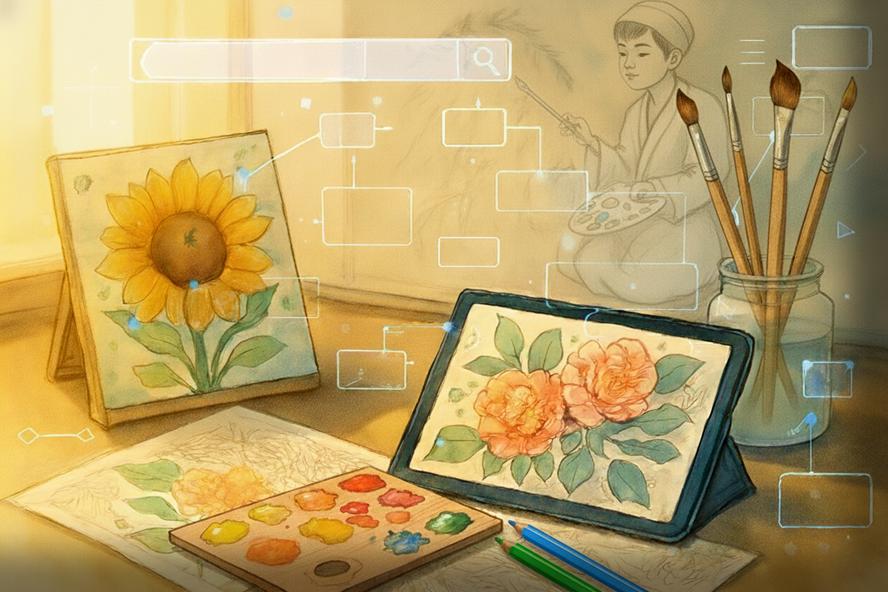
A Brush with Memory
Drawing never came easily to me; it was neither realistic enough for classical standards nor abstract enough to claim artistic license. Trees, no matter how many times I tried, retained their childlike contours. The angle of airplane wings always looked slightly off, making one wonder if they could ever fly if real.
Coloring was different. I could stay within the lines, and I liked the neatness of it. The image seemed to brighten as color filled it in. I chose shades with care. Harmony was important but so was contrast. I seemed to have an instinct for it even as a child.
Years later, I stumbled upon adult coloring books at a bookstore. I was not looking for them, but there they were—botanical illustrations, vintage travel posters, stained glass motifs. I picked one up. I then wandered to the next shelf. A set of colored pencils caught my eye: sixty colors, two tones per pencil, with more shades of blue than I remembered. It felt indulgent, yet oddly dignified.
Coloring apps came next. They were fun, but tapping a screen was simply not quite the same as the physical act of coloring. It felt too clean, too fast. The tactile act—the choosing, the filling, the slow layering—was missing.
Then I saw the paint-by-numbers kits online. Beautiful canvases, lightly divided into segments, each marked with a faint number. No color yet. Just outlines. As though waiting for a brush to bring them to life. Somehow, that incompleteness reminded me of Ma Liang, the boy from the story The Magic Paintbrush that I had read when I was a child. His paintings became real, so he often left them unfinished. But when he wanted to help others—those in need or facing hardship—he would complete the images, and they would come alive.
I knew my paintings would not come to life. But there was something uniquely artsy about holding a paintbrush—more fluid, more expressive than the precision of a pencil. And that finally nudged me into ordering a kit. A tentative gesture, just to try. One that marked the beginning of an unexpected return to something I had not even realized I missed.
Colorful Choices: Notes from a Tentative Painter
As I was delightfully painting away at my newest purchase, a thought crossed my mind. I had long known that I would never be an artist, yet here I was, painting as though I bore some semblance of one. Creative endeavor has often been associated with skill and talent, rendering it seemingly out of reach for many.
However, the rise in popularity of adult coloring books and paint-by-number kits signals a shift in perception and opportunity. Not all creative forms need to begin with invention. A design already drawn, a canvas already divided, a palette already chosen—these are not limitations but generous invitations.
Structured formats like coloring and paint-by-number have become widely available, found in bookstores, online shops, therapy rooms, and living rooms. Engaging with them cultivates mindfulness, a sense of control in a chaotic world, and the satisfaction of completing something beautiful, even if it was pre-designed.
One may still not become a professional artist, but there is no longer an expectation to be technically skilled or able to draw in order to enjoy the creative process. These formats offer a way in, a way back—and perhaps, a way forward.
Coloring: Technique, Texture, and Interpretation
Coloring is often considered simple—a child’s pastime. Yet within its repetition lies a choreography of pressure, layering, and choice. The page may be pre-drawn, the lines printed, but the interpretation is entirely one’s own. It is not about filling space, but rather, noticing it, attending to it.
Coloring books now span a wide range of styles and intricacy. Some are dense with detail—mandalas, architectural motifs, or art deco patterns. Others are looser, more lyrical—botanical sketches, vintage posters, literary scenes. The choice matters. A crowded page may feel overwhelming on a tiring day. A sparse one may feel too light when one craves immersion.
As with the page design, the choice of tool shapes both the outcome and the experience of coloring itself. Color pencils offer the most control among common tools. They respond to pressure, allowing for subtle gradations and layering. A light hand builds transparency; a firmer stroke deepens saturation. Stroke direction matters. Circular motions create softness. Linear strokes add structure. Cross-hatching introduces texture. For those inclined, shadows can be introduced—though they require more patience and a steady hand.
Markers are vivid but less forgiving. They saturate quickly and may bleed through thin paper. Gel pens add gloss and detail, though they dry slowly. Watercolor pencils behave differently. Unlike watercolor brushes, which apply wet pigment from the start, one colors first in dry strokes with watercolor pencils, then applies water to soften and blend. This activation requires attention: too much water can wash out detail, while too little may leave uneven or overly sharp transitions.
Tool behavior is not only a matter of type, but also of construction. A color pencil that is too soft may smudge or break under pressure, while one that is too hard or too waxy can resist layering, making smooth gradations difficult. Investing in slightly better tools—within reasonable means and without indulgence—can make the coloring experience smoother and more satisfying. A well-made tool will do what it should, without fuss.
Beyond the tool itself, technique refines the result. Layering colors gradually adds depth. Blending with a tissue, a blender pencil, or even a fingertip can soften transitions. A blotting sheet beneath the page prevents impressions on the next sheet. These are small considerations, but they make a difference in the final output.
Painting: Method, Movement, and Material
Painting introduces a different kind of control—one that is less about precision and more about flow. Most paint-by-numbers kits come with acrylic paints, a pre-numbered canvas, a few basic brushes, and sometimes a simple reference guide. Designs range from animals and landscapes to abstract compositions and custom portraits. The canvas is divided, but the experience is not mechanical. Painting is not about speed but steadiness—a process that feels almost meditative. The image builds gradually, and what begins as fragments eventually becomes a whole.
Acrylics dry fast. That is both a feature and a challenge. It is essential to clean brushes thoroughly between colors. Once stiffened, a brush is difficult to restore. The common wisdom is to begin with lighter shades to avoid accidental overlap, and to work in natural light whenever possible, which helps with color accuracy and reduces eye strain.
Brush quality matters more than one might expect. A frayed tip, overly stiff or soft bristles, loose hairs, or an uncomfortable handle can frustrate, especially in detailed areas. Some kits include finer brushes or linen canvases; others offer upgrades. But even basic sets can work well if handled with care.
Some choose to paint by color—completing all areas marked “3” before moving to “4.” Others paint by section, watching small areas come together. Neither is better. Over time, one learns to choose kits and adopt the approach that best aligns with one’s preferences.
Not every day calls for the same palette. Not every mood welcomes the same design. There is no right way to do it. Only the way that feels right.
Rendered Pages, Chosen Strokes
Another question surfaced as I continued painting. This resurgence of adult coloring books and paint-by-numbers—was it an analog holdout, driven by nostalgia amidst an increasingly digital and pixelated world? That seemed plausible. But given how deeply AI has threaded itself into our lives and across industries, I reckoned it had played a non-trivial role here too. Exactly how, I wondered.
It turns out, AI has not only touched this space—it has been pivotal in expanding and personalizing structured art experiences. It has democratized access to diverse creative engagements, enabling participation without formal artistic instruction.
For example, platforms such as ColorBliss, GenColor AI, and Dzine AI allow users to input descriptive phrases that generative models interpret to produce bespoke coloring pages. A user might type “sunset over a quiet lake” or “botanical garden in spring,” and receive a printable design tailored to that vision. With free tiers or limited-use credits available for personal use, hobbyists can step outside the bounds of pre-made coloring books to dictate the image they wish to color.
Beyond personal use, AI platforms have opened doors to small-scale commercial creativity. Creators can generate entire coloring books from prompts, often complete with commercial licenses and formatting support for print-on-demand services such as Amazon KDP. Meanwhile, independent sellers on marketplaces such as Etsy have reportedly used combinations of AI tools like Midjourney and ChatGPT to produce illustrated, text-based coloring books for sale. What began as a hobby can, for some, become a commercially viable creative line.
Paint-by-number kits are evolving in parallel. Bulk suppliers now offer photo-based customization, where user-uploaded images can be digitally converted into segmented canvases. While the underlying technology is not always disclosed, the speed and precision suggest that advanced algorithms or AI are likely part of the process, making personalized kits easier to produce and distribute.
In addition to the production of coloring books and paint-by-number kits, AI is increasingly integrated into professional visual creative work, including comics and educational materials. AI-enabled platforms support illustrators and colorists with palette suggestions, automatic shading, and lighting tools. Clip Studio Paint’s emerging “Colorize” feature, for instance, uses machine learning to automatically apply color to line art. Artists can then refine the results, enhancing efficiency without relinquishing creative control.
Before the rise of AI, coloring and customization tended to be manual, time-consuming, and potentially costly. Today, they can be accomplished in minutes—scalable, accessible, and increasingly intuitive. The tools have multiplied and grown more intelligent, widening the entry points for creative engagement.
The value, however, lies not in novelty, nor in nostalgia. In a world where content is increasingly generated and the image, infinitely reproducible, the differentiator is no longer the creation of the form, but the application of selective attention and intent. Curation. Discernment. Deliberate choice.
AI can produce the image. But ultimately, it is still the user who must decide what is worth coloring in. To decide—when to complete the picture and let it come to life, à la Ma Liang.
From the Creatives Hobbies: Not Too Late, Far from Perfect series by Jacquie T.
Comments ()