
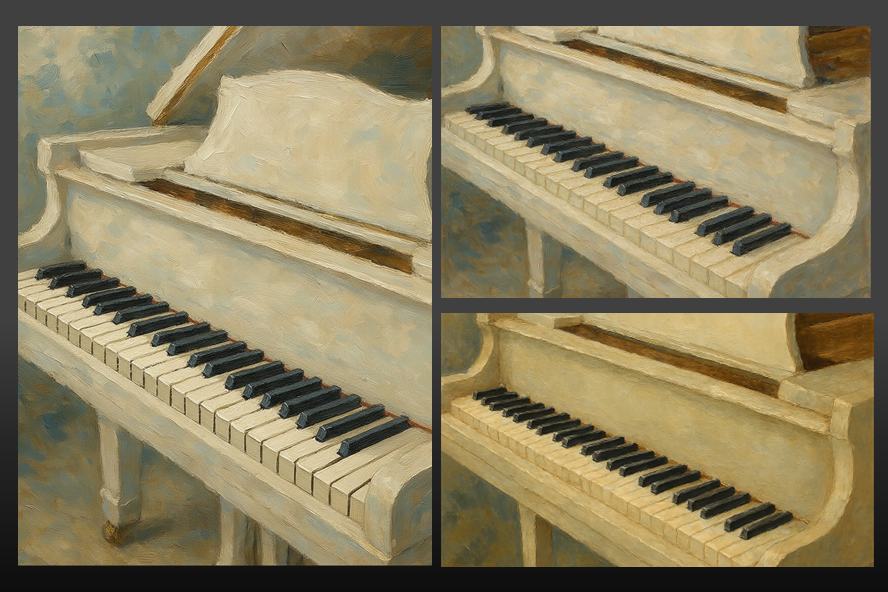
Two black keys among three white keys, then three black keys among four white keys.
Really, how hard can it be? Why can’t the AI just get this right?
I was trying to create the cover for one of my books in the Contemplationes series, and the AI image creator simply could not get the piano keyboard to look right. It generated a beautiful image that conveyed my vision, but the keyboard was wrong. The AI could not correct that single detail while keeping the rest intact. Instead, it offered entirely different images, even when I used the same prompt. And the keyboard was still wrong in every image. I had to fix it manually. This was April 2025.
Fast forward to September 2025. An image I generated for one of my posts in the AI Conundrums and Curiosities: A Casual Philosophy Series had a word spelt wrongly. This time, I could simply ask for the correction, and the system returned the image intact, with only the error fixed. I could even request more advanced changes—add or remove an element, change the colors of selected items, extend the picture. Only a few months apart, the advancement in AI capability was striking. What once required design software, technical skills, and hours of effort could now be done quickly and effectively through a set of simple prompts.
Not Too Late, Far from Perfect
I have always been drawn to the process of learning, especially in the realm of creative craft. There is something deeply engaging about stepping into a new domain, unfamiliar yet full of possibility. The early stages are not only about acquiring technique. They also entail discovering how something works, what it demands, and what it might reveal. Each pursuit opens fresh terrain. The satisfaction, when something finally clicks, is immense. And often, the sense of potential feels greater than the result itself.
Creative pursuits are sometimes seen as peripheral—pleasant but expendable when measured against pragmatic demands. They rarely offer direct economic return, and so they are easily postponed. Yet curiosity does not wait for the calendar to clear. These crafts take time to learn. Experience accumulates only if one begins, and momentum matters.
I had pursued these crafts, often hesitantly at first—wondering if I was too old to begin, and usually in a non-sequential way, as curiosity and urgency took hold. Progress was slow, sometimes even clumsy. And the persistent question lingered: would I ever become competent in any of them? Perhaps not. Then, was this truly a good use of time?
The words of a former manager would come to mind. A remarkable individual with significant professional achievements, who also manages to live an expansive life, including publishing books on business and technology that ranked among top sellers, teaching at universities, earning additional degrees, contributing actively to the community, and exploring unexpected pursuits such as K-pop dancing. He often said to me, kindly and encouragingly: “If it makes you happy, go for it. And remember, today is the youngest you will ever be. So, start now.”
I know he is right. Mastery may remain elusive, but these pursuits are worthy, unapologetically, in their own right. Today, when I look back, I am glad for what I had started yesterday; tomorrow, I too will be grateful for whatever I dare to begin today.
The recent experience with the startling pace of AI innovation gave me pause. Creative crafts tend to be manual, tactile, human. I had seen how technology shaped the way we learn and create, but with AI, that shift feels markedly accelerated. At home, the changes seem subtle; in commercial contexts, one reckons they are likely significant. I wanted to know more.
As these thoughts filled my mind, the idea of this series began to take shape.
A Note on the Series and Use of AI
This series is an attempt to capture, in a structured way, the joy in pursuing something simply because, the richness of each craft, and the interplay between human effort and artificial intelligence.
It gathers reflections from my attempts at a handful of creative crafts, but it is not a diary of effort, nor a manual of techniques. Rather, it is a lighthearted look at my own encounters with each craft, a considered account of what I have learned, and a curiosity-driven exploration of how AI is shaping these spaces—particularly in commercial contexts.
I hope that for fellow hobbyists, the series might offer gentle encouragement and new perspectives. For those casually curious about a craft, perhaps it can serve as a helpful overview with practical insights. And for readers interested in AI, it may offer a glimpse of how these fields and the surrounding commercial contexts are evolving.
Similar to what I have shared in my other works, I have drawn on AI tools for support in creating these posts—for images, research, phrasing suggestions, and clarity review. Thus, you may notice traces of AI in sentence structure or word choice, though these are also very much a reflection of my own style and preferences.
The picture of the piano keyboard is rendered incorrectly again (see pictures above). And AI still may not fix the error. I tried—different prompts, different AI tools. It is, at best, hit and miss. This is September 2025.
To those reading this post, thank you for your presence. I hope you will enjoy the posts to come—the first, a look at knitting.
From the Creatives Hobbies: Not Too Late, Far from Perfect series by Jacquie T.
Comments ()