

Introduction: Are You Using Technology… or Is Technology Using You?
Take a moment and look around.
How many digital devices are within arm's reach?
A smartphone.
A laptop.
A smartwatch.
Wireless earbuds.
A smart TV.
Perhaps a tablet quietly waiting for your attention.
Now ask yourself another question:
When was the last time you sat quietly for ten minutes without checking a screen?
If that question makes you uncomfortable, you're certainly not alone.
Modern technology has transformed our lives in extraordinary ways. We can communicate across continents in seconds, access almost any piece of information instantly, and work from virtually anywhere in the world.
These innovations have made life more convenient than ever before.
But convenience often comes with a hidden cost.
Many people no longer own their technology.
Their technology owns their attention.
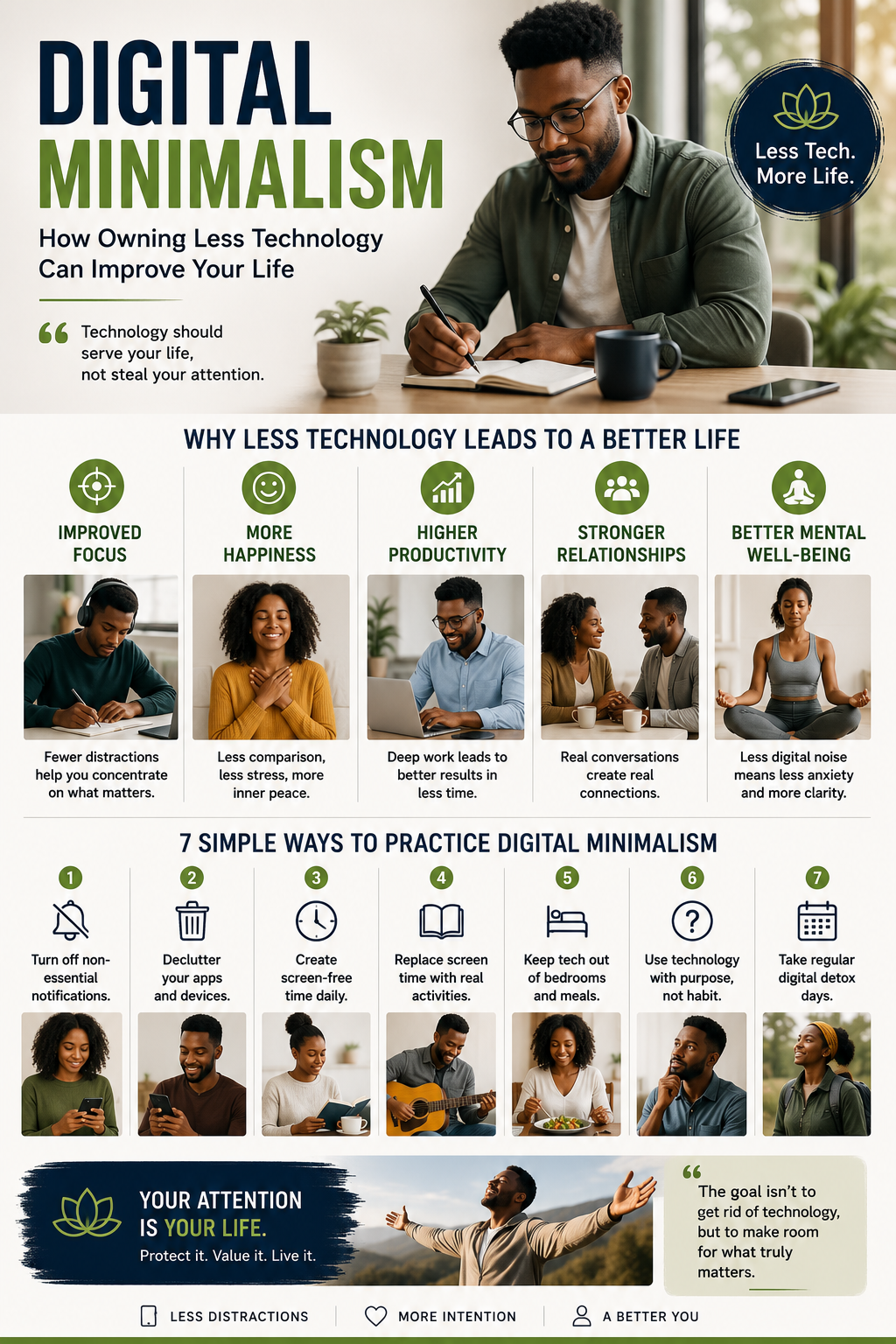
Welcome to the growing movement known as Digital Minimalism—a practical philosophy that isn't about rejecting technology but about using it intentionally to create a richer, more meaningful life.
What Is Digital Minimalism?
Digital minimalism is the intentional practice of using technology in ways that genuinely add value while eliminating unnecessary digital noise.
It asks one simple but powerful question:
"Does this technology improve my life—or simply occupy my time?"
Digital minimalism isn't about living without smartphones, social media, or the internet.
It's about becoming the master of your digital tools instead of becoming their servant.
Important Truth
Technology is a wonderful tool, but it makes a poor master.
The Digital Overload Problem
The average person encounters thousands of digital stimuli every day.
Notifications.
Emails.
Text messages.
Breaking news.
Social media updates.
Advertisements.
Videos.
Online meetings.
Streaming services.
Every notification competes for the same limited resource:
Your attention.
The result?
Many people finish the day feeling mentally exhausted without accomplishing the things that matter most.
Humor Break
Have you ever unlocked your phone to check the weather...?
And twenty minutes later found yourself watching a documentary about penguins in Antarctica?
Your original mission never stood a chance. 😄
The Hidden Cost of Digital Clutter
Just as a cluttered desk makes it difficult to concentrate, a cluttered digital life creates mental noise.
Digital clutter includes:
- hundreds of unread emails
- dozens of unused apps
- constant notifications
- unnecessary social media accounts
- endless browser tabs
- overflowing photo galleries
Each one quietly consumes mental energy.
Important Reminder
Clutter doesn't only occupy space.
It occupies attention.
Why Our Brains Struggle With Constant Connectivity
The human brain evolved in environments with relatively few interruptions.
Today's digital world is completely different.
Every vibration.
Every notification.
Every "breaking news" alert.
Every message.
Interrupts your concentration.
Even brief interruptions can significantly reduce productivity because your brain needs time to regain focus.
The Myth of Being Constantly Available
Modern culture often celebrates instant responses.
Reply immediately.
Answer every message.
Stay connected.
Always be reachable.
But constant availability often comes at the expense of deep thinking and meaningful work.
Ironically, always being connected can leave us feeling disconnected—from ourselves and from the people around us.
Digital Minimalism Improves Focus
Focus has become one of the most valuable skills of the twenty-first century.
Every distraction fragments your attention.
Digital minimalism protects it.
By reducing unnecessary digital interruptions, you create space for:
- deeper concentration
- better creativity
- improved problem-solving
- higher-quality work
Truth
The fewer distractions you allow, the more meaningful your attention becomes.
Digital Minimalism Improves Happiness
Social media often encourages comparison.
News feeds frequently amplify negativity.
Algorithms reward outrage because outrage keeps people engaged.
Digital minimalism creates distance from these emotional traps.
Instead of consuming endless content, you begin experiencing more of your own life.
Humor Break
Some people spend so much time watching other people enjoy life online that they forget to enjoy their own. 😄
Why Less Screen Time Improves Relationships
Technology connects us globally.
But sometimes separates us locally.
Have you ever seen?
A family at dinner...
Everyone is looking at their own phones?
They're physically together.
Mentally somewhere else.
Digital minimalism encourages intentional presence.
Real conversations.
Eye contact.
Listening without distractions.
Relationships thrive where attention exists.
Important Truth
One hour of undistracted conversation is often more meaningful than ten hours of distracted company.
The Productivity Advantage
Every app competes for your attention.
Every notification interrupts momentum.
Every unnecessary click steals time.
Digital minimalists intentionally remove low-value activities to create space for high-value work.
The result?
They often accomplish more while feeling less overwhelmed.
The Fear of Missing Out (FOMO)
One reason many people struggle to disconnect is the fear of missing something important.
Ironically...
The more connected we become digitally...
The more disconnected we often feel emotionally.
Instead of asking:
"What am I missing online?"
Digital minimalism asks:
"What am I missing in real life?"
The Joy of Missing Out (JOMO)
An interesting shift happens when people embrace intentional technology use.
FOMO becomes JOMO.
The Joy of Missing Out.
Missing endless notifications.
Missing online arguments.
Missing unnecessary drama.
Missing distractions.
And gaining peace instead.
Humor Break
Nothing important has ever happened because someone refreshed social media for the 47th time before breakfast. 😄
Signs You May Need a Digital Reset
Consider these questions:
- Do you check your phone immediately after waking up?
- Do you feel anxious when your battery is low?
- Do you scroll without knowing why?
- Do you struggle to finish reading a book?
- Do notifications interrupt your conversations?
- Do you often feel mentally tired after spending hours online?
If several sound familiar...
Your digital habits may deserve a closer look.
Practical Steps Toward Digital Minimalism
Digital minimalism doesn't require dramatic changes overnight.
Small, intentional adjustments make a significant difference.
1. Turn Off Non-Essential Notifications
If everything is urgent...
Nothing truly is.
Silence unnecessary alerts.
Protect your attention.
2. Declutter Your Phone
Delete apps you rarely use.
Organize what's left.
A cleaner phone creates a calmer mind.
3. Schedule Screen-Free Time
Create daily periods where technology disappears.
Morning.
Meals.
Evenings.
Walks.
Let your mind breathe.
4. Replace Screen Time With Real Activities
Instead of scrolling:
- read a book
- exercise
- cook
- journal
- garden
- learn a skill
- spend time with family
Real experiences leave lasting memories.
5. Create Tech-Free Spaces
Keep bedrooms.
Dining tables.
Family conversations.
Free from unnecessary devices.
Presence becomes easier.
6. Consume More Intentionally
Ask before opening any app:
"Why am I here?"
Purpose replaces habit.
7. Take Regular Digital Detox Days
Choose one day each week—or even a few hours—to disconnect from unnecessary technology.
Your mind will thank you.
What You Gain When You Own Less Technology
Digital minimalism isn't about what you lose.
It's about what you regain.
You regain:
- attention
- creativity
- peace
- productivity
- meaningful relationships
- better sleep
- deeper thinking
- emotional balance
Less digital clutter.
More intentional living.
The Digital Minimalism Formula
If you remember nothing else:
Intentional Technology + Fewer Distractions + More Presence + Meaningful Activities = A Better Life
Not abandoning technology.
Simply using it wisely.
The Mature Perspective on Technology
As we grow older, many of us realize that our most precious resource isn't money.
It isn't status.
It isn't even time.
It's attention.
Where your attention goes...
Your life follows.
Technology should support the life you want to build—not constantly interrupt it.
The happiest people aren't always those with the newest devices.
They're often those who know when to put them down.
Conclusion: Own Your Technology Before It Owns You
Technology has changed the world in remarkable ways.
It helps us learn.
Work.
Communicate.
Create.
Innovate.
But the greatest technological advantage isn't owning more devices.
It's knowing when not to use them.
Final Truth
Every notification asks for your attention.
Every click asks for your time.
Every hour online is an hour you cannot spend anywhere else.
Choose wisely.
Because the goal isn't to disconnect from technology.
The goal is to reconnect with life.
Read more books.
Have more conversations.
Take more walks.
Watch more sunsets than screens.
Laugh more with people than with algorithms.
Own fewer digital distractions.
Create more meaningful moments.
Because in a world where almost everyone is constantly connected...
The truly remarkable person may be the one who knows exactly when to disconnect.
Comments ()