

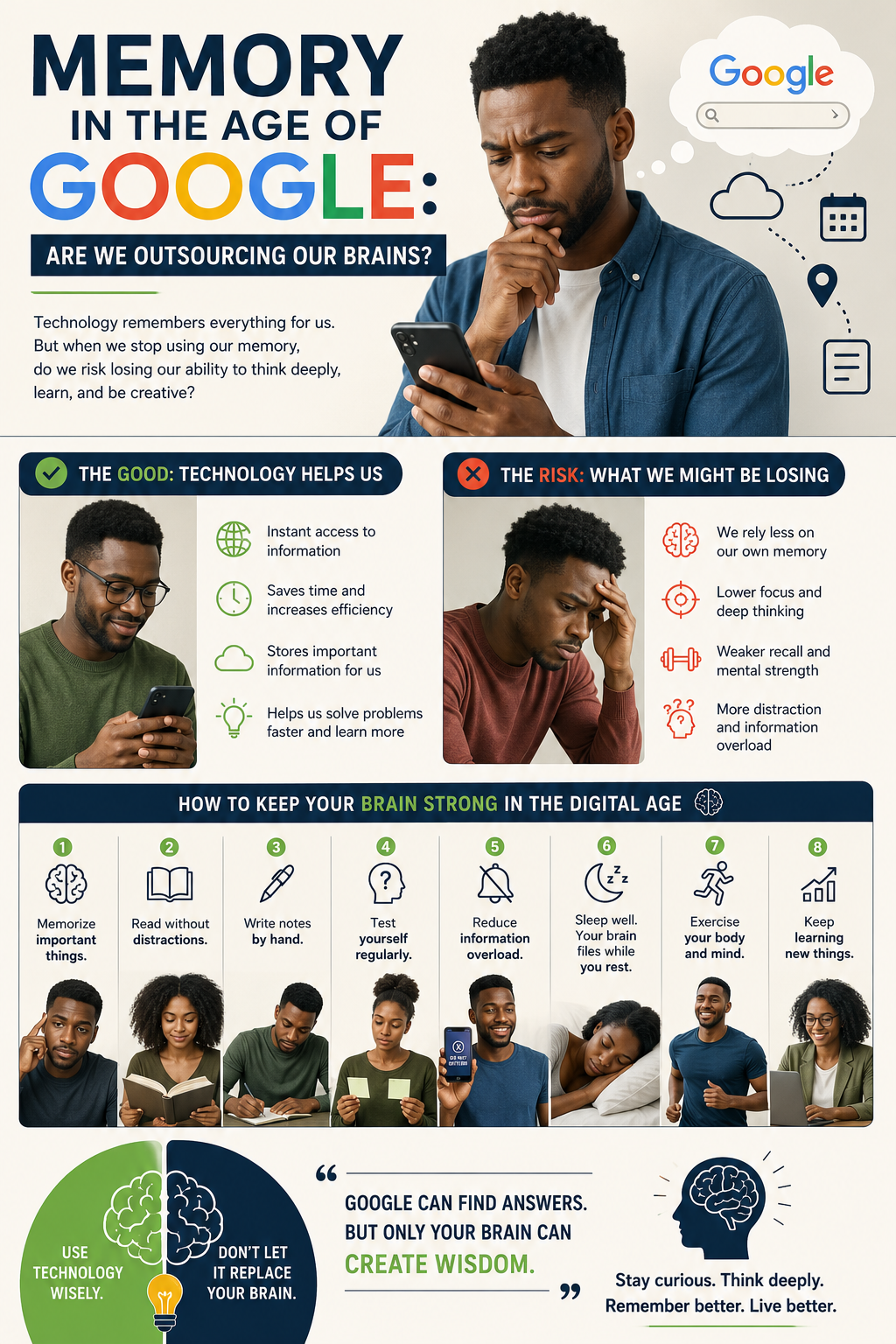
Introduction: Do You Remember Phone Numbers Anymore?
Quick question.
How many phone numbers do you know by heart?
Not contacts stored in your phone.
Actually memorized.
If you're under forty, there's a good chance the answer is...
"Maybe one."
If you're over forty, you probably remember a time when memorizing phone numbers, birthdays, directions, and shopping lists was simply part of daily life.
Today?
We don't need to remember much.
Google remembers.
Our smartphones remember.
Cloud storage remembers.
Voice assistants remember.
Even our refrigerators are starting to remember.
Modern technology has become incredibly good at storing information for us.
But this raises an important question:
As technology gets smarter, are our brains becoming lazier?
Welcome to one of the most fascinating debates in modern neuroscience and psychology:
Are we outsourcing our memory?
Your Brain Was Never Meant to Be a Hard Drive
Many people think memory works like a computer.
Store information.
Retrieve information.
Done.
The human brain is much more sophisticated.
Memory isn't simply storage.
It's the foundation of:
- learning
- decision-making
- creativity
- problem-solving
- relationships
- personal identity
Every experience you have becomes part of the story that makes you... you.
Without memory, there is no wisdom.
Only information.
Important Truth
Memory isn't just about remembering facts.
It's about connecting experiences to create understanding.
Meet "The Google Effect"
Researchers have identified something called the Google Effect, sometimes referred to as digital amnesia.
Here's how it works:
Instead of remembering information itself...
Your brain remembers where to find it.
For example:
Instead of remembering:
"The capital of Iceland is Reykjavík."
Your brain remembers:
"I can Google it in three seconds."
This isn't necessarily bad.
In fact, it's an efficient strategy.
But it changes how we think.
Humor Break
Many of us no longer remember birthdays.
We trust Facebook to remind us.
When Facebook forgets...
Suddenly, we're terrible friends. 😄
Why Our Brains Love Outsourcing Memory
Your brain is incredibly efficient.
It constantly asks:
"Do I really need to remember this?"
If technology stores the information...
Your brain often decides:
"Nope."
It frees mental space for other things.
This process is called cognitive offloading.
Instead of storing information internally...
We store it externally.
Examples include:
- smartphones
- calendars
- notes apps
- cloud storage
- GPS
- search engines
Technology becomes an extension of our memory.
The Good News: Technology Makes Us Smarter in Some Ways
Let's be fair.
Technology has transformed learning.
We now have instant access to:
- scientific research
- language translation
- educational videos
- maps
- medical information
- financial tools
Knowledge that once required hours in a library now appears in seconds.
That's remarkable.
Technology isn't the enemy.
Used wisely, it's one of humanity's greatest achievements.
Important Reminder
The goal isn't to reject technology.
It's to use it without letting it replace thinking.
The Hidden Cost of Digital Memory
Problems begin when convenience replaces mental effort.
Imagine never exercising.
Eventually, your muscles weaken.
Memory works similarly.
The less we challenge it...
The less efficient it can become.
Common examples:
- relying on GPS for familiar routes
- saving every password
- never memorizing important information
- constantly checking search engines
Convenience grows.
Mental effort declines.
The GPS Effect
Have you ever driven somewhere using GPS...?
Only to realize you couldn't get back without it?
Years ago, people learned routes by observing landmarks.
Today, many drivers simply follow a voice saying:
"Turn left in 300 meters."
The destination is reached.
But the brain does less navigation.
Humor Break
Some people couldn't find their own supermarket without Google Maps.
Even though they've visited it every Saturday for three years. 😄
Information Overload: Too Much, Too Fast
Another modern challenge isn't a lack of information.
It's too much information.
Every day we consume:
- emails
- articles
- social media
- videos
- podcasts
- news
- advertisements
- notifications
The brain struggles to decide:
What's important?
What should I remember?
What can I ignore?
Result:
Mental clutter.
Reduced focus.
Poor recall.
Decision fatigue.
Important Truth
More information doesn't automatically create more knowledge.
Why We Remember Less Than We Think
Memory requires attention.
Attention requires focus.
Modern technology constantly interrupts focus.
Notifications.
Messages.
Alerts.
Breaking news.
Every interruption weakens memory formation.
If you aren't fully paying attention...
Your brain can't properly store the experience.
The Multitasking Myth
Many people believe they can:
- watch television
- answer emails
- scroll social media
- text friends
All at the same time.
What actually happens?
Your attention switches rapidly.
Each switch reduces memory quality.
Your brain remembers less because it never fully focuses.
Why Handwriting Still Matters
Studies suggest that writing notes by hand often improves learning compared to typing everything.
Why?
Because handwriting forces your brain to process information rather than simply record it.
It requires:
- attention
- interpretation
- summarization
That strengthens memory.
Example:
Typing often copies information.
Writing helps you understand it.
Memory Isn't Just Storage—It's Creativity
One surprising fact about memory:
Creativity depends on it.
Creative ideas often emerge by connecting older memories in new ways.
If you constantly rely on external information without deeply processing it...
You may have fewer mental building blocks for creative thinking.
Truth
Innovation isn't knowing more.
It's connecting what you already know in new ways.
Digital Convenience vs Mental Strength
Technology creates a fascinating trade-off.
We gain:
- speed
- convenience
- access
- efficiency
But we risk losing:
- concentration
- deep thinking
- recall
- patience
Balance becomes essential.
How to Strengthen Your Memory in the Digital Age
Fortunately, memory can improve.
Like a muscle, it benefits from regular exercise.
1. Memorize Important Things
Phone numbers.
Addresses.
Quotes.
Names.
Exercise your brain intentionally.
2. Read Without Constant Distractions
Put the phone away.
Focus deeply.
Attention creates memory.
3. Write Notes by Hand
Especially when learning.
Your brain will thank you.
4. Test Yourself
Instead of rereading information...
Try recalling it.
Retrieval strengthens memory far better than passive review.
5. Reduce Information Overload
Not everything deserves your attention.
Consume information intentionally.
Not endlessly.
6. Sleep Well
Memory consolidation happens during sleep.
Poor sleep equals poorer memory.
Your brain literally files away important information while you rest.
7. Exercise Regularly
Physical movement increases blood flow to the brain.
Healthy bodies support healthier minds.
8. Learn Something New
Languages.
Music.
Chess.
Cooking.
New skills create new neural connections.
Humor Break
Your brain enjoys challenges.
Unfortunately, arguing with strangers on social media doesn't count as cognitive training. 😄
The Future of Human Memory
Artificial Intelligence will continue making information easier to access.
Search engines will become smarter.
Wearable devices will remember more for us.
Digital assistants will become increasingly helpful.
The question isn't whether technology will evolve.
It will.
The real question is:
Will we continue exercising the remarkable brain we already possess?
The Memory Formula
If you remember nothing else:
Attention + Deep Learning + Sleep + Curiosity + Mental Exercise = Stronger Memory
Not endless scrolling.
Not constant searching.
Intentional thinking.
The Mature Perspective on Technology
Technology is one of humanity's greatest tools.
But tools are meant to support us.
Do not replace us.
The goal isn't to memorize everything.
That's impossible.
The goal is to remember what truly matters.
The names of people you love.
The lessons life has taught you.
The wisdom you've earned.
The ideas that inspire you.
The experiences that shaped you.
Because memory isn't merely information.
It's identity.
Conclusion: Google Can Store Information. Only You Can Create Wisdom.
Search engines can answer questions.
Artificial Intelligence can summarize articles.
Smartphones can remember appointments.
Cloud storage can preserve photographs.
But none of these technologies can replace your ability to:
Think deeply.
Reflect carefully.
Learn meaningfully.
Connect ideas creatively.
Grow through experience.
Final Truth
Technology should extend your intelligence—not replace it.
So use Google.
Use AI.
Use your smartphone.
They're extraordinary tools.
But don't forget to use the most powerful piece of technology you'll ever own:
Your brain.
Because information can be downloaded.
Wisdom cannot.
And in an age where almost everyone has access to knowledge...
The people who truly stand out will be those who know how to think.
Comments ()