

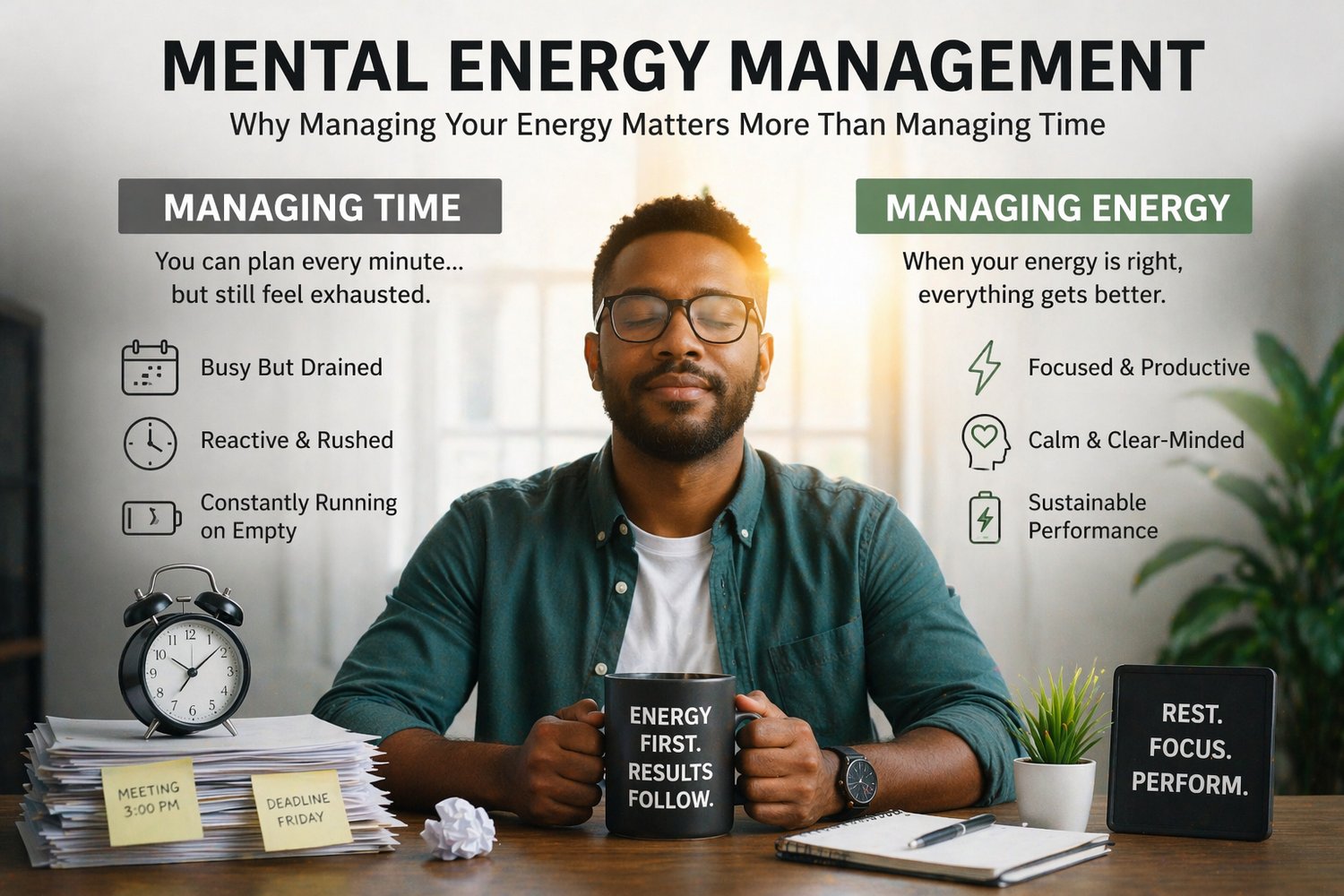
Introduction: You Don’t Have a Time Problem—You Have an Energy Problem
Let’s be honest.
Most people say:
“I don’t have enough time.”
But if we’re being real…
You’ve had days where:
- You had plenty of time… but no motivation
- You sat at your desk… but couldn’t focus
- You tried to work… but your brain said, “Not today.”
Truth:
Productivity is not about time.
It’s about energy.
Because 2 hours of focused, high-energy work
can outperform 8 hours of tired, distracted effort.
What Is Mental Energy?
Mental energy is your brain’s ability to:
- focus
- think clearly
- make decisions
- stay productive
It affects:
- your performance
- your mood
- your creativity
- your discipline
Simple reality:
No energy = no focus
No focus = no results
Why Time Management Alone Fails
Time management assumes:
- all hours are equal
But they’re not.
Example:
- 9 AM (fresh brain) → high performance
- 3 PM (energy dip) → low focus
- 10 PM (exhausted) → minimal output
Humor Break:
Scheduling “deep work” at 10 PM after a long day is like…
Trying to run a marathon… on 2% battery 😄
The Energy Equation
Your productivity is a function of:
Energy × Focus × Time
If energy is low, everything else suffers.
The 4 Types of Energy You Must Manage
To truly optimize performance, you need to manage more than just mental energy.
1. Physical Energy
- sleep
- nutrition
- movement
2. Mental Energy
- focus
- attention
- cognitive load
3. Emotional Energy
- stress levels
- mood
- relationships
4. Spiritual / Purpose Energy
- meaning
- motivation
- direction
Insight:
When one drops, your performance drops.
The Hidden Energy Killers
Let’s expose what’s draining you.
1. Constant Distractions
Every notification = energy loss.
2. Multitasking
Switching tasks burns mental fuel.
3. Decision Fatigue
Too many choices = mental exhaustion.
4. Poor Sleep
The ultimate energy destroyer.
5. Emotional Stress
Unresolved stress drains focus fast.
Humor Break:
Your brain after 50 decisions:
“I’m done. Even choosing lunch feels like a life decision now.”
The Mental Energy Management System
Let’s move from awareness → action.
Step 1: Protect Your Peak Energy Hours
You have specific times when your brain is strongest.
Identify:
- when you feel most alert
- when you think clearly
Then:
Use that time for:
- deep work
- important decisions
- creative tasks
Step 2: Work in Energy Cycles (Not Endless Hours)
Your brain is not designed for nonstop focus.
Ideal rhythm:
- 60–90 minutes focused work
- short break (5–15 minutes)
Why it works:
It prevents burnout and maintains energy.
Step 3: Reduce Cognitive Load
Too much information = mental fatigue.
Simplify:
- tasks
- priorities
- decisions
Rule:
Clarity saves energy.
Step 4: Manage Your Input
Your brain is constantly consuming information.
Limit:
- unnecessary news
- social media overload
- constant notifications
Replace with:
- focused content
- intentional learning
- silence
Step 5: Recharge Strategically
Rest is not wasted time.
It’s an energy investment.
Quick recovery methods:
- short walks
- deep breathing
- stepping away from screens
Even 5–10 minutes can reset your brain.
Step 6: Protect Emotional Energy
Stress drains more energy than work.
Manage:
- negative environments
- toxic interactions
- unnecessary conflict
Truth:
Peace of mind = power of focus
Step 7: Align Work With Purpose
Energy increases when work feels meaningful.
Ask:
- Why does this matter?
- What’s the bigger goal?
Result:
More motivation, less resistance.
Step 8: Build Energy Rituals
Create habits that restore your energy daily.
Examples:
- morning routine
- exercise
- quiet reflection
Consistency builds sustainable energy.
Step 9: Stop Overworking
More hour’s ≠, more results.
Reality:
Overworking leads to:
- burnout
- poor decisions
- low-quality output
Mature mindset:
Work smarter. Rest strategically.
Step 10: Respect Your Limits
You’re not a machine.
You’re human.
High performers don’t ignore limits.
They manage them.
The Mature Perspective: Sustainable High Performance
For professionals, entrepreneurs, and leaders:
Energy is your most valuable asset.
Because:
- ideas require energy
- decisions require energy
- leadership requires energy
Reality:
Burnout is not from working too much.
It’s from working without recovery.
The Energy Advantage
In a world where everyone is busy…
The real advantage is:
Who can stay focused longer—without burning out?
The Mental Energy Formula
If you remember nothing else:
- protect your energy
- work in cycles
- reduce distractions
- recharge often
- align with purpose
Conclusion: Manage Energy, Multiply Results
You don’t need more hours.
You need better energy.
Final Truth:
Time is limited.
Energy is renewable—if managed correctly.
So instead of asking:
“How can I do more today?”
Ask:
“How can I manage my energy better?”
Because when your energy improves…
Everything improves.
Final Thought:
Your success is not determined by how long you work.
It’s determined by:
How well you use your energy while working.
Comments ()