

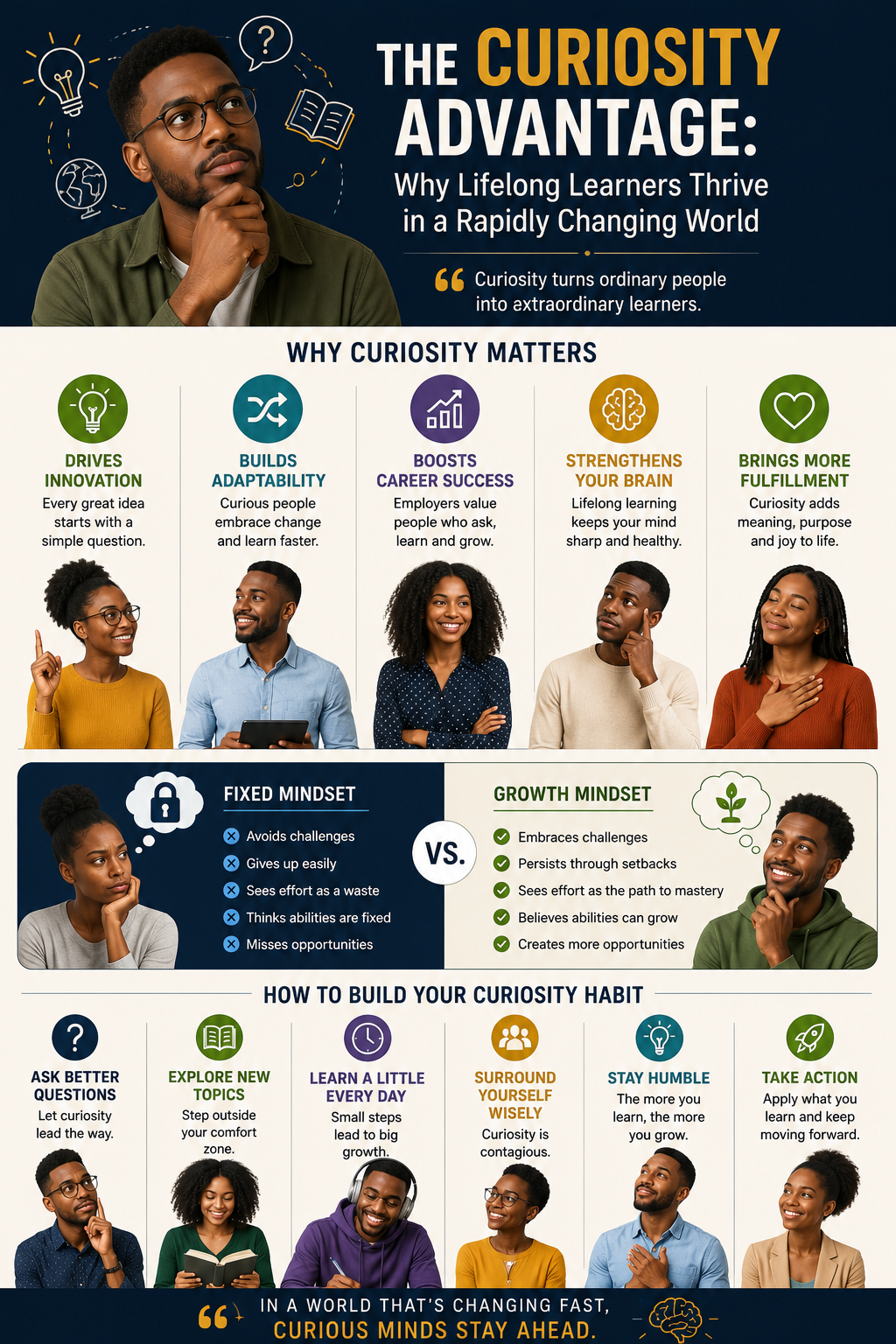
Introduction: The Most Powerful Skill You Were Never Taught
Imagine two people graduating from university on the same day.
Both are intelligent.
Both are ambitious.
Both begin similar careers.
Fast-forward ten years.
One has become an innovative leader, confidently navigating new technologies and embracing every challenge that comes their way.
The other feels overwhelmed, struggling to keep up with change and wondering why the world seems to be moving faster every year.
What made the difference?
It wasn't necessarily intelligence.
It wasn't luck.
And it certainly wasn't having a crystal ball.
It was curiosity.
In today's world, knowledge has an expiration date.
Technology evolves.
Industries transform.
New careers emerge.
Old ones disappear.
The people who thrive aren't those who know everything.
They're the ones who never stop learning.
Welcome to The Curiosity Advantage.
Curiosity: Humanity's Original Superpower
Before there were universities...
Before there were books...
Before there was the internet...
There was curiosity.
Curiosity led humans to discover fire.
Build civilizations.
Cross oceans.
Invent electricity.
Explore space.
Create artificial intelligence.
Every breakthrough in history began with one simple question:
"What if?"
Or perhaps:
"Why?"
Curiosity isn't just a personality trait.
It's the engine of progress.
Important Truth
Curiosity turns ordinary people into extraordinary learners.
Why Curiosity Matters More Than Ever
For centuries, people could learn one profession and practice it for an entire lifetime.
Today?
Entire industries can change within five years.
Artificial Intelligence.
Automation.
Remote work.
Digital marketing.
Cybersecurity.
Renewable energy.
Jobs evolve faster than ever before.
The people who succeed are no longer those with the most knowledge.
They're those who learn the fastest.
Humor Break
Technology updates so quickly that some people buy a new phone on Monday, and by Friday, it's already asking if they'd like to upgrade. 😄
The Psychology of Curiosity
Psychologists describe curiosity as the desire to close a gap between what we know and what we want to know.
When we encounter something unfamiliar, the brain experiences a small sense of incompleteness.
Learning satisfies that curiosity.
Interestingly, curiosity also activates the brain's reward system.
Learning literally feels good.
That's why solving puzzles, learning new skills, or discovering fascinating facts can be genuinely enjoyable.
Fixed Mindset vs Growth Mindset
One of the biggest differences between lifelong learners and everyone else is mindset.
A fixed mindset says:
- "I'm just not good at this."
- "I've always been bad with technology."
- "I'm too old to learn something new."
A growth mindset says:
- "I don't understand it yet."
- "I can improve with practice."
- "Learning never stops."
One mindset closes doors.
The other opens them.
Important Reminder
Your abilities are not permanently fixed.
They're constantly developing.
Curiosity Makes You More Adaptable
Life rarely goes exactly according to plan.
Careers change.
Industries evolve.
Unexpected challenges appear.
Curious people adapt more easily because they naturally explore solutions instead of resisting change.
Rather than asking:
"Why is everything changing?"
They ask:
"What can I learn from this?"
That simple shift changes everything.
Why Employers Love Curious People
Technical skills matter.
But curiosity often predicts long-term success.
Why?
Because curious employees:
- ask better questions
- solve problems creatively
- embrace innovation
- learn new tools quickly
- adapt to change
In an AI-driven world, these qualities are becoming priceless.
Truth
Companies don't just hire knowledge.
They can keep learning.
Curiosity Fuels Innovation
Innovation isn't magic.
It's curiosity in action.
Every inventor.
Every entrepreneur.
Every scientist.
Every artist.
Every great leader.
Started by asking questions others overlooked.
Examples:
"What if we could fly?"
"What if computers fit into our pockets?"
"What if diseases could be prevented?"
The future belongs to people willing to ask better questions.
Why Curiosity Improves Relationships
Curiosity doesn't only improve careers.
It strengthens relationships, too.
Instead of assuming we know everything about others, curiosity encourages us to ask:
- How are you really feeling?
- What matters most to you?
- How do you see this situation?
Curiosity builds understanding.
Assumptions create misunderstandings.
Humor Break
Many arguments could be avoided if people replaced:
"I know exactly what you're thinking."
With:
"Can you help me understand?" 😄
Lifelong Learning Keeps Your Brain Healthy
Learning isn't only good for your career.
It's also good for your brain.
Research suggests that continuous mental stimulation helps maintain cognitive function as we age.
Learning encourages the brain to form new neural connections.
Examples include:
- reading
- learning a language
- playing an instrument
- solving puzzles
- studying history
- exploring science
The brain loves novelty.
Important Truth
Every new skill teaches your brain how to keep learning.
The Digital Age Makes Learning Easier Than Ever
Never before has knowledge been so accessible.
Today you can learn:
- photography
- coding
- investing
- public speaking
- cooking
- psychology
- languages
Often from your phone.
The challenge isn't access to knowledge.
It's making time to use it.
Curiosity Creates Confidence
Confidence isn't knowing everything.
It's trusting your ability to figure things out.
Curious people don't panic when facing unfamiliar situations.
They explore.
Experiment.
Learn.
That process naturally builds confidence.
Confidence grows from competence.
Competence grows from curiosity.
The Cost of Stopping Learning
When curiosity disappears, growth slows.
People become:
- resistant to change
- less adaptable
- less creative
- more fearful of the unknown
The world continues moving.
They simply stop moving with it.
Important Reminder
The greatest risk today isn't change.
It's refusing to change.
How to Become More Curious
Fortunately, curiosity can be developed.
Here are practical ways to strengthen it.
1. Ask Better Questions
Instead of asking:
"Can I do this?"
Ask:
"How could I learn to do this?"
Questions shape thinking.
2. Read Outside Your Expertise
Explore subjects you've never studied.
History.
Astronomy.
Psychology.
Economics.
Art.
Unexpected connections often produce the best ideas.
3. Embrace Beginner Status
Don't fear looking inexperienced.
Every expert once knew nothing.
4. Learn One New Thing Every Day
Even fifteen minutes daily compounds into remarkable growth.
5. Surround Yourself With Curious People
Curiosity is contagious.
Spend time with people who love learning.
6. Stay Humble
The more you learn...
The more you realize how much remains unknown.
That's wisdom.
Humor Break
The smartest people in the room usually ask the most questions.
The loudest people often answer questions nobody asked. 😄
The Curiosity Formula
If you remember nothing else:
Curiosity + Consistency + Humility + Continuous Learning = Lifelong Growth
Not perfection.
Not a genius.
Simply a commitment to keep learning.
The Mature Perspective on Success
As we grow older, many of us realize something profound:
Success isn't about reaching a finish line.
It's about continuing to grow.
The happiest, most fulfilled people often remain students for life.
They never lose their sense of wonder.
They never stop asking questions.
They never assume they've learned enough.
Because they understand that learning is not a phase of life.
It is a way of life.
Conclusion: Stay Curious, Stay Relevant
The future belongs to those who remain adaptable.
Those who welcome change instead of fearing it.
Who asks questions instead of pretending to know all the answers?
Those who see every challenge as an opportunity to learn something new.
Final Truth
Your greatest competitive advantage isn't what you already know.
It's your willingness to keep learning.
Degrees may open doors.
Experience may build confidence.
But curiosity keeps those doors open for a lifetime.
So read another book.
Learn another skill.
Ask another question.
Explore another idea.
Because in a world changing faster than ever before...
Your curiosity may become your greatest investment.
And unlike technology, markets, or careers...
No one can ever take away what you've learned.
Comments ()