

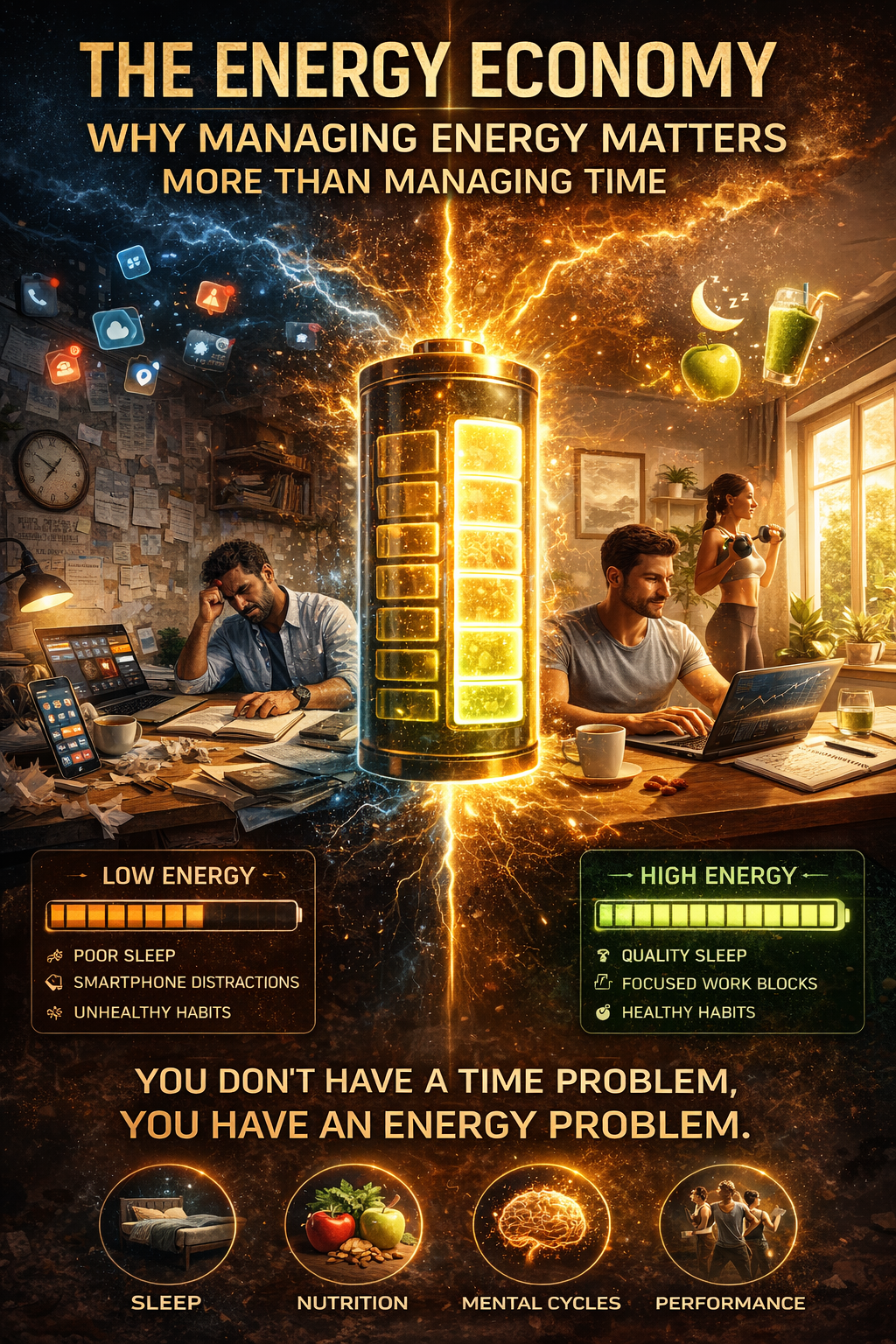
Introduction: You Don’t Have a Time Problem—You Have an Energy Problem
Let’s be honest.
Most of us don’t say:
“I ran out of time today.”
We say:
“I’m tired.”
“I can’t think.”
“I’m drained.”
You can have a full day ahead of you… and still feel incapable of doing anything meaningful.
That’s because productivity isn’t just about time.
It’s about energy.
You don’t perform based on how many hours you have—you perform based on how much usable energy you bring into those hours.
The Myth of Time Management
For decades, productivity advice has focused on:
- managing schedules
- optimizing calendars
- squeezing more into each hour
But here’s the flaw:
Time is fixed. Energy is flexible.
You can’t create more hours in a day.
But you can increase—or destroy—your energy.
Example:
Two people both have 8 hours to work.
- One is focused, rested, and energized
- The other is tired, distracted, and sluggish
At the same time.
Completely different results.
Welcome to the Energy Economy
Think of your energy like money.
You wake up each day with a limited “energy budget.”
Every activity you do either:
- spends energy
- or restores energy
Energy Expenses:
- stressful meetings
- multitasking
- poor sleep
- constant notifications
Energy Investments:
- quality sleep
- exercise
- focused work
- quiet time
If you spend recklessly, you go into energy debt.
And just like financial debt, it catches up with you.
Ultradian Rhythms: Your Hidden Productivity Cycle
Your body doesn’t operate at a constant level of energy.
It works in cycles called ultradian rhythms.
These are natural 90–120 minute cycles of:
- peak focus
- gradual fatigue
What this means:
You are designed to:
- work intensely for ~90 minutes
- then rest and reset
Problem:
Most people ignore this.
They try to push through for 4–6 hours straight.
Your brain responds with:
- fatigue
- poor focus
- procrastination
Humor Break:
Trying to work nonstop is like pressing the gas pedal on an empty tank and wondering why the car won’t move.
Sleep: The Ultimate Performance Tool
Sleep is not just rest.
It is biological recovery and optimization.
What happens during sleep:
- memory is consolidated
- brain toxins are cleared
- emotional balance is restored
Lack of sleep leads to:
- poor decision-making
- low focus
- irritability
- reduced productivity
Reality check:
If you’re sacrificing sleep to “get more done,” you’re actually reducing your performance.
Nutrition: Fuel for Your Brain
Your brain consumes a significant amount of your body’s energy.
What you eat directly affects:
- mental clarity
- focus
- mood
Poor nutrition causes:
- energy crashes
- brain fog
- reduced concentration
Simple truth:
You can’t expect high performance with low-quality fuel.
Mental Energy: The Hidden Factor
Physical energy matters—but mental energy is critical.
What drains mental energy:
- constant decision-making
- multitasking
- digital distractions
- overthinking
What preserves it:
- routine
- focus
- simplicity
- fewer decisions
Example:
This is why successful people simplify:
- what they wear
- what they eat
- how they structure their day
Less decision-making = more energy for important work.
The Multitasking Energy Leak
Multitasking feels productive.
But it actually drains energy faster.
Your brain switches between tasks, losing focus each time.
Result:
- slower performance
- higher fatigue
- lower quality work
Truth:
Multitasking is not efficient.
It’s energy fragmentation.
How to Manage Your Energy Like a Pro
Let’s make this practical.
1. Work in Energy Cycles
Use 60–90 minute focus blocks.
Then take short breaks.
Your brain works better in intervals.
2. Prioritize High-Energy Tasks Early
Do your most important work when your energy is highest.
For most people, that’s morning.
3. Protect Your Sleep
Treat sleep like an investment—not an option.
Better sleep = better performance.
4. Reduce Energy Drains
Identify and limit:
- unnecessary meetings
- constant notifications
- digital distractions
5. Schedule Recovery
Recovery is not wasted time.
It’s what allows you to perform consistently.
The Mature Professional Advantage
For professionals, entrepreneurs, and leaders, this concept is powerful.
You don’t need to work more hours.
Please work with better energy.
Instead of asking:
“How can I do more?”
Ask:
“How can I perform better with the energy I have?”
The Real Secret to Peak Performance
Peak performers don’t just manage time.
They manage:
- energy
- focus
- recovery
They understand:
You can’t operate at your best if you’re constantly running on empty.
Conclusion: Energy Is Your True Currency
Time is important.
But energy determines what you actually do with that time.
If your energy is low, your output suffers.
If your energy is high, your performance improves.
Final thought:
Your productivity is not limited by time—
It is limited by how well you manage your energy.
So tomorrow morning, don’t just plan your schedule.
Plan your energy.
Because in the real world:
Energy is the currency of performance.
Comments ()