

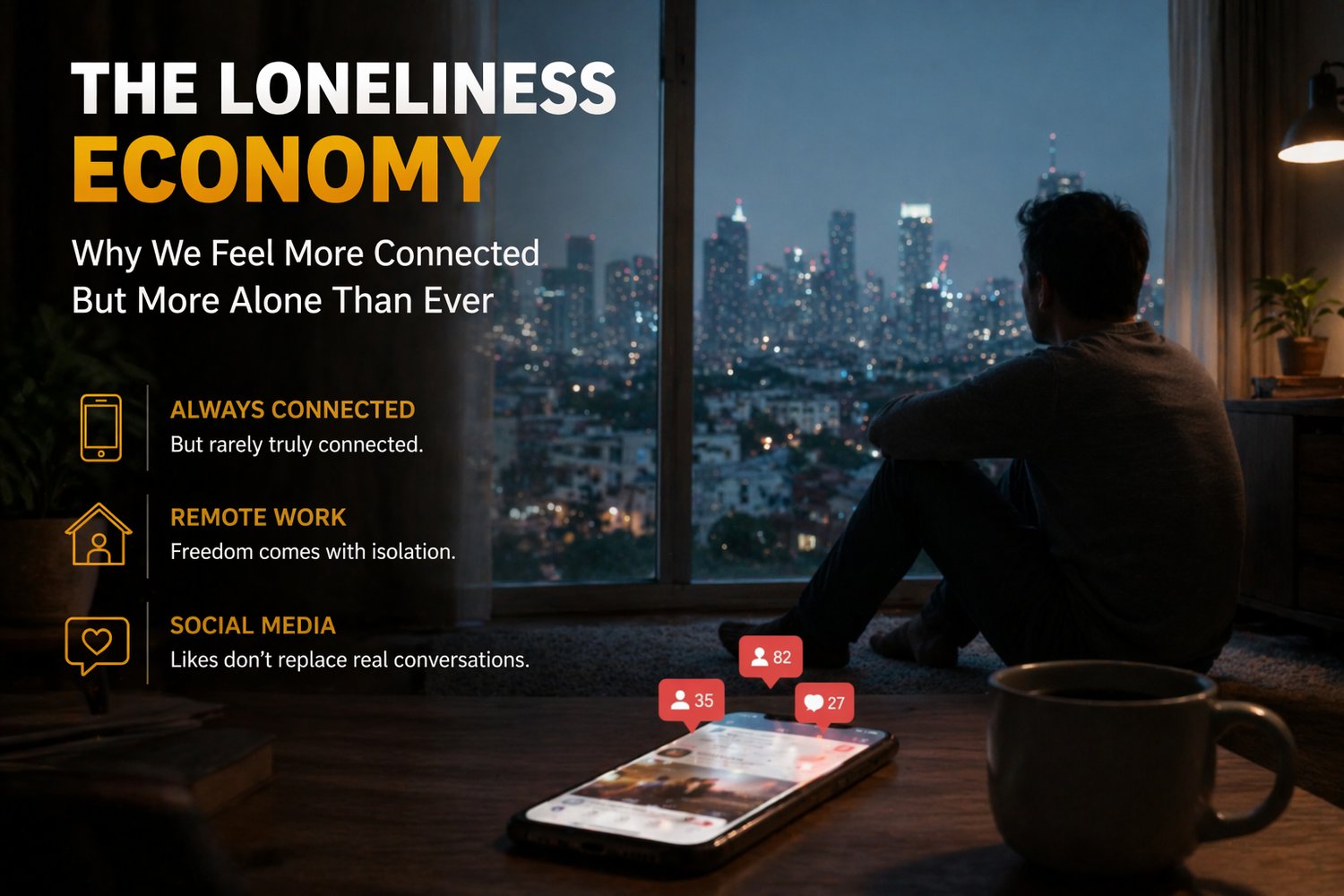
Introduction: Connected… But Somehow Alone
You’ve probably experienced it.
- Hundreds of contacts in your phone
- Dozens of conversations happening daily
- Notifications constantly lighting up your screen
And yet…
There are moments when you feel completely alone.
Not physically.
But emotionally.
Welcome to the Loneliness Economy—where connection is everywhere, but belonging feels rare.
The Global Reality: Loneliness Is No Longer Personal—It’s Structural
Let’s start with the facts.
- Around 1 in 6 people globally experience loneliness
- Loneliness is linked to over 871,000 deaths per year
- In some countries, over half of adults report feeling isolated
Even more striking:
Loneliness has been compared to the health impact of smoking daily
This is no longer just a “feeling.”
It’s a public health issue.
Humor Break:
We’ve reached a point where:
You can have 5,000 followers…
but no one to call when your Wi-Fi goes down 😄
What Is the Loneliness Economy?
The Loneliness Economy is the modern system where:
- Technology increases interaction
- But decreases meaningful connection
It’s driven by:
- social media platforms
- remote work environments
- digital communication replacing real interaction
The paradox:
We are more connected than ever—
Yet more disconnected than ever before.
The Psychology of “Connected Isolation”
Loneliness today isn’t about being alone.
It’s about feeling unseen, unheard, and emotionally disconnected.
Why?
Because not all connections are equal.
There are two types:
- Surface connection → likes, comments, quick messages
- Deep connection → trust, presence, meaningful conversation
Modern life is full of the first…
and starving for the second.
Social Media: Connection or Illusion?
Let’s talk about the biggest player in this space.
Research shows:
Heavy social media users are more than twice as likely to feel lonely
Why?
Because social media often creates:
- comparison
- curated realities
- shallow interactions
What you see:
- highlight reels
- success stories
- “Perfect lives.”
What you feel:
- behind
- disconnected
- inadequate
Humor Break:
Social media is the only place where:
Everyone is “living their best life”…
at the same time 😄
Remote Work: Freedom With a Hidden Cost
Remote work has changed everything.
Benefits:
- flexibility
- convenience
- independence
But also:
- reduced social interaction
- fewer casual conversations
- less sense of belonging
You don’t:
- bump into colleagues
- share spontaneous moments
- build natural relationships
Result:
Work gets done…
But the connection gets lost.
The Decline of Real-World Interaction
Modern life has quietly reduced physical interaction.
Think about it:
- online shopping instead of stores
- texting instead of calling
- streaming instead of going out
Even communities have changed.
Before:
- neighbors talked
- people gathered
- relationships formed naturally
Now:
- people stay indoors
- interactions are scheduled
- connection is optional
The Hidden Health Impact
Loneliness is not just emotional.
It’s physical.
Research links loneliness to:
- Increased risk of heart disease (29%)
- Higher risk of stroke (32%)
- increased risk of depression and anxiety
Truth:
Loneliness doesn’t just affect how you feel.
It affects how long you live.
Why This Is Happening Now
Several modern shifts are driving this trend.
1. Digital Substitution
Technology replaces—not enhances—real interaction.
2. Individualism
People are more independent—but less connected.
3. Busyness Culture
Everyone is busy…
but not necessarily connected.
4. Urban Living
More people around you…
but fewer relationships.
The Mature Perspective: Why This Hits Adults Harder
For mature audiences—professionals, parents, leaders—the loneliness dynamic is unique.
Why?
Because:
- responsibilities increase
- time decreases
- social circles shrink
Friendships become:
- less frequent
- more effort-based
- easier to neglect
Reality:
Loneliness in adulthood is often silent.
The Solution: From Connection to Belonging
The goal is not more interaction.
It’s a better interaction.
1. Prioritize Depth Over Frequency
You don’t need more people.
You need real conversations.
Ask:
- Who can I talk too honestly?
- Who understands me?
2. Reintroduce Physical Presence
Digital is convenient.
But physical connection is powerful.
Simple actions:
- meet in person
- take walks
- share meals
3. Be Intentional With Relationships
Connection doesn’t “just happen” anymore.
It must be created.
Schedule:
- calls
- meetups
- check-ins
4. Reduce Passive Consumption
Less scrolling.
More connecting.
Replace:
- endless content consumption
With:
- meaningful interaction
5. Find Purpose-Based Communities
People connect best through:
- shared goals
- shared struggles
- shared meaning
Examples:
- faith groups
- fitness groups
- learning communities
The Future: Will It Get Better or Worse?
The truth?
It depends on how we adapt.
Technology will continue to grow.
But so will awareness.
The opportunity:
To use technology as a tool…
Not a replacement for human connection.
Conclusion: Don’t Just Be Seen—Be Known
We live in a world where:
- visibility is easy
- connection is common
- but belonging is rare
Final Truth:
You don’t need more followers.
You need more real relationships.
So the next time you feel that quiet sense of disconnection, ask yourself:
“Am I truly connecting—or just interacting?”
Then choose differently.
Final Thought:
In a world full of noise, notifications, and constant communication…
The real luxury is not connection.
It’s a meaningful human connection.
If you want, I can also create:
- 🎨 A clean, realistic visual illustration (new style)
- 🔥 10 SEO tags
- 🚀 A viral headline version
- 📘 Turn this into a high-selling ebook
This topic is EXTREMELY powerful for traffic + emotional engagement 🚀
Comments ()