

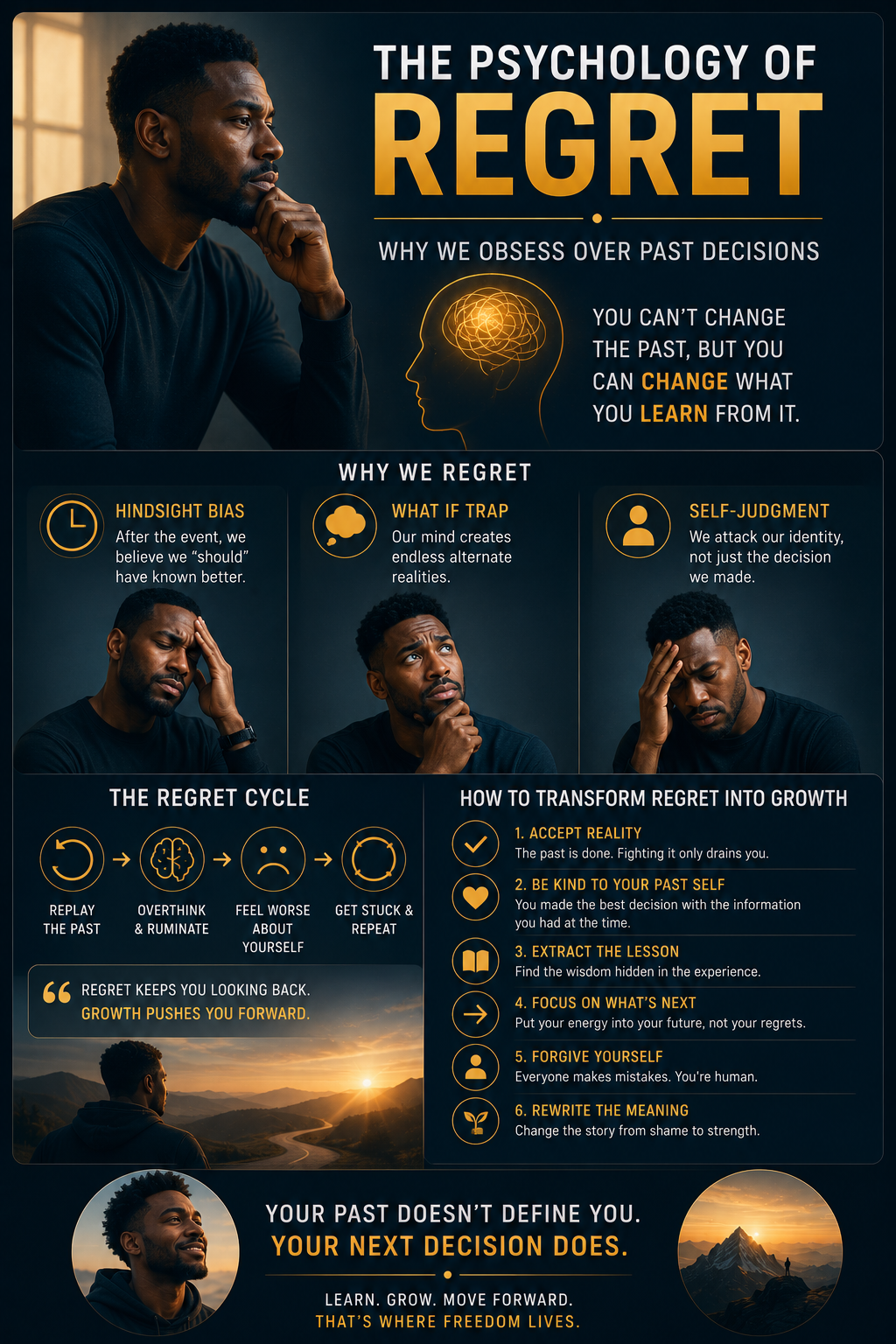
Introduction: The Conversation You Keep Having With Yourself
Almost everyone has a decision they wish they could revisit.
A career opportunity not taken.
A relationship that ended badly.
Money was invested poorly.
Words spoken in anger.
A chance missed because of fear.
Years later, the memory can still appear unexpectedly.
You're driving to work.
Taking a shower.
Trying to fall asleep.
And suddenly your brain says:
"Remember that terrible decision from 2014?"
"Let's review it again."
Not because the information is useful.
Not because anything can be changed.
Simply because your mind enjoys opening old files without permission.
Welcome to the fascinating and frustrating world of regret.
One of the most universal human emotions.
What Is Regret?
Regret is the emotional discomfort we feel when we believe a different choice would have produced a better outcome.
It is essentially the mind's way of saying:
"If only I had done something differently."
Regret combines:
- disappointment
- sadness
- self-judgment
- hindsight
And unlike many emotions, regret is deeply tied to imagination.
Because regret requires us to mentally create an alternative reality.
Example:
You didn't just lose a job opportunity.
You imagine the life you could have had if you had taken it.
That imagined life becomes part of the emotional pain.
Why Humans Experience Regret
Interestingly, regret serves an evolutionary purpose.
It helps us learn.
The brain reviews mistakes so we can avoid repeating them.
Without regret, growth would be difficult.
However...
The brain wasn't designed to stop after learning.
It often keeps replaying the event long after the lesson has been absorbed.
Humor Break
Your brain treats some mistakes like a Netflix series.
One episode would be enough.
Instead, it keeps releasing new seasons 😄
The Two Types of Regret
Psychologists often divide regret into two categories.
1. Regret of Action
These are things we did.
Examples:
- saying something hurtful
- making a poor investment
- ending a relationship impulsively
- taking a risky opportunity that failed
These regrets often hurt intensely at first.
But they usually fade with time.
2. Regret of Inaction
These are things we didn't do.
Examples:
- opportunities not pursued
- dreams postponed
- risks avoided
- conversations never held
Interestingly, research suggests these regrets often last longer.
Because unanswered questions remain.
Examples:
- What if I had applied?
- What if I had moved?
- What if I had started the business?
- What if I had told them how I felt?
Why Regret Feels So Powerful
Regret affects us because it attacks our identity.
We don't simply question our decision.
We question ourselves.
Thoughts often sound like:
- I should have known better.
- What was I thinking?
- How could I be so foolish?
- Why didn't I act?
The event becomes personal.
And that's where suffering increases.
The Hindsight Illusion
One reason regret feels unfair is because of something psychologists call:
Hindsight Bias
After an event occurs, we convince ourselves we should have predicted it.
Example:
Today, you know how everything turned out.
In the past, you did not.
Yet your brain judges Past You using information that only Present You possesses.
Important Truth
You made the best decision you could with the information you had at the time.
That matters.
Why We Obsess Over "What If"
The human brain dislikes unfinished stories.
When outcomes feel unresolved, the mind continues searching for answers.
This creates:
- rumination
- overthinking
- mental replay loops
The problem:
Most "what if" questions have no answer.
Because the alternative reality never existed.
Humor Break
Some people spend years mentally living in an alternate universe where every decision worked perfectly 😄
The Comparison Problem
Modern life makes regret even worse.
Social media constantly exposes us to other people's success stories.
Result:
You compare your actual life to:
- someone else's highlight reel
- your imagined alternative life
Neither comparison is fair.
The Hidden Gift of Regret
Despite its discomfort, regret can be valuable.
When handled properly, regret becomes information.
Not punishment.
Healthy regret teaches:
- wisdom
- humility
- perspective
- better decision-making
The goal isn't eliminating regret.
The goal is to use it constructively.
The Difference Between Reflection and Rumination
This distinction is critical.
Reflection says:
"What can I learn?"
Rumination says:
"Let's suffer repeatedly."
Reflection creates growth.
Rumination creates exhaustion.
Important Question:
Am I learning from this memory?
Or simply replaying it?
Why Perfectionism Fuels Regret
Perfectionists often experience more regret.
Because they believe:
- Every decision must be correct
- Mistakes are unacceptable
- failure reflects personal inadequacy
But life doesn't work that way.
Every decision involves uncertainty.
No one chooses perfectly every time.
Truth
Growth requires mistakes.
The Regret Trap of Successful People
Ironically, ambitious people often struggle with regret.
Why?
Because they constantly evaluate alternatives.
They ask:
- Could I have done more?
- Should I have chosen differently?
- Did I waste time?
- Am I behind?
Success-oriented minds often become expert second-guessers.
How to Overcome Regret
Let's move from understanding to healing.
Step 1: Accept Reality
This sounds simple.
But it's powerful.
The event happened.
The decision was made.
The past cannot be edited.
Energy spent fighting reality is wasted energy.
Step 2: Stop Judging Your Past Self Unfairly
Remember:
Past You didn't know what Present You know.
Give yourself the same compassion you would offer a friend.
Ask:
Would I speak to someone else the way I'm speaking to myself?
Step 3: Extract the Lesson
Every regret contains information.
Find it.
Questions:
- What did I learn?
- What would I do differently now?
- How has this experience helped me grow?
Step 4: Focus on Future Decisions
Regret looks backward.
Growth looks forward.
Instead of asking:
"Why did I do that?"
Ask:
"What will I do next?"
Step 5: Forgive Yourself
This may be the hardest step.
Yet it is often the most important.
Everyone makes mistakes.
Everyone misjudges situations.
Everyone has imperfect moments.
You are not uniquely flawed.
You are human.
Humor Break
If perfection were required for success, humanity would still be living in caves, arguing about fire 😄
Step 6: Rewrite the Meaning
You may not be able to change the event.
But you can change the story.
Example:
Instead of:
"That failure ruined my life."
Consider:
"That experience taught me lessons I couldn't have learned any other way."
Meaning shapes emotion.
The Wisdom Hidden Inside Regret
Many of life's greatest lessons arrive disguised as mistakes.
Regret often points toward:
- values
- priorities
- missed desires
- future opportunities
It reveals what truly matters.
Important Insight
Sometimes regret is not a sign of failure.
It's a sign of growth.
The Regret Formula
If you remember nothing else:
Accept + Learn + Forgive + Move Forward = Emotional Freedom
Not denial.
Not avoidance.
Growth.
The Mature Perspective on Regret
As people gain wisdom, many discover something surprising:
The goal isn't living without regret.
The goal is to refuse to let regret become your permanent address.
Everyone carries stories.
Everyone makes mistakes.
Everyone wishes they had handled certain moments differently.
That's part of being human.
Conclusion: Your Past Is a Teacher, Not a Prison
Regret feels painful because it reminds us of our imperfections.
But it also reminds us of something else:
We have grown.
We have learned.
We have changed.
Final Truth
The purpose of regret is not to keep you trapped in the past.
Its purpose is to help you make better choices in the future.
So the next time your mind replays an old mistake...
Listen to the lesson.
Take the wisdom.
Leave the punishment behind.
Because your future deserves more attention than a past you can no longer change.
And growth begins the moment you stop living in "what if" and start investing in "what's next."
Comments ()