

Introduction: The Problem With Waiting to Feel Motivated
Most people believe success starts with motivation.
They say:
- “I just need to get motivated.”
- “I’ll start when I feel ready.”
- “I’m waiting for the right time.”
But motivation is unreliable.
Some days you feel energized and focused. Other days, you feel tired and distracted. If success depended on motivation alone, very few people would achieve consistent results.
The truth is simple:
Motivation starts action, but systems create success.
Highly successful people do not rely on motivation. They rely on systems that work even when motivation disappears.
What Is Motivation?
Motivation is a temporary emotional state that makes you feel ready to take action.
It can come from:
- Inspiration
- Excitement
- Fear
- Pressure
- Goals
- Deadlines
Motivation feels powerful — but it rarely lasts.
You may feel motivated:
- At the beginning of a new year
- After watching an inspiring video
- After setting a new goal
But motivation fades quickly.
And when it fades, many people stop.
Why Motivation Fails
Motivation fails because it depends on feelings.
Feelings change constantly.
Some days you feel focused.
Other days you feel:
- Tired
- Stressed
- Distracted
- Overwhelmed
If your success depends on how you feel, your results will always be inconsistent.
Example
A student feels motivated on Monday and studies for three hours.
On Tuesday, they feel tired and study nothing.
Motivation creates inconsistency.
What Successful People Do Differently
Successful people understand something important:
They remove the need to feel motivated.
Instead, they create systems.
A system is a structured way of doing something repeatedly.
Examples include:
- Fixed study times
- Daily exercise routines
- Scheduled work sessions
- Weekly planning
- Automatic savings
Systems reduce decision-making and create consistency.
What Is a System?
A system is a repeatable process that produces results.
Instead of asking:
“Do I feel motivated today?”
A system asks:
“What is scheduled today?”
Systems make action automatic.
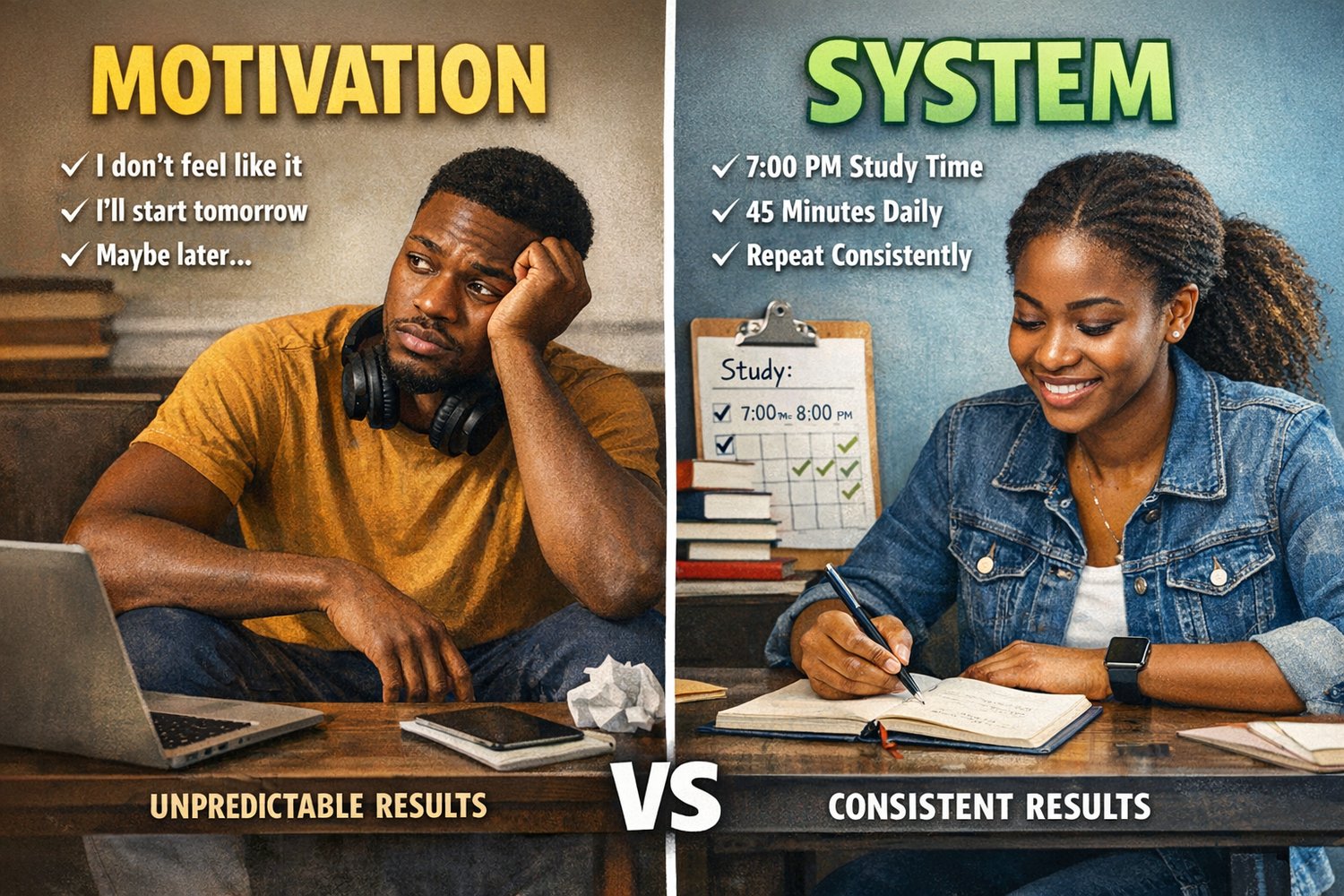
Motivation vs Systems
Motivation Says:
- Start when you feel ready
- Work when inspired
- Try when energized
Systems Say:
- Start at 6 p.m.
- Study for one hour
- Repeat tomorrow
Motivation is emotional.
Systems are practical.
Motivation is temporary.
Systems are permanent.
Why Systems Always Win
Systems win because they remove uncertainty.
When something is scheduled, it becomes normal.
No decision required.
No emotional struggle required.
Just execution.
Example
Student A studies only when motivated.
Student B studies every day from 7–8 p.m.
After three months:
Student B performs better, even if Student A feels more motivated.
Consistency beats intensity.
Discipline Is Easier With Systems
Many people believe discipline means forcing yourself to work.
But discipline becomes easier when systems exist.
Systems reduce resistance.
Instead of deciding daily:
- When to study
- What to study
- How long to study
The system already answers those questions.
Less thinking = more action.
The Hidden Secret: Systems Reduce Stress
Without systems:
- You constantly decide what to do
- You feel overwhelmed
- You procrastinate
With systems:
- Your day has structure
- Your tasks are clear
- Your progress is visible
Systems create calm.
Chaos creates stress.
How to Build Systems That Work
You do not need complicated systems.
Simple systems work best.
1. Fixed Time Systems
Choose consistent times.
Examples:
- Study at 7 p.m.
- Exercise at 6 a.m.
- Plan on Sunday
Consistency builds habits.
2. Small Daily Actions
Large goals fail when they feel overwhelming.
Small daily systems succeed.
Example:
Instead of:
"Study all weekend."
Use:
"Study 45 minutes daily."
Small actions create big results.
3. Environment Systems
Your environment influences behavior.
Examples:
- Keep books on the desk
- Turn off notifications
- Keep workspace clean
Good environments support good systems.
4. Tracking Systems
Track your actions.
Examples:
- Study calendar
- Habit tracker
- Progress chart
Tracking builds accountability.
Why Motivation Still Matters (But Only at the Start)
Motivation is useful at the beginning.
It helps you start:
- New habits
- New goals
- New systems
But motivation cannot maintain progress.
Systems maintain progress.
Motivation lights the fire.
Systems keep it burning.
The Consistency Advantage
Most people underestimate consistency.
Small daily actions create massive long-term results.
Example:
1 hour daily study:
= 365 hours per year.
Consistency compounds.
The Most Productive People Think Differently
They do not ask:
"Do I feel motivated?"
They ask:
"What is the system?"
They trust routines.
They follow schedules.
They repeat processes.
Success becomes predictable.
Conclusion: Stop Waiting for Motivation
Motivation comes and goes.
Systems stay.
If you wait for motivation, progress will be slow and inconsistent.
If you build systems, progress becomes automatic.
The most successful people do not rely on motivation.
They rely on systems that work every day.
Start small.
Build structure.
Repeat consistently.
Systems always win.
7-Day System Building Challenge
Day 1: Choose one habit
Day 2: Set a fixed time
Day 3: Prepare the environment
Day 4: Start small
Day 5: Track progress
Day 6: Repeat
Day 7: Evaluate
Then continue.
Comments ()