
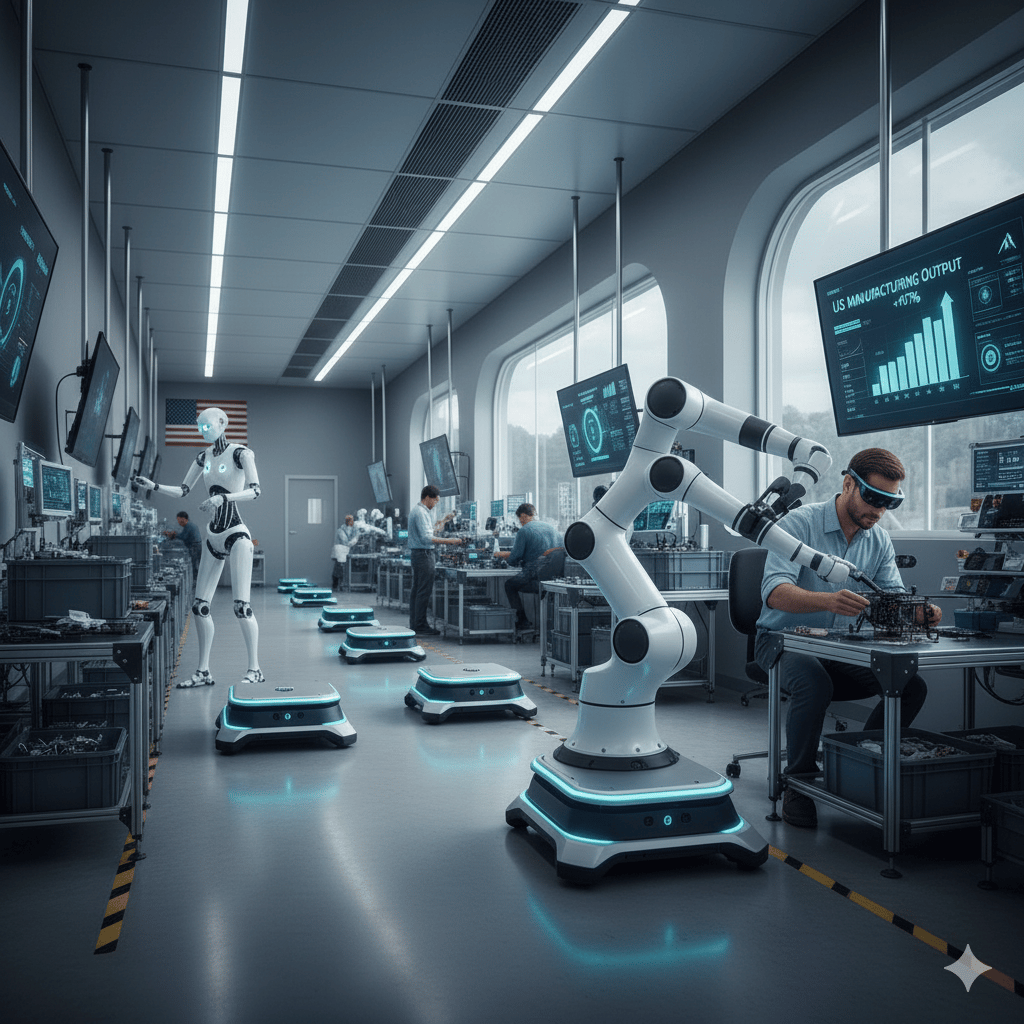
What could be the future of robotics in the next five years? With the current and accelerated development of robotics, the future does not seem easily predictable. However, some key indicators could help us to have a glimpse of what the future could look like. That is the purpose of this post, which is much more like a possible predictable future.
The next five years will see robotics in the US evolve from a high-cost, single-task solution to an adaptable, AI-powered collaboration tool. This shift is primarily driven by the maturation of generative and physical AI, enabling robots to reason, adapt, and operate in unstructured environments. No longer confined to the bolted-down cages of traditional factories, robotics will move squarely into everyday logistics, healthcare, and consumer services. This technological leap—a "ChatGPT moment" for physical hardware—will fuel a powerful push for reshoring manufacturing, giving the US a critical competitive advantage by offsetting rising domestic labor costs with sophisticated automation.
The convergence of AI and affordable hardware will make Collaborative Robots (Cobots) the true engine of US factory floors and warehouses. Cobots are already lowering the barrier to entry for Small to Medium-sized Enterprises (SMEs) because they are designed to work safely alongside humans without requiring expensive safety infrastructure. This trend is central to addressing the persistent labor shortage in manufacturing and logistics. By 2030, the focus will shift from simple task repetition to true human-robot collaboration, where the cobot anticipates human needs, adapts its programming on the fly, and allows human workers to focus on higher-value, non-routine tasks like quality oversight and complex problem-solving.
Beyond the factory, the American economy will be fundamentally transformed by two specific segments: Autonomous Mobile Robots (AMRs) and Humanoid Robots. AMRs are set to dominate the vast US warehousing and logistics sector, streamlining e-commerce fulfillment by efficiently navigating dynamic, human-heavy environments. Simultaneously, high-profile American tech giants are heavily investing in humanoid platforms—general-purpose robots designed in the human form. While the full realization of the household humanoid is further off, the immediate five-year impact will be seen in test deployments across specific, repetitive tasks in retail, elder care, and specialized manufacturing where a human-like form factor offers inherent utility.
The healthcare sector will experience a paradigm shift, moving beyond the established utility of surgical systems like the Da Vinci robot. The next wave will involve service robotics and wearable exoskeletons in rehabilitation, patient monitoring, and long-term care facilities. As the US population ages, robots will become critical support systems, helping to manage medication, assist with mobility, and reduce the physical burden on human caregivers. This not only improves efficiency but critically addresses the growing national crisis of caregiver burnout and shortages, creating a more sustainable model for geriatric care.
Finally, the increasing visibility of autonomous systems will force an acceleration in the US regulatory and workforce development landscapes. Concerns over job displacement—a persistent public fear—must be addressed proactively through massive, targeted upskilling initiatives and the promotion of Robot-as-a-Service (RaaS) models that lower the financial risk for companies to adopt automation. The core challenge for the next five years will not be technological capacity, but successfully navigating the societal integration of robotics, ensuring that the productivity gains translate into economic stability and new, higher-skilled opportunities for the American workforce.