

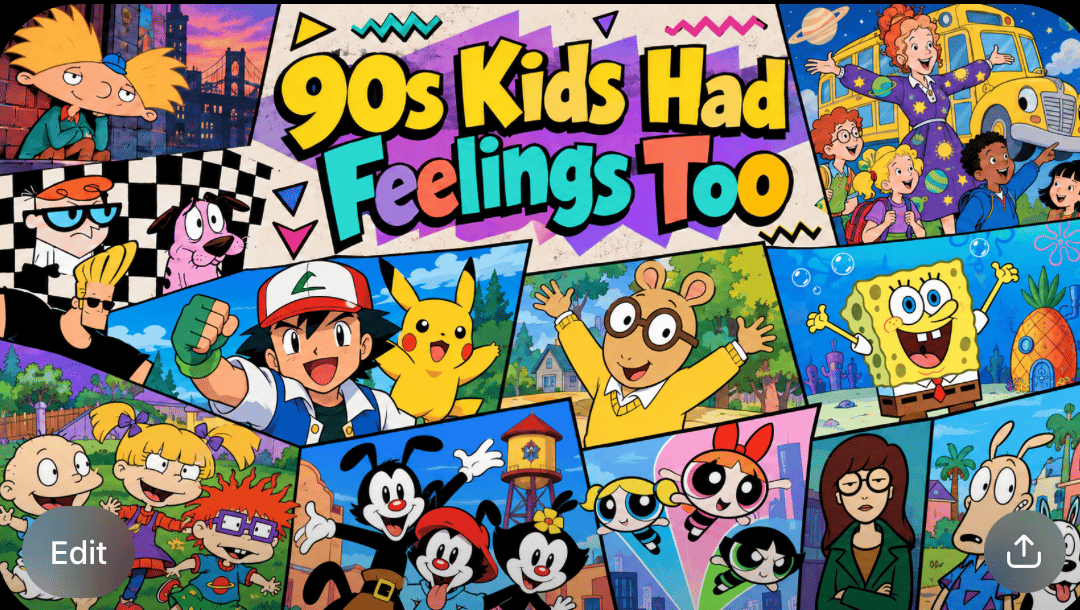
Whenever the topic of children’s mental health comes up, someone from my generation is guaranteed to say: “We didn’t have all this anxiety and depression when we were growing up!”
Wait a minute, didn’t we?
Or had anxiety and depression simply not been invented yet? Because I definitely remember being called lazy when I did not get out of bed. I remember being told I was disrespectful when I talked back, and then being “given something to cry about” when I became emotional. We may not have called it anxiety, depression, trauma, or emotional dysregulation, but that does not mean it was not happening. Sometimes, we simply did not have the language to explain what we were experiencing. Other times, no one had taken the time to teach us the correct language.
Look… We Had a Different Kind of Childhood!
Growing up in the 90s was different. We played outside until the streetlights came on. We drank water from the hose—and survived! I am so serious. We drank from the hose because Mama had already told us: “STOP RUNNING IN AND OUT THE HOUSE!” There were no smartphones documenting every awkward stage of our lives. If you embarrassed yourself at school, you were laughed at….at school. If you got in trouble in front of the other students, you were laughed at….at school. It was certainly embarrassing, but it usually did not become a video that thousands of people had watched, shared, saved, and commented on before you even made it home. Back then, humiliation often had an expiration date…. It happened and people moved on! When we went home, we could sometimes disconnect from the school drama. Today’s children do not always receive that break.
But why? Because bullying can follow them home through text messages, group chats, social media, gaming platforms, screenshots, and anonymous accounts. Comparison is no longer limited to the most popular child at school. Through one simple post, young people can compare their appearance, clothes, families, relationships, accomplishments, and entire lives to millions of people online. Their nervous systems are receiving information constantly. That does not make today’s children weak. It means they are developing within an environment that many adults never had to navigate as children.
But First…. Let’s Stop Pretending We Were All Fine!
Yes, many 90s children developed independence, creativity, resilience, and problem-solving skills. But some of us were literally taught to suffer quietly.
I definitely was told:
- “Stop crying before I give you something to cry about.” 🙄
- “What happens in this house stays in this house.” 🤦🏾♀️
- “You’re too young to be stressed.”
- “Fix your face.”
I was taught obedience before emotional awareness. I learned how to read the room, monitor adults’ moods, avoid triggering certain family members, and hide the feelings that made other people uncomfortable. There were many days when my mother drank and many days when my father abused her. I remember what happened, but I cannot remember ever telling either of them how it made me feel. More importantly, I cannot remember anyone asking. I learned how to survive what was happening around me long before I learned how to understand what was happening inside me.
Then we grew into adults who could handle everybody else’s crisis but did not know what to do with our own emotions. We did not necessarily “turn out fine.” Many of us simply became highly functioning adults with unhealed wounds. It’s me. I’m that adult. LBVS!
We learned how to work through the pain. We learned how to smile through the pain. We learned how to take care of everyone else while ignoring our own pain.
I wish functioning and healing were the same thing, but they are not. Being productive does not always mean you are okay. Sometimes, it simply means you became really good at surviving without allowing anyone to see how much you were hurting.
Today’s Youth Have More Language
Today’s young people know words such as anxiety, depression, trauma, boundaries, triggers, panic attacks, toxic relationships, and emotional safety. I feel like today adults hear this language and assume children are being dramatic or making excuses. Yes mental-health language can be misunderstood, used incorrectly and overly used. Feeling nervous does not automatically mean someone has an anxiety disorder. Feeling sad does not automatically mean someone has major depressive disorder. Being uncomfortable does not always mean a situation is unsafe. A disagreement is not automatically trauma. The ability to name an emotion gives us an opportunity to understand it. It opens the door for conversations many of us were never allowed to have. The goal should not be to take that language away from young people. The goal should be to teach them how to use it accurately while still developing accountability, resilience, emotional regulation, and healthy coping skills.
Their Struggles Are Real
As much as I want to blame the internet, smartphones, and social media for everything happening with children today, and sometimes I really do, buttttt….. Social media is not the sole cause of the youth mental-health crisis, and we must be careful not to oversimplify such a complicated issue. Family relationships, trauma, discrimination, poverty, community violence, academic pressure, lack of sleep, biological factors, and limited access to support all matter. This generation is not only trying to figure out who they are. They are doing it while being watched, measured, liked, disliked, followed, unfollowed, recorded, filtered, compared, and publicly commented on……My goodness the struggle is real!
We Must Become the Adults We Needed
Instead of saying, “I went through worse, and I survived,” we should ask:
“What did surviving cost me?” Too damn much!
Did it cost me the ability to trust people? It did!
Did it teach me to hide my emotions? Yup, quite often!
Did it make me believe love had to hurt? This Part right here!!!
Did I become independent because I was confident, or because I learned that nobody was coming to help me? Our responsibility is not to make children suffer simply because we suffered. Our responsibility is to give them the tools we needed but did not get. Teach them how to communicate. Teach them how to tolerate discomfort. Teach them how to identify unhealthy thoughts. Teach them how to handle rejection without losing themselves. Teach them that boundaries do not eliminate responsibility. Teach them how to disconnect from social media. Encourage sleep, movement, hobbies, friendships, family time, and real conversations. Most importantly, create an environment where they can tell the truth before they reach a breaking point.
The Bottom Line
The children of today are not automatically weaker than the children of the 90s. They are growing up in a different world, a world that is very much different! We had depression. We had anxiety. We experienced trauma. We struggled with family problems, bullying, insecurity, grief, abuse, poverty, loneliness, and fear. The difference is that many of us were expected to remain quiet about it. What happens in this house, stays in this house! Today’s young people are speaking. Our job is not to shame them for having a voice. Our job is to listen, guide, correct, support, and teach them how to use that voice in healthy and responsible ways. We were not necessarily stronger. Sometimes, we were simply quieter. And silence should never be the standard by which we measure strength.
If you or someone you know is experiencing emotional distress or thoughts of suicide, call or text 988 to reach the Suicide & Crisis Lifeline. If there is immediate danger, call 911 or go to the nearest emergency room.
Comments ()