
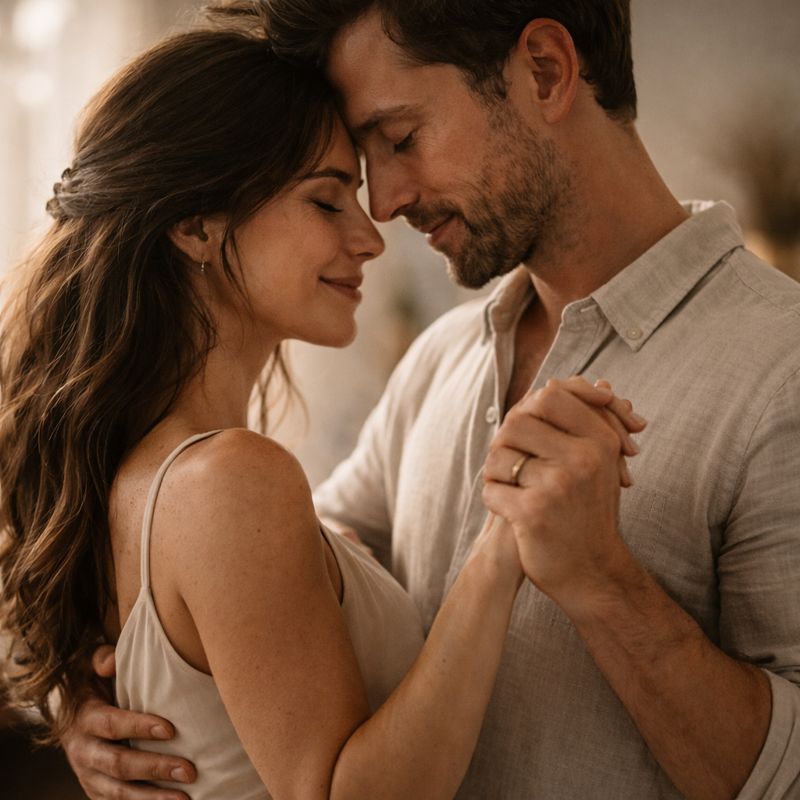
There is a quiet, almost unnoticeable moment in every couple’s life when connection shifts.
Not because something is wrong, but because life becomes full.
Routines multiply, responsibilities grow, and the space between two people slowly fills with everything except presence.
Most couples feel this shift at some point — not as distance, but as a soft fading of the attention they once naturally gave each other.
Couple dance offers a way of reconnection.
Not by returning to something old, but by opening a new moment of meeting —
a moment where partners sense each other through movement, rhythm, and the simple awareness of sharing space together.
Here are a few ways in which movement begins to reopen connection between partners — gentle shifts that grow quietly, yet meaningfully, over time.
1. Movement brings the mind, body, and emotions into the same moment
In daily life, we are rarely whole.
We speak with our minds while our bodies rush forward, or we feel deeply while our attention drifts elsewhere. Dance quietly gathers all these layers — thought, emotion, breath, posture — into one shared experience.
This is where connection begins to strengthen.
Not through effort, but through alignment:
two people responding to the same rhythm, noticing each other’s presence with a clarity that often gets lost in routine.
Movement creates a moment of unity — something felt rather than performed.
2. Shared rhythm brings calm into the relationship
When two people move together, their nervous systems begin to mirror one another.
Breath steadies.
Tension releases.
The atmosphere between them grows gentler.
From this calmness, communication becomes easier — not because anything dramatic changes, but because the body is no longer standing guard.
In this softened space, unspoken things can surface without pressure, and partners naturally become more open, attentive, and emotionally available.
This quiet regulation deepens intimacy.
Not the grand, cinematic kind, but the kind that comes from feeling safe in each other’s presence — the kind that allows touch to be warmer, closeness to feel natural, and affection to grow without effort.
Dance becomes a grounding point — a small place of order in a world that constantly pulls attention away from closeness.
3. Dancing together reveals the natural balance between partners
Partnered dance is a dialogue — a continuous exchange of suggestion and response.
But it also reveals something that daily life often hides:
the distinct roles that create harmony between a man and a woman.
In movement, these roles are not stereotypes.
They are instinctive patterns the body gradually recognizes:
• The woman softens, listens, follows with intuition and grace
• The man anchors, guides, holds structure and direction
• Both contribute equally, but differently
• The harmony appears between the roles, not within one alone
This balance is hard to explain in conversation, yet in dance it becomes felt — slowly, naturally, and in a way the body understands before the mind does.
Partners often describe the experience as “finally feeling right” — as if the relationship realigns itself into a more natural order, one that brings clarity, warmth, and mutual respect.
Many women rediscover a sense of femininity that daily life pushes aside.
Many men rediscover a steadiness and grounded strength they didn’t know they had lost.
The effect is subtle, but deeply renewing.
4. Movement allows partners to see each other anew
In movement, a person appears in a different quality — spontaneous, present, freed from the layers of habit.
Partners often see each other in a refreshed, unexpected light:
in his steadiness,
in her softness,
in the shared laughter when a step slips out of place,
in the quiet beauty of moving at the same pace.
Dance does not add anything artificial.
It simply reveals what has long been there — held beneath routines, responsibilities, and the gentle fatigue of everyday life.
Dance does not solve everything.
But it opens a space where two people can return to themselves and to each other. In that meeting place, movement becomes a gentle reminder that relationships do not always need more words.
Sometimes they simply need a shared rhythm, a gentle hand, and the courage to rediscover each other through movement.
Comments ()