

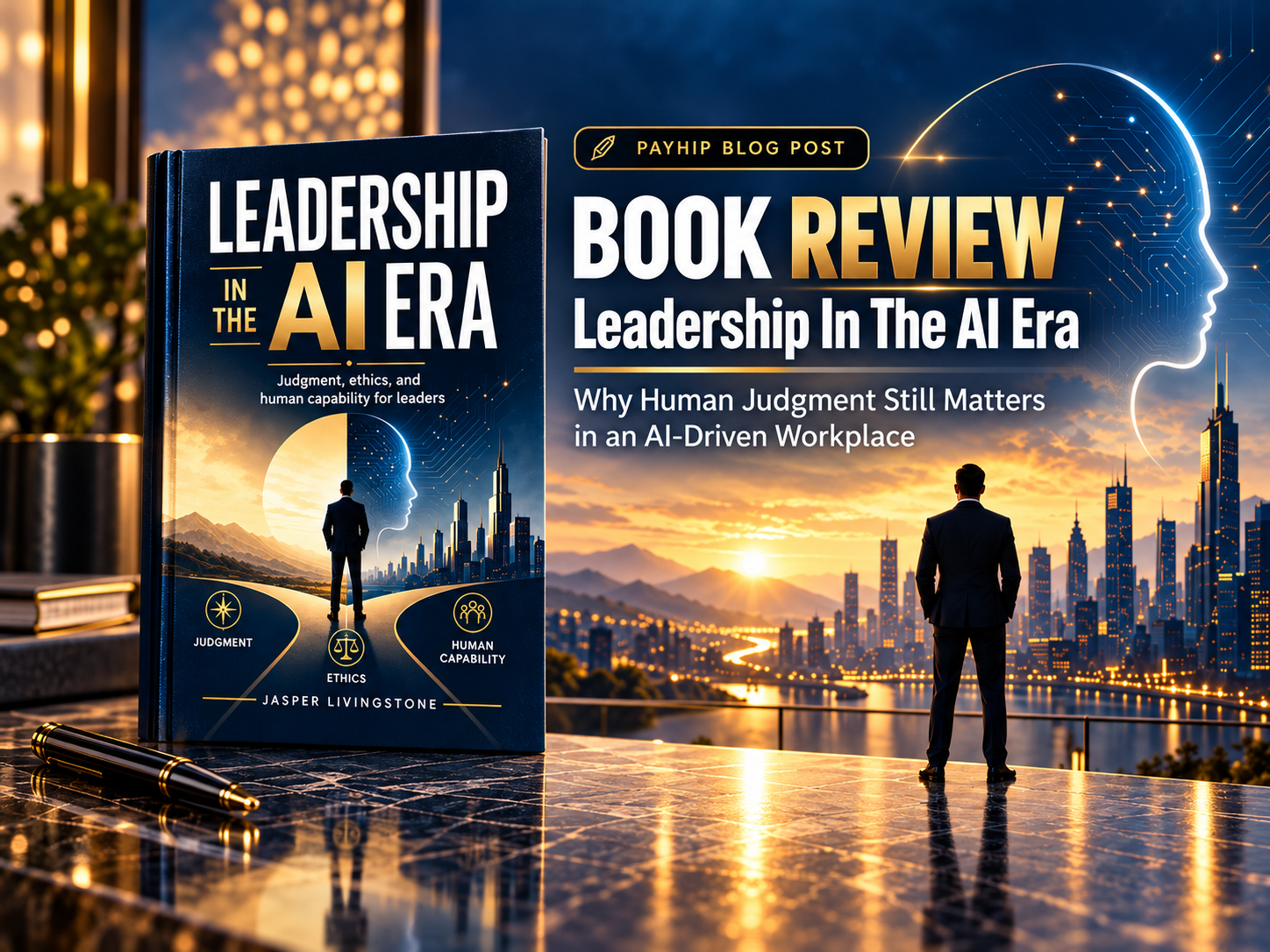
Leadership In The AI Era Review: Why Human Judgment Still Matters in an AI-Driven Workplace
Artificial intelligence is becoming part of everyday business decision-making. Leaders now use AI to analyse information, prepare reports, identify patterns, generate recommendations, support planning, automate routine tasks, and improve the speed of decision-making across finance, operations, technology, customer service, strategy, risk, and many other business functions. This shift creates major opportunities for organisations, but it also creates a new leadership responsibility. As AI becomes more involved in how decisions are prepared and presented, leaders need to remain clear about who owns the final decision, who checks the assumptions behind an AI recommendation, and who accepts responsibility when the outcome affects people, customers, employees, investors, regulators, or the organisation itself.
Leadership In The AI Era by Jasper Livingstone explores this growing challenge from a practical management and leadership perspective. The book does not treat AI as a replacement for leadership. Instead, it focuses on how leaders should work with AI while keeping human judgment, ethics, accountability, and decision ownership at the centre of the process. This makes the book especially relevant for executives, managers, technology leaders, transformation professionals, risk specialists, and anyone responsible for introducing AI into business processes. Rather than asking only what AI is capable of doing, the book encourages leaders to ask a more important question: what responsibilities should remain firmly with people, even when technology becomes faster, smarter, and more involved in the decision process?
One reason this book feels timely is the speed at which AI tools are entering the workplace. Employees already use generative AI to summarise documents, prepare presentations, analyse information, write recommendations, draft policies, review data, and support day-to-day decisions. The productivity benefits are clear, yet speed also creates risk when people begin to accept AI output without enough review. An AI system might produce a detailed answer within seconds, but a confident response does not always mean the information is correct, complete, current, or suitable for a specific business situation. Leaders still need to understand the context, question assumptions, recognise uncertainty, and decide whether additional evidence or human expertise is required before acting.
This is where Leadership In The AI Era becomes especially useful. It places responsibility back with the people making and approving decisions. The book presents AI as a decision-support capability rather than an authority. AI might analyse more information than a manager has time to review manually, and it might identify patterns which would otherwise remain hidden, but the leader still needs to decide what those findings mean and whether they should influence the final decision. This distinction matters because organisations face real consequences when decisions affect financial performance, safety, compliance, employment, customer trust, or reputation. Technology might contribute to the analysis, but accountability cannot simply be transferred to the system.
A strong theme throughout the book is the importance of human judgment. Modern AI systems are designed to produce useful and convincing responses, and this creates a new challenge for managers because a polished answer often looks more reliable than it truly is. Leaders therefore need stronger questioning habits. They need to ask where the information came from, what assumptions influenced the answer, what data might be missing, what risks have not been considered, and whether the recommendation makes sense in the real business environment. Leadership In The AI Era encourages this type of disciplined thinking and provides practical frameworks, including the Leadership Signal Test and the Decision Ownership Map, to help leaders separate AI recommendations from human responsibility.
The discussion around AI governance is another useful part of the book. Governance is sometimes treated as a barrier which slows down innovation, yet weak governance creates its own problems. When an organisation does not clearly define where AI should be used, who should review its output, and who remains responsible for decisions, confusion appears quickly. Different teams might use different standards, employees might rely too heavily on AI-generated information, and managers might struggle to explain how important decisions were made. Good AI governance gives people clearer boundaries. It helps teams understand which decisions require human review, which information needs verification, and which situations involve higher legal, ethical, operational, financial, or reputational risk.
The book also highlights a problem which is likely to become more common as AI adoption grows. When a poor decision produces an unwanted result, people might be tempted to say that the AI recommended it. This response creates what the book describes as an accountability gap. A machine does not attend a board meeting, explain the business reasoning, answer to a regulator, or accept responsibility for the consequences. Leaders do. For this reason, organisations need to make decision ownership clear before AI becomes deeply embedded in business processes. A manager approving an AI-supported
recommendation remains responsible for that approval. An executive presenting an AI-supported strategy still needs to explain the reasoning behind it. A company using automated systems still owns the impact those systems have on employees, customers, and other stakeholders.
Another important aspect of modern AI leadership is the ability to explain decisions. As AI becomes part of important business processes, senior leaders will increasingly need to explain AI-supported decisions to boards, regulators, auditors, employees, customers, investors, and the public. Saying that a system recommended a particular action will not be enough in many situations. Leaders need to understand the information behind a decision, the assumptions involved, the level of uncertainty, the risks considered, and the reasons the final action was chosen. This makes explainability a leadership skill rather than a purely technical issue. Leaders who understand how to communicate the reasoning behind AI-supported decisions will be better prepared to maintain trust when decisions are questioned.
Leadership In The AI Era is therefore relevant to a broad range of professionals. Business executives responsible for transformation will recognise the challenge of introducing AI without losing accountability. CIOs, CTOs, and digital leaders will find the discussion useful when deciding how AI should fit into enterprise systems and operating models. Risk, compliance, audit, and governance professionals will recognise the importance of decision ownership and explainability. Managers introducing AI into their teams will gain a clearer way to decide when employees should rely on AI, when they should verify the output, and when experienced human review should take priority. Public-sector leaders also face many of the same issues because transparency, fairness, accountability, and public trust often play an even larger role in their decision-making.
What makes the book useful is its focus on leadership behaviour rather than technology alone. You do not need to become an AI engineer to lead effectively in an AI-driven organisation. You need to understand where AI adds value, where its limits matter, and where your own judgment remains essential. Leaders still need to ask difficult questions, challenge assumptions, understand consequences, establish responsibility, and make decisions they are prepared to defend. As AI systems become easier to access, these skills become more important because the technology will increasingly influence how information reaches decision-makers.
The larger issue facing organisations is no longer whether employees will use AI. AI is already entering everyday work. The more important question is whether organisations will develop the leadership discipline needed to use it responsibly. This includes clear decision ownership, appropriate human review, stronger governance, better questioning, and greater awareness of the risks created when people trust machine-generated answers too quickly. Leadership In The AI Era provides a practical way to think about these responsibilities and helps readers consider how leadership itself needs to evolve as artificial intelligence becomes part of normal business operations.
For readers interested in AI leadership, digital transformation, enterprise technology, governance, management, or responsible decision-making, Leadership In The AI Era offers a timely perspective. The book reminds readers that artificial intelligence might support the decision process, but leadership still determines how information is interpreted, challenged, approved, and turned into action. The future of leadership will involve working closely with intelligent systems, yet judgment, ethics, responsibility, and accountability will remain human responsibilities.
If your organisation is introducing AI into everyday work, this book gives you a useful question to carry into every important decision: who owns the decision when AI is involved? The answer should remain clear, even as the technology becomes more capable.Leadership In The AI Era by Jasper Livingstone is available through Payhip for readers who want a practical guide to human judgment, ethical leadership, AI governance, responsible decision-making, and leadership accountability in the age of artificial intelligence.