
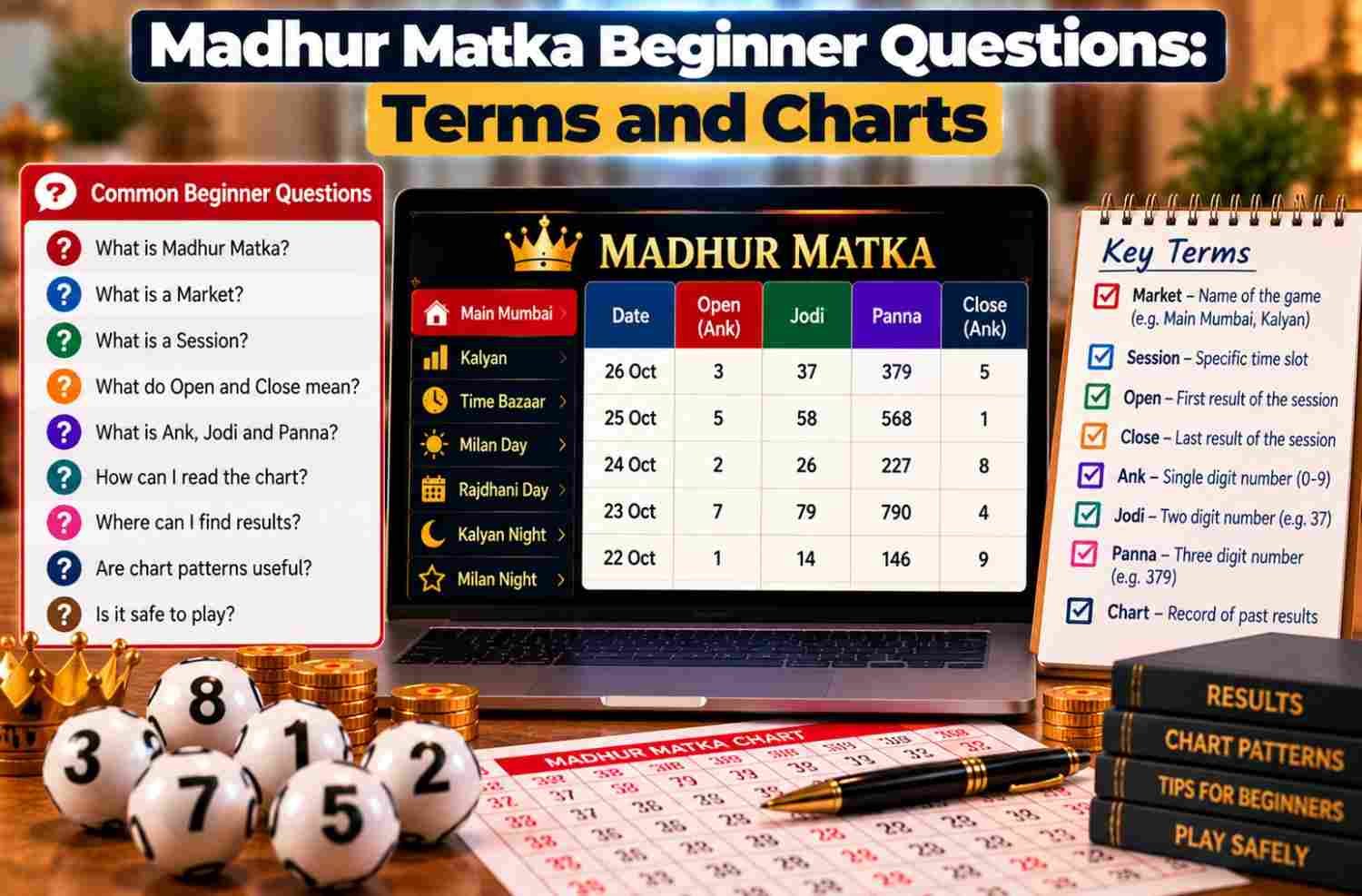
Why does one page display several market names, while another shows separate opening and closing fields? What do Ank, Jodi and Panna mean, and why do historical charts sometimes disagree? Beginners examining madhur matka information often encounter these questions before they can identify what an entry actually represents. Each number gains meaning from its accompanying market label, session, date, and field heading. Without that context, even a detailed chart can create confusion. Reading the complete record matters more than recognising an isolated number.
What Information Appears on a Results Page?
A results page may highlight recent entries or organise older records into charts. Publishers arrange headings and fields differently.
Common elements include:
- Market name: Identifies the record series to which an entry belongs.
- Session label: Separates a named period or variation from another category with a similar name.
- Date: Indicates the calendar day associated with the displayed record.
- Numerical field: Shows an individual digit, a pair or a three-digit entry, depending on its heading.
- Status indicator: May identify an unfinished row, although symbols differ between displays.
These elements work together. A pair beneath one market heading may differ from a similarly named category elsewhere. A number without its field label lacks essential context. Always inspect the adjacent column titles before interpreting it.
Why Page Layout Matters
Some pages place recent records above their historical charts. Others provide separate views for different numerical categories. A narrow mobile screen can also hide nearby headings or divide one row across several lines. Before comparing entries, locate the complete row and confirm which column each value occupies.
How Do Markets, Sessions and Results Differ?
These words describe different parts of the same information structure. Confusing them can mix unrelated records.
A market identifies a named record series. A session distinguishes a period or variant within that classification. A result represents the associated numerical entry. Publishers combine these labels differently, so no naming arrangement applies everywhere.
Why Similar Names Can Refer to Different Records
Labels such as Morning, Day and Night may appear beside a shared name. These additions can distinguish sessions rather than viewing times. The label does not establish a schedule, and publishers may use different wording.
Consider a hypothetical chart with two rows carrying the same main market name but different session descriptions. Even when their dates match, the rows need not refer to the same record. Comparing them as though they were identical would produce a misleading discrepancy.
To keep the categories separate, read the complete market name, any session suffix and the date together. Only then examine the numerical field.
What Do Ank, Jodi and Panna Represent?
Numerical headings tell readers what kind of entry a chart displays. Similar numbers can carry different meanings.
- Ank: A single digit, usually within the range zero to nine.
- Jodi: A two-digit pairing that commonly presents the opening and closing Ank together.
- Panna: A three-digit grouping, which some displays also call Patti or Panel.
Do not confuse a single-digit field with a two-digit pair. Similarly, a three-digit entry does not represent the same category as its associated Ank. Records may show several elements or one category.
Where a display includes separate opening and closing Anks, the position of each digit matters. Reversing their order changes the paired entry, even when both digits appear in the record.
What Do Other Numerical Labels Indicate?
Some charts distinguish single, double and triple Panna by three distinct digits, two matching digits or three matching digits, respectively. Abbreviations may appear in headings, but their presentation varies.
A label such as Panel Chart commonly signals a fuller record display, whereas a Jodi Chart focuses on paired entries. Neither heading alone proves that the underlying records are complete or accurate. The columns and dates still determine what information the chart communicates.
If a heading lacks a clear definition, avoid assigning it a meaning solely because another page uses similar terminology.
Why Do Opening and Closing Fields Appear Separately?
Opening and closing labels distinguish parts of a result. The opening side contains the initial entry; the closing side contains a later component. A complete line may present both alongside their pair.
A page might show an opening entry while leaving the closing column empty. That arrangement establishes only what the page currently displays. It does not confirm why the other field lacks information or when somebody might add it.
Distinguishing Partial and Complete Entries
A partial row cannot establish a complete result. Readers can describe the opening field without assuming a value for the absent closing field.
Likewise, a placeholder, dash or blank cell may represent missing information, a publishing convention or a display problem. Its meaning depends on the page's own labelling. Never treat a blank as a numerical result unless the source explicitly defines that convention.
How Should Beginners Read Historical Charts?
Historical charts organise earlier entries by date, market or session. They document earlier displays without independently confirming each entry’s reliability.
Some charts arrange dates from oldest to newest, while others show the latest rows first. Weekly grids may also place dates across columns. Assuming universal ordering can attach numbers to the wrong days.
Keep Dates Attached to Their Entries
When examining an archived row, check its market heading and session label before reading the date. Then identify whether the row contains a single Ank, a Jodi or a fuller grouping. Without those details, the number loses context.
A date can also refer to the session rather than the moment when someone updated the page. Without timestamps, readers cannot confirm the update time.
For example, two archives may show the same sequence in opposite chronological directions. Checking the date heading prevents a mistaken comparison between neighbouring entries from different days.
Recent Displays Are Not Historical Archives
A recent-results panel may summarise only a portion of the available information. An archive may preserve more fields but omit recent corrections. Neither layout guarantees reliability. Meaningful comparisons require matching categories, dates and labels.
Why Do Different Pages Sometimes Disagree?
Differences do not necessarily prove an error. Publishers may use different date formats, session divisions or update intervals. Missing labels and transcription mistakes can also create conflicts.
Before deciding that two entries contradict one another, check:
- Full market wording: Similar titles may identify separate categories.
- Session description: Morning and Night entries need not match.
- Date format: Day-first and month-first arrangements can cause confusion.
- Field heading: Do not compare a Jodi directly with a Panna.
- Record completeness: One page may show only an opening component.
If labels match but numbers differ, the conflict may remain unresolved. Neither entry deserves automatic preference.
What Does an Empty or Delayed Entry Mean?
An empty cell provides no value. It cannot establish whether a session occurred or which number belongs there. A delayed update remains one possible explanation, not a verified conclusion.
When a row lacks both a date and a clear heading, the reader may have no reliable way to identify the missing information. Preserving that uncertainty is more accurate than inventing a reason.
Can Historical Patterns Establish Future Results?
Previous entries describe past records, not future certainties. Repeated values and apparent sequences may attract attention, but repetition alone cannot demonstrate that a later entry will follow the same arrangement.
Matching pairs across dates only indicate that a publisher recorded similar values, assuming the records are accurate. They reveal no dependable future rule.
Likewise, a long absence does not guarantee the return of a particular entry. Without a validated predictive method and suitable evidence, any promise of certainty exceeds what historical charts can support.
Readers should distinguish an observable pattern from a demonstrated relationship. The first describes what appears in the archive; the second requires evidence that the archive alone cannot provide.
What Practical Checks and Safety Precautions Help?
Careful reading requires record checks and online precautions. Polished layouts do not guarantee accuracy.
- Identify the category: Match the market name and complete session label before comparing values.
- Confirm the date: Check which day each row represents and whether the display clearly identifies its date format.
- Read the heading: Distinguish Ank, Jodi and Panna fields instead of treating all numbers alike.
- Check completeness: Notice blank closing fields, unexplained symbols and missing entries.
- Compare responsibly: Look for matching labels across records before calling a difference an error.
- Protect personal details: Avoid unnecessary registration forms and requests for sensitive information.
- Examine unfamiliar addresses: Treat unexpected redirects, suspicious downloads and unsolicited messages cautiously.
Question certainty claims and unexplained corrections. A credible display provides enough context to identify its records.
Conclusion
Readers can interpret Madhur Matka records more accurately by connecting each number with its market, session, date and heading. Opening and closing fields require separate attention, while historical charts need their original context. Incomplete rows and conflicting displays can leave genuine questions unresolved. Most importantly, previous entries document what a chart reports; they cannot guarantee later results. A sound reading begins with clear labels, recognises missing information and avoids conclusions that the record cannot justify.