
India Athletic Footwear Market Outlook
This research report by IMARC Group on the India Athletic Footwear Market provides a forecast of market size, share, and emerging trends for 2026–2034. The report covers segmentation by product type, distribution channel, end user, and region, with regional coverage across West and Central India, South India, North India, and East and Northeast India.
Market Snapshot
- Market Name: India Athletic Footwear Market
- Region: India
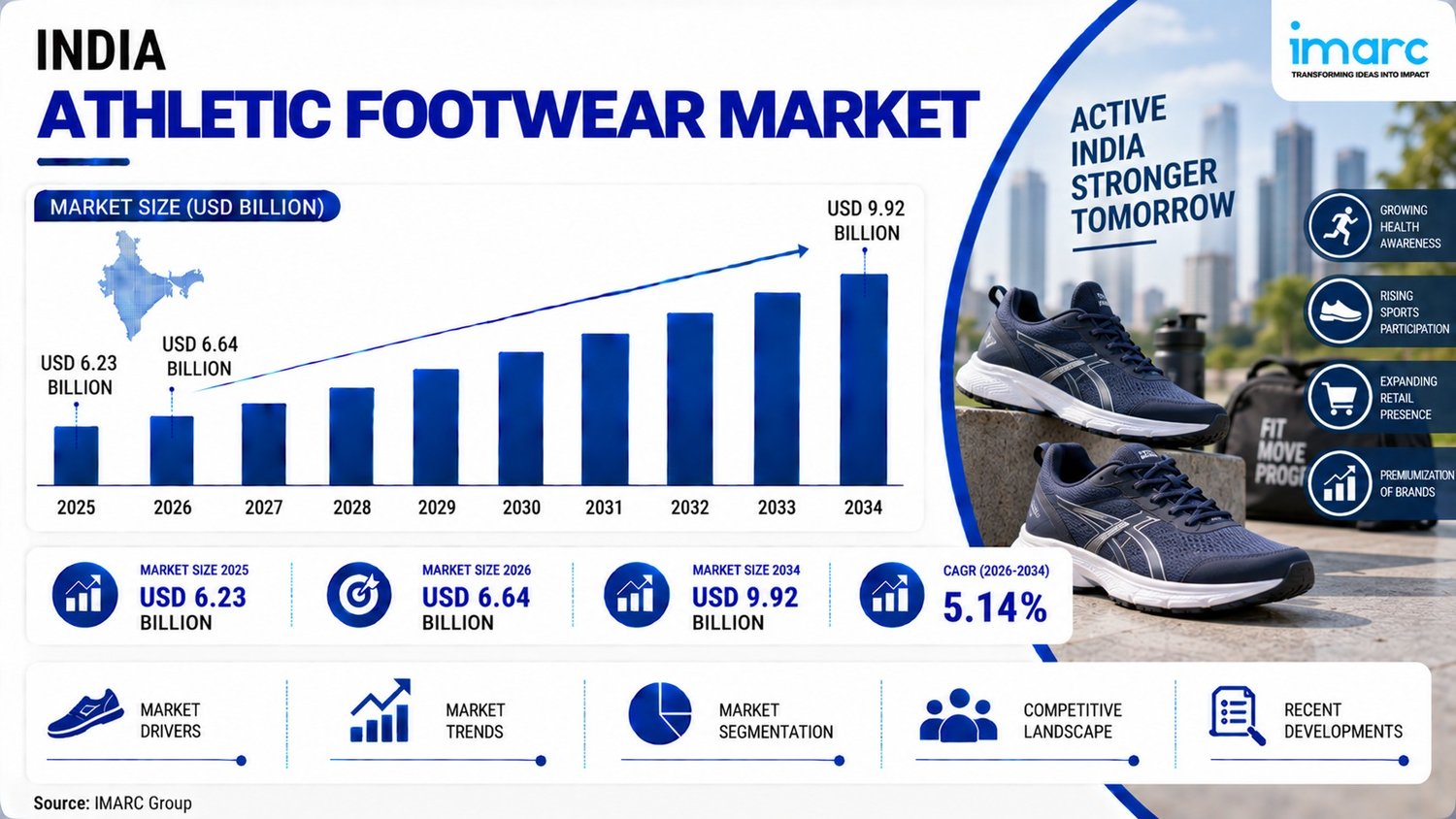
- Base Year and Market Size: USD 6.23 Billion (2025) and USD 6.64 Billion (2026)
- Forecast Year and Market Value: USD 9.92 Billion (2034)
- CAGR: 5.14%
- Forecast Period: 2026–2034
- Segmentation Covered: Product type, distribution channel, end user, and region
Current Market Size of the India Athletic Footwear Industry
The India athletic footwear market size grew from USD 6.23 Billion in 2025 to USD 6.64 Billion in 2026, and is projected to reach USD 9.92 Billion by 2034 at a CAGR of 5.14% during 2026–2034. Expanding sports manufacturing incentives, growing grassroots athletic participation, rapid domestic factory investments, and rising demand for specialised performance shoes drive this expansion.
How AI Personalization and Omnichannel Shifts Are Redefining the India Athletic Footwear Market
- AI-powered search improves online shoe discovery, as Myntra expanded AI tools across personalised search, product videos, and customer support in July 2026 per Business Standard, lifting buyer conversions.
- Distributed analytics networks speed up online fulfilment, with Puma India cutting delivery times by 70% and doubling express capacity through Accenture's digital twin redesign, raising omnichannel availability.
- Unified store and digital inventories expand reach, as Metro Brands grew e-commerce revenue 39% in FY 2025–26 while connecting 1,032 stores with quick-commerce platforms per its Annual Report.
- Direct-to-consumer platforms reshape brand economics, with Campus Activewear generating over 46.5% of revenue from D2C alongside 29,000+ retail touchpoints in FY 2025–26 per its Annual Report, improving retention.
- Mobile apps deepen direct engagement, with Bata India's app crossing 450,000 downloads to contribute around 14% of Bata.com sales alongside expanded outlets per The Economic Times in November 2026.
Emerging Trends in the India Athletic Footwear Market
India-First Product Engineering for Local Conditions
Global sportswear brands are designing athletic shoes specifically for Indian terrain and running habits instead of importing generic lines. In October 2026, Nike launched the Vegam Run at INR 3,795 alongside plans for a Bengaluru capability centre per The Economic Times, accelerating locally tailored product cycles.
Rising Local Sourcing by Global Sportswear Labels
International athletic brands are expanding Indian contract manufacturing to meet domestic quality mandates and shorten lead times. ASICS produces about 30% of its footwear locally and plans to raise Indian production to 40% of sales within three years per Bloomberg, strengthening domestic sports-shoe supply chains.
Community-Led Retail Expansion in Sports Gear
Multi-sport retailers are pairing store expansion with organised running clubs and coaching events to build repeat footwear buyers. Decathlon India operates 132 stores and targets 200 outlets by 2030 after posting INR 4,133.10 crore in FY 2024–25 revenue according to Mint, expanding access to technical footwear.
Premiumisation Lifting Realisations Among Domestic Manufacturers
Mass-market Indian footwear producers are shifting portfolios toward higher-margin sports and athleisure silhouettes to offset raw material inflation. Relaxo Footwears reported Q2 FY 2026–27 revenue growth of 11.6% year-on-year to INR 702 crore in November 2026 per NSE filings, reflecting stronger consumer demand for branded athletic styles.
Request Sample Report with Datasheet – TOC, Charts & Key Insights: https://www.imarcgroup.com/india-athletic-footwear-market/requestsample
Growth Drivers of the India Athletic Footwear Market
Grassroots Sports Funding Under Khelo India
Sustained federal spending on youth athletics directly expands India's base of regular sports footwear consumers. In FY 2026–27, Khelo India received INR 924.35 crore, supporting 1,067 Khelo India Centres, 267 academies, and 2,745 athletes according to the Press Information Bureau in August 2026, boosting institutional demand.
Focus Product Scheme Boosting Footwear Manufacturing Scale
Dedicated industrial incentives strengthen domestic design, component supply, and non-leather footwear production across India. The Focus Product Scheme for the footwear and leather sector aims to generate INR 4 lakh crore in turnover, over INR 1.1 lakh crore in exports, and 22 lakh jobs per the Ministry of Finance.
Zero-Duty Trade Agreements Expanding Export Manufacturing
Preferential overseas access encourages Indian factories to build modern athletic shoe lines. India's leather and footwear exports reached USD 4.75 billion in FY 2025–26 per DGCIS, with UK and EU zero-duty pacts projected by the Council for Leather Exports to lift shipments to USD 5.5 billion.
Large-Scale Non-Leather Footwear Plant Investments
Foreign contract manufacturers are commissioning dedicated non-leather sports footwear complexes in southern industrial corridors to serve global and local demand. In June 2026, MEPZ Special Economic Zone approved TKG Taekwang India's INR 514.72 crore non-leather footwear unit at Tiruchirappalli creating 13,364 jobs per PIB, deepening local capacity.
Key Market Segments in the India Athletic Footwear Market
The India athletic footwear market is segmented by product type, distribution channel, end user, and region.
Product Type Segmentation
- Running Shoes
- Sports Shoes
- Walking Shoes
- Trekking and Hiking Shoes
- Aerobic Shoes
Running shoes led the product type segment with a 31.8% share in 2025 and grow faster than the overall market, driven by marathon participation, fitness awareness, and advanced cushioning technologies. Sports shoes followed at 27.6%, propelled by cricket, badminton, football, and kabaddi alongside everyday versatile wear.
Distribution Channel Segmentation
- Specialty Stores
- Brand Outlets
- Online Channels
- Other Distribution Channels
Specialty stores dominated the distribution channel segment with a 32.7% share in 2025, supported by curated product assortments, expert guidance, and professional fitting services. Brand outlets held the next-largest disclosed share at 28.6% through full-range visibility, while online channels expand faster than the overall market.
End User Segmentation
- Detailed end user segments not disclosed
Adult fitness enthusiasts and urban commuters anchor athletic footwear demand across India as daily running, gym workouts, and casual athleisure styling gain mainstream adoption. Youth and student buyers represent the next major demand group, driven by organised school sports, collegiate leagues, and rising brand awareness nationwide.
Regional Breakdown
- West and Central India
- South India
- North India
- East and Northeast India
West and Central India led the regional market with a 32.8% share in 2025, supported by strong urban consumer demand, higher disposable incomes, organised retail infrastructure, and premium brand penetration. South India followed as a major secondary market at 27.6%, driven by sports participation and e-commerce adoption.
Who Are the Key Players in the India Athletic Footwear Market?
Competition in the India athletic footwear market centres on cushioning innovation, local manufacturing scale, omnichannel retail networks, and youth-focused brand positioning. Leading participants include Nike, Inc., Adidas AG, Puma SE, Relaxo Footwears Limited, and Campus Activewear Limited. Companies compete across price tiers through India-specific running silhouettes, exclusive brand outlets, digital marketplaces, and deep distribution across metropolitan and regional cities.
Latest Recent Developments in the India Athletic Footwear Market
- In October 2026, the Union Cabinet approved the Khelo India Sports Goods Manufacturing Scheme with an INR 1,856.67 crore outlay through FY 2033–34, according to the Press Information Bureau.
- In July 2026, Adidas broke ground on the Evervan Kothari footwear manufacturing plant in Karur, Tamil Nadu to expand local sourcing, according to The Economic Times.
- In June 2026, DPIIT amended Footwear Quality Control Orders, extending legacy stock clearance to 31 July 2027 and allowing 4,500 annual R&D sample imports, according to PIB.
If you require any specific information not covered within this report's scope, we will provide it as part of the customization.
Request Report Customization: https://www.imarcgroup.com/request?type=report&id=21637&flag=E
Frequently Asked Questions (FAQs)
Q1. How big is the India athletic footwear market and what is its projected growth?
The India athletic footwear market grew from USD 6.23 Billion in 2025 to USD 6.64 Billion in 2026. It is expected to reach USD 9.92 Billion by 2034, registering a CAGR of 5.14% during 2026–2034.
Q2. Why is demand rising for athletic footwear across India?
Demand is rising due to INR 924.35 crore in FY 2026–27 Khelo India funding, the Focus Product Scheme for footwear, zero-duty UK and EU trade pacts, and major non-leather factory investments like TKG Taekwang's INR 514.72 crore plant.
Q3. Which product types and distribution channels hold the largest market shares?
Running shoes led product types with a 31.8% share in 2025 and grow faster than the overall market, followed by sports shoes at 27.6%. Specialty stores led distribution at 32.7%, followed by brand outlets at 28.6%.
Q4. Where is athletic footwear consumption most concentrated regionally in India?
West and Central India led the regional market with a 32.8% share in 2025, supported by strong urban demand, higher disposable incomes, and organised retail. South India followed at 27.6%, driven by sports participation and e-commerce adoption.
Q5. What key shifts are reshaping athletic footwear brands in 2026?
Brands are launching India-specific running shoes such as Nike's Vegam Run, raising local production as ASICS targets 40% domestic sourcing, expanding community-led sports retail like Decathlon India, and shifting toward higher-margin athleisure portfolios.
Comments ()