
Discover how AI for Growing Minds helps parents and educators understand artificial intelligence, guide ethical tech use, and prepare children for an AI-driven future.
Introduction: Parenting in the Age of Artificial Intelligence
Artificial Intelligence is no longer a futuristic concept reserved for tech labs and sci-fi movies. It is already embedded in our daily routines — from voice assistants and personalized video recommendations to adaptive learning apps in classrooms.
For parents and educators, this raises urgent questions:
- How do we explain AI to children?
- Should we be worried about its impact?
- How do we teach kids to use AI responsibly?
- What skills will matter most in an AI-driven world?
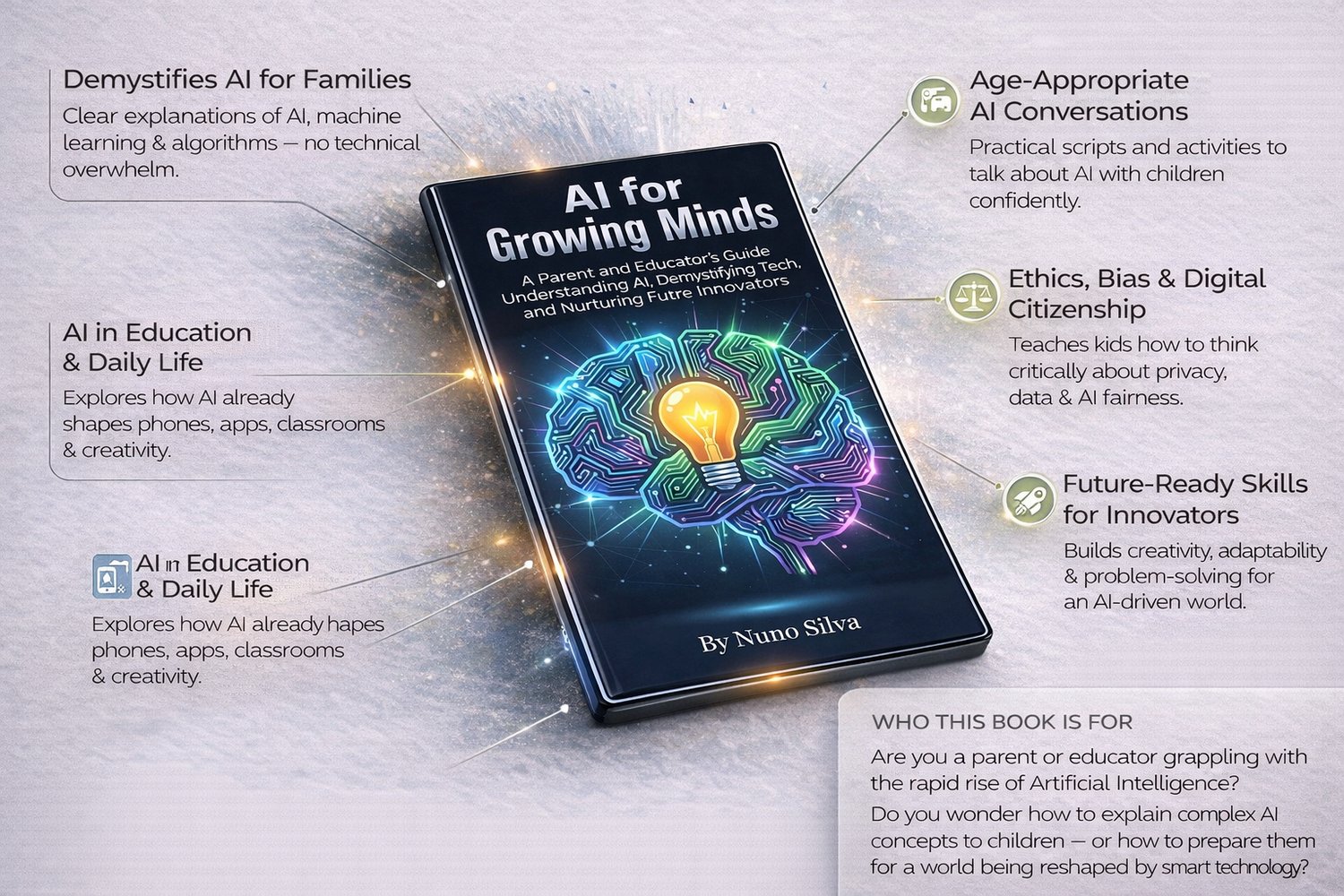
These are exactly the concerns addressed in AI for Growing Minds: A Parent and Educator's Guide to Understanding AI, Demystifying Tech, and Nurturing Future Innovators
AI_for_Growing_Minds_KDP
.
Rather than overwhelming readers with technical jargon, this ebook offers a practical, empowering roadmap for guiding children through the AI revolution — with clarity, confidence, and purpose.
This article explores why AI for Growing Minds is essential reading for modern families and schools — while leaving the most powerful insights for the book itself.
Why AI Literacy Is the New Digital Literacy
We once taught children how to type, search online, and stay safe on social media. Today, that is no longer enough.
AI is shaping:
- What children see online
- How they learn
- How information is filtered
- How content is created
- How decisions are made
Without AI literacy, children risk becoming passive consumers of technology instead of informed participants.
AI for Growing Minds emphasizes that understanding AI is not about turning kids into programmers — it’s about helping them become critical thinkers in a world increasingly influenced by intelligent systems.
Demystifying AI: Beyond Robots and Sci-Fi Myths
Many adults still associate AI with robots, automation, or dystopian narratives. But children are interacting with AI daily without even realizing it.
The ebook begins by breaking down:
- What AI actually is
- How machine learning works (in simple terms)
- How algorithms shape online experiences
- Why AI doesn’t “think” like humans
This foundation is crucial. When children understand that AI learns from data — and that data can contain bias — they begin to see technology more clearly.
Instead of fear, there is awareness.
Instead of blind trust, there is thoughtful curiosity.
AI Is Already in Your Child’s World
One of the most powerful insights in AI for Growing Minds is this:
AI is not coming. It is already here.
Children encounter AI in:
- YouTube and TikTok recommendation feeds
- Educational apps that adapt to learning speed
- Smart speakers and voice assistants
- Online gaming environments
- Search engines and homework tools
Understanding this everyday exposure helps parents shift from reactive to proactive conversations.
Rather than banning technology out of fear, the book encourages guided engagement.
Teaching Kids to Think Critically About Algorithms
Algorithms decide:
- What videos are recommended
- What news appears in feeds
- What ads are shown
- What search results rank first
Without awareness, children may assume these systems are neutral or objective.
The ebook explores how to:
- Explain algorithms in age-appropriate ways
- Encourage children to question digital content
- Identify filter bubbles
- Discuss personalization and data use
These conversations help children develop healthy skepticism — a skill that will be invaluable throughout their lives.
The Ethical Compass: Bias, Privacy & Responsibility
Artificial intelligence reflects the data it is trained on. That means it can inherit human bias.
AI for Growing Minds addresses critical ethical issues such as:
- Algorithmic bias
- Data privacy
- Digital footprints
- AI-generated misinformation
- Responsible AI usage
Rather than presenting these topics as alarming threats, the book frames them as opportunities to teach values:
- Fairness
- Empathy
- Accountability
- Respect for privacy
This ethical grounding is one of the strongest pillars of the ebook.
AI in Education: Threat or Opportunity?
AI in schools is often controversial. Some see it as cheating; others see it as innovation.
The truth lies somewhere in between.
The ebook explores how AI can:
- Personalize learning experiences
- Support struggling students
- Provide adaptive feedback
- Assist teachers with planning and assessment
At the same time, it cautions against overreliance and encourages human oversight.
The message is balanced and practical:
AI should enhance learning — not replace thinking.
Preparing Children for an AI-Driven Future
One of the most compelling sections of the book focuses on future-ready skills.
Instead of emphasizing technical coding skills alone, AI for Growing Minds highlights:
- Creativity
- Problem-solving
- Adaptability
- Collaboration
- Emotional intelligence
- Critical thinking
These are the uniquely human strengths that AI cannot replicate.
Children who cultivate these skills will not be replaced by AI — they will work alongside it.
Talking About AI at Different Ages
A five-year-old does not need the same explanation as a teenager.
The ebook offers guidance on:
- Age-appropriate conversations
- Activities that introduce AI concepts
- Games and analogies that make learning fun
- Encouraging curiosity without overwhelming detail
This practical approach makes the book accessible to parents at any stage of their child’s development.
From Passive Users to Active Creators
One of the most empowering themes in the ebook is the shift from:
Passive tech consumption → Active tech creation
Children can:
- Experiment with simple coding tools
- Explore robotics kits
- Use AI creatively in storytelling
- Analyze how systems work
The goal is not technical mastery. It is agency.
When children understand that technology is built by humans, they begin to imagine themselves as future innovators — not just end-users.
Why This Ebook Matters Now
We are at a pivotal moment.
AI is accelerating faster than traditional education systems can adapt. Parents and educators need practical guidance — not fear-based headlines or dense technical manuals.
AI for Growing Minds stands out because it:
- Speaks in accessible language
- Bridges technology and parenting
- Balances optimism with responsibility
- Encourages action, not anxiety
It is not a textbook.
It is a compass.
Frequently Asked Questions (FAQs)
What is AI for Growing Minds about?
It is a practical guide designed to help parents and educators understand artificial intelligence and guide children responsibly in an AI-driven world.
Is this book technical?
No. The book avoids heavy technical jargon and focuses on clear explanations and real-world examples.
Does the book teach coding?
It introduces the importance of understanding technology but focuses more on mindset, ethics, and critical thinking than technical programming.
Is AI safe for children?
AI itself is a tool. The key is guided use, digital literacy, and ethical awareness — themes thoroughly explored in the ebook.
What age group is this book for?
The book supports parents and educators working with children of various ages by offering adaptable conversation strategies.
Final Thoughts: Empowering the Next Generation
AI is not something we can ignore.
It is shaping the world our children will inherit.
The question is not whether they will interact with AI.
They already are.
The real question is:
Will they understand it?
Will they question it?
Will they use it wisely?
AI for Growing Minds offers a roadmap to help families and educators move from uncertainty to empowerment.
It invites us to:
- Replace fear with knowledge
- Replace confusion with clarity
- Replace passive consumption with thoughtful engagement
The future will belong to children who can think critically, adapt creatively, and navigate technology responsibly.
If you are ready to guide your child not just to survive — but to thrive — in the age of artificial intelligence, this ebook is the place to begin.
Get the ebook HERE