

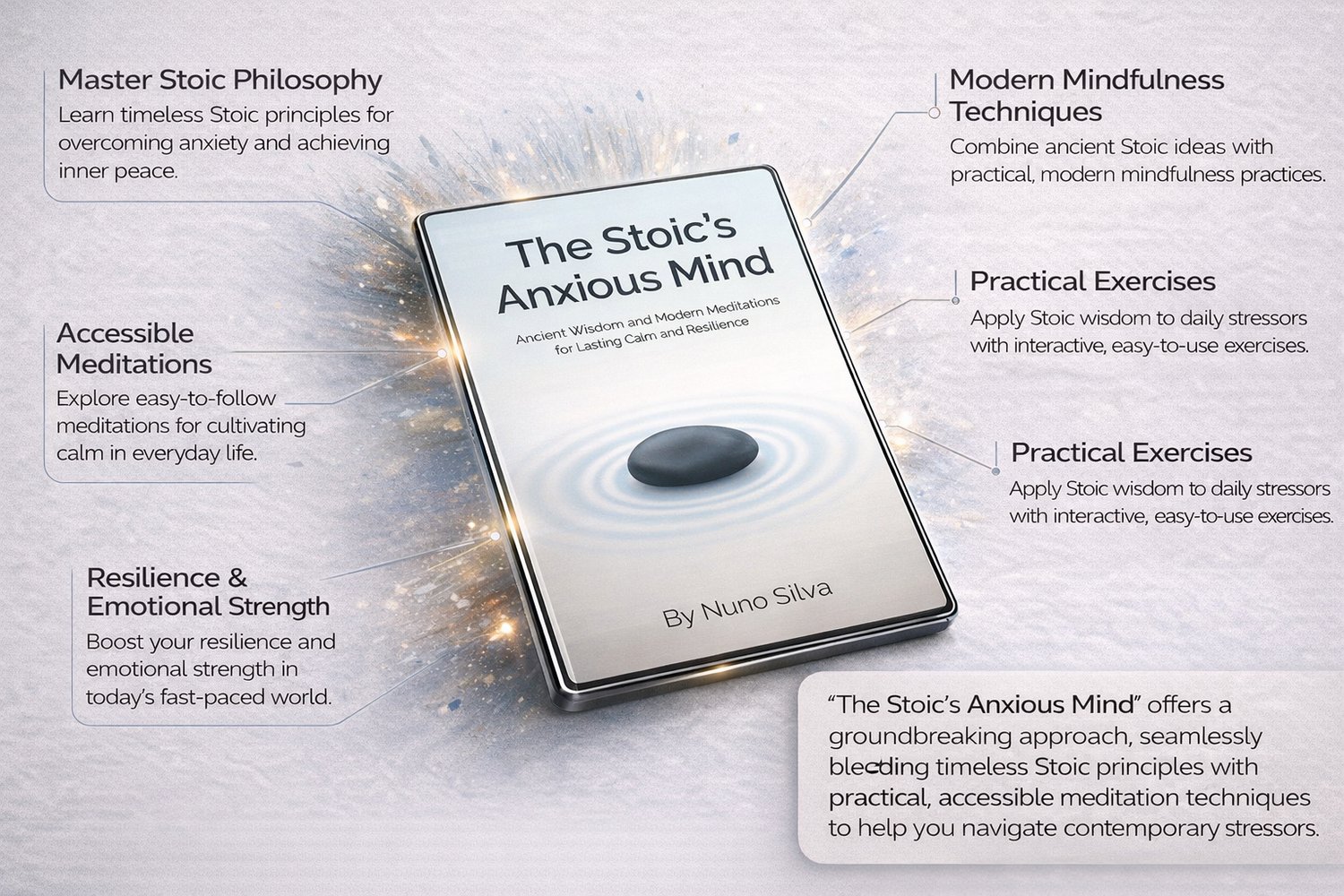
The Stoic’s Anxious Mind: How Ancient Wisdom Helps Calm Modern Anxiety
Discover how Stoic philosophy helps calm anxiety, overthinking, and emotional overwhelm. Learn why The Stoic’s Anxious Mind is a must-read for inner peace.
Introduction: Why Anxiety Feels Louder Than Ever
Anxiety is no longer a quiet companion — it’s a constant background noise in modern life.
From endless notifications and financial pressure to uncertainty about the future, many people feel trapped inside their own thoughts. Overthinking. Catastrophizing. Emotional exhaustion. Sleepless nights.
Yet long before modern psychology existed, Stoic philosophers were already addressing the anxious mind — not with suppression or denial, but with clarity, discipline, and inner resilience.
That is the foundation of the ebook The Stoic’s Anxious Mind.
This is not another self-help book filled with vague affirmations. It is a grounded, practical guide inspired by Stoicism — adapted for people who struggle with anxiety, rumination, and emotional overload in today’s world.
This article explores why Stoicism is uniquely powerful for anxiety — and why this ebook resonates with readers seeking calm without false positivity.
What Is “The Stoic’s Anxious Mind”?
At its core, The Stoic’s Anxious Mind explores a powerful idea:
Anxiety is not caused by events — but by how the mind interprets them.
This insight, originally articulated by Stoic thinkers like Epictetus and Marcus Aurelius, is the backbone of modern cognitive psychology — and the foundation of this ebook.
Rather than promising to “eliminate anxiety,” the book teaches readers how to:
- Understand anxious thought patterns
- Regain control over emotional reactions
- Reduce mental suffering without suppressing feelings
- Build calm through reason, not avoidance
The result is a mindset that feels stable, grounded, and resilient, even when life remains unpredictable.
Why Stoicism Works So Well for Anxiety
1. Stoicism Targets the Root of Anxiety — Not the Symptoms
Most approaches focus on calming techniques:
- Breathing
- Distraction
- Temporary relief
Stoicism goes deeper.
It asks:
- What are you trying to control that you cannot?
- What assumptions are you making about the future?
- Which thoughts are facts — and which are interpretations?
The Stoic’s Anxious Mind teaches readers how to separate reality from mental narratives — a skill that dramatically reduces anxiety over time.
2. Control vs. No Control: The Most Liberating Concept
One of the central Stoic principles explored in the ebook is the Dichotomy of Control.
You control:
- Your judgments
- Your actions
- Your values
You do not control:
- Other people
- Outcomes
- The past
- Random events
Anxiety thrives when this boundary is blurred.
This ebook gently guides readers to reclaim mental energy by releasing what was never theirs to control in the first place.
Anxiety, Overthinking, and the Stoic Perspective
Overthinking Is a Misuse of Imagination
Stoicism does not deny fear — it reframes it.
In The Stoic’s Anxious Mind, readers learn how anxiety is often:
- Imagination mistaken for reality
- Future scenarios treated as certainty
- Emotional reasoning disguised as logic
Rather than fighting thoughts, Stoicism teaches how to observe, evaluate, and reframe them — a method that aligns closely with modern CBT techniques.
Emotional Regulation Without Emotional Suppression
A common misconception about Stoicism is that it promotes emotional numbness.
The ebook makes it clear:
- Stoics feel emotions
- They simply refuse to be ruled by them
This distinction is crucial for people with anxiety, who often fear their own emotional responses.
The Stoic approach offers emotional clarity, not emotional denial.
Who Is This Ebook For?
The Stoic’s Anxious Mind is written for people who:
- Struggle with chronic anxiety or constant worry
- Overthink conversations, decisions, and future outcomes
- Feel mentally exhausted by their own thoughts
- Want calm without spiritual fluff or toxic positivity
- Appreciate philosophy, psychology, and practical wisdom
It is especially powerful for readers who feel that:
“My anxiety isn’t irrational — it’s exhausting.”
What Makes This Ebook Different From Typical Anxiety Books?
1. Philosophy Meets Practical Life
Rather than academic Stoicism or abstract quotes, the ebook translates ancient wisdom into modern mental habits.
Readers don’t just learn what Stoics believed — they learn how to think like one when anxiety arises.
2. Short, Reflective, Actionable
The writing style is designed to:
- Be read slowly
- Be revisited during anxious moments
- Encourage reflection rather than information overload
This makes it ideal for:
- Morning reading
- Night-time anxiety
- Moments of emotional overwhelm
3. No Promises of “Curing” Anxiety
Instead of unrealistic claims, the ebook offers:
- Mental stability
- Emotional strength
- Psychological freedom
This honesty builds trust — and long-term impact.
Why This Ebook Resonates in the Modern World
We live in an age of:
- Constant stimulation
- Endless comparison
- Information overload
- Fear-driven news cycles
Stoicism provides an antidote:
- Mental discipline
- Clear values
- Emotional sovereignty
The Stoic’s Anxious Mind positions Stoicism not as an ancient philosophy — but as a necessary skill for modern survival.
Frequently Asked Questions (FAQs)
Is The Stoic’s Anxious Mind a self-help book?
It is a philosophical guide with practical applications. It focuses on mindset, perception, and emotional mastery rather than quick fixes.
Does this ebook replace therapy?
No. It complements therapy by strengthening mental resilience and self-awareness through Stoic principles.
Is the book religious or spiritual?
No. Stoicism is a practical philosophy rooted in reason, not belief systems or spirituality.
Can Stoicism really help with anxiety?
Yes. Many modern psychological techniques are directly influenced by Stoic philosophy, particularly cognitive reframing.
Is this ebook suitable for beginners in Stoicism?
Absolutely. It is written in clear, accessible language with no prior knowledge required.
Final Thoughts: Calm Is a Skill — Not a Personality Trait
Anxiety does not mean weakness.
Overthinking does not mean failure.
Emotional sensitivity does not mean fragility.
The Stoic’s Anxious Mind offers a different perspective:
Calm is something you practice — not something you wait for.
By learning how to think clearly under pressure, accept uncertainty, and respond rather than react, readers gain something deeper than temporary relief.
They gain inner steadiness.
If you are searching for:
- A rational approach to anxiety
- Emotional control without repression
- Ancient wisdom adapted for modern struggles
Then The Stoic’s Anxious Mind is not just a book — it is a mental framework worth owning.