

For years, the Cybersecurity Maturity Model Certification (CMMC) has been the boogeyman in the closet of government contracting. Everyone knew it was coming, but many companies quietly hoped it would stay in the shadows a little longer. That hope just expired. In the past few weeks, the Department of Defense pulled the trigger and finalized the rules. CMMC, a framework designed to protect the defense industrial base from cyber threats, is no longer a "someday" problem. It is now baked into government contracts starting this November. Think of it like the NFL announcing that the new rulebook is officially in play, and refs will be throwing flags from the first snap.
So, what does this really mean? If your company touches sensitive government data, you are already in the game whether you signed up or not. The two key data types you need to know are Federal Contract Information (FCI) and Controlled Unclassified Information (CUI).
- Federal Contract Information (FCI) is information provided by or generated for the government under a contract that is not intended for public release.
- Controlled Unclassified Information (CUI) is a more sensitive category of information that requires safeguarding, even though it is not formally classified. This can include technical drawings, project requirements, or research data.
If you handle either FCI or CUI, CMMC is now the price of admission. And here’s the catch: it is not a one-time ticket. It is season tickets. You cannot just pass a certification once and hang the plaque on your wall. You have to show up consistently, prove you belong, and keep your security playbook sharp.
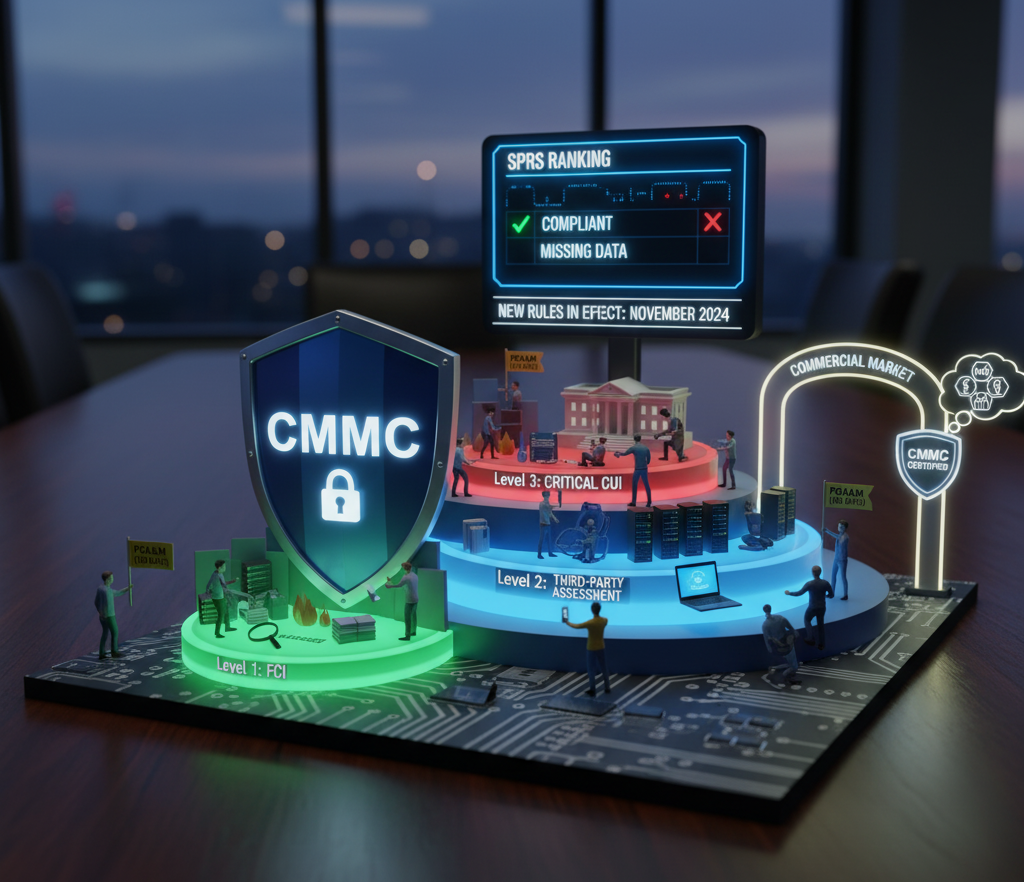
The rules are tiered, almost like levels in a video game. Level 1 is the “tutorial mode,” where companies handling only FCI can perform a self-assessment. Level 2 is where most contractors will land, and this is where the real work begins. Meeting the NIST 800-171 controls and, in some cases, undergoing a third-party assessment is no small task. Level 3 is the championship level, reserved for contracts with the most sensitive data, and it comes with government assessors breathing down your neck.
One of the most important updates is the introduction of conditional certifications. Think of it like passing your driver’s test with a learner’s permit. You may not have mastered parallel parking, but you have shown you are serious and now you have 180 days to work out the kinks. This breathing room will save a lot of companies, but only if they are organized enough to have a solid Plan of Action and Milestones (POA&M) that proves they are closing the gaps.
Another major change is the spotlight on the Supplier Performance Risk System (SPRS). If CMMC is your security transcript, SPRS is your GPA. Contracting officers will check it before awarding new work or extending options. If your SPRS record is missing or outdated, you are basically walking into a bank asking for a loan with no credit history. And just like in real life, that does not end well.
Here is the kicker: it is not just prime contractors who need to sweat this. Subcontractors are now on the hook too. If you are a sub and you process or store CUI on your systems, you will need your own certification. There is some wiggle room; for instance, if all of your work happens inside the prime’s secure systems, you might dodge the bullet. But do not assume. Ask. Clarify. Because one weak link can blow the whole supply chain.
So how do you position your company for success in this new reality? The first step is to stop treating cybersecurity like an afterthought or a bolt-on accessory. It has to be baked into your daily operations, like coffee in the breakroom. Map out where you touch sensitive data. Lock down your controls. Get your documentation in order: system security plans, incident response playbooks, and POA&Ms. And keep your SPRS record fresh, because that is the scoreboard the refs are watching.
Yes, CMMC will cost time and money. But here is the flip side: companies that embrace it now will gain a massive competitive advantage. While your competitors scramble to patch holes, you will already be on the field, trusted, compliant, and ready to play. In government contracting, trust is currency. CMMC is how you prove you can be trusted.
And here’s the part too many companies overlook. Smart organizations will not stop at compliance. They will flip CMMC into a marketing tool. Imagine being able to tell your commercial clients, “We meet the same cybersecurity standards required by the Department of Defense.” That is not just a compliance box, that is a badge of honor. Commercial companies face the same fears: ransomware, data breaches, and supply chain risks. If you can show them that your systems are hardened to military-grade expectations, you instantly stand apart from competitors. That kind of trust travels. It can win you not just federal work, but contracts in industries like finance, healthcare, energy, and manufacturing where cybersecurity is now as critical as price or performance.
The bottom line? The game just got real. The final whistle has blown on “wait and see.” If your company wants to win and keep government work, CMMC is no longer optional. It is not just another compliance checkbox. It is the key to staying in the league, and if you play it smart, it can also become your MVP when it comes to landing commercial business.
By: Brad W. Beatty
Comments ()