

Hiring managers in 2026 are not waking up thinking,
“You know what would fix everything? One more CISSP.”
They are staring at noisy dashboards, half tuned alerts, Terraform that they do not fully trust, and a growing pile of Mac malware no one really wants to touch. It is less Hogwarts and more The Matrix… too much data, not enough people who can actually bend reality inside it.
The problem is not a shortage of certifications. The problem is a shortage of people who can change what the systems do.
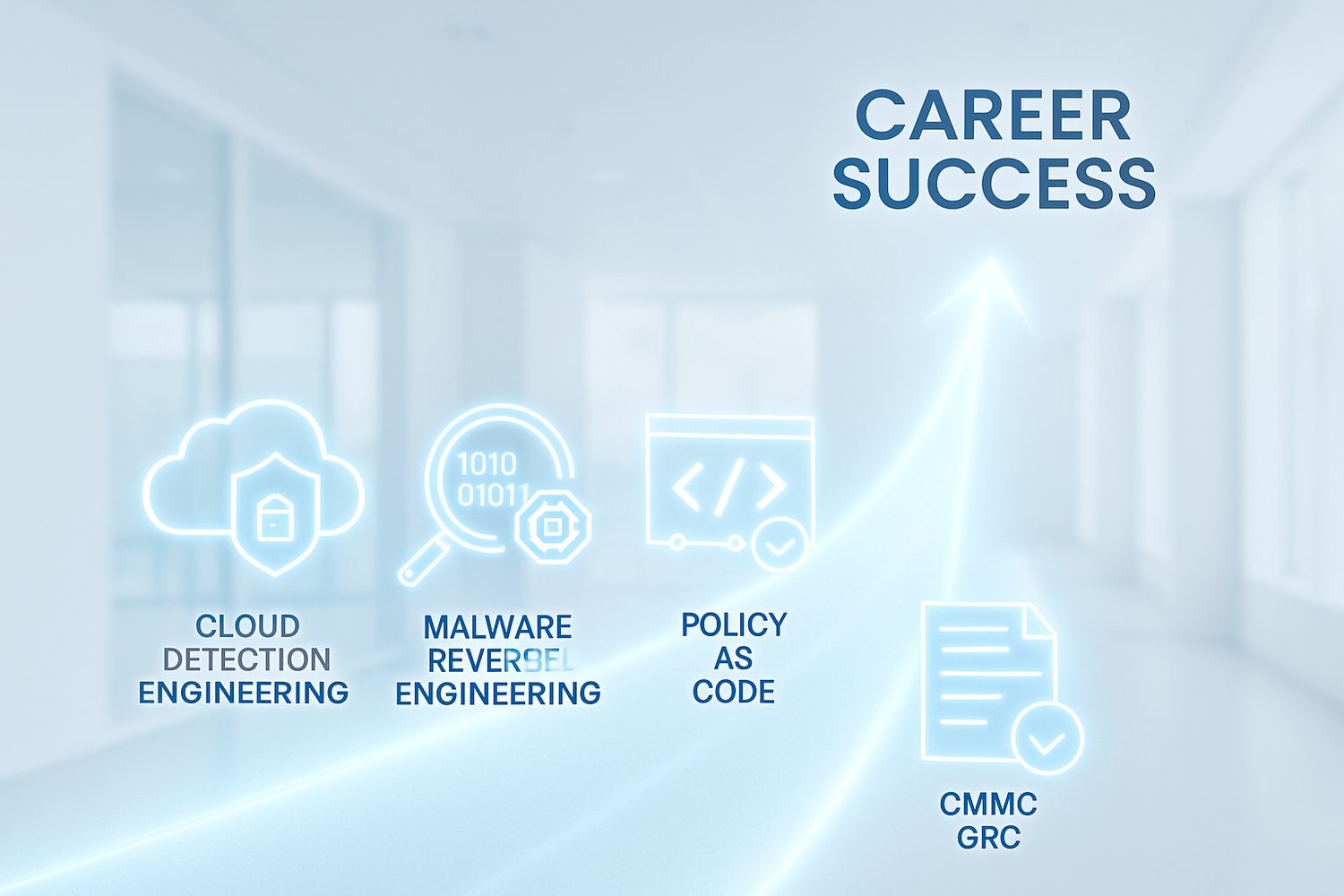
Right now, based on job postings and recruiter conversations, four types of roles are quietly becoming the ones that actually get you hired:
- Cloud detection engineering
- macOS and ARM malware reverse engineering
- Policy as code
- CMMC focused GRC
Here is what those really mean in plain English, and how to pivot into them without collecting six new certs first.
Cloud Detection Engineering: teaching your tools what “bad” looks like
In simple terms, a cloud detection engineer teaches security tools what to look for in cloud platforms like Amazon Web Services (AWS), Microsoft Azure, and Google Cloud Platform (GCP).
Instead of just watching alerts pop up in a SIEM (Security Information and Event Management system), you design those alerts. You decide what suspicious behavior looks like, write the rules, and tune them so they fire when it matters and stay quiet when it does not.
A normal workday might look like this:
- Pulling in logs, such as AWS CloudTrail
- Reading a real incident write up about how an attacker abused tokens or cloud identities
- Translating that behavior into a query in KQL (Kusto Query Language for Microsoft Sentinel) or SPL (Search Processing Language for Splunk)
- Testing it in a small lab, then tuning it so it does not drown everyone in noise
It is part security, part software engineering, and part Ghostbusters deciding which ghosts the proton pack should actually fire on.
How to pivot into cloud detection engineering
Pick one cloud, like AWS or Azure, and one SIEM, such as Sentinel or Splunk free tier. Turn on logging in a small lab account. Do a few “suspicious” things on purpose, like repeated failed logins or odd privilege changes. Write rules that detect them. Then publish your work in a GitHub repository or short blog post with screenshots and queries.
When a recruiter asks what you have done, you can say, “I built and tuned detections for real techniques in AWS using Sentinel. Here is the repo.” That lands very differently than “familiar with SIEMs.”
macOS and ARM Malware Reverse Engineering: opening the black box
A malware reverse engineer takes a suspicious program apart so the team knows how it works and how to stop it. On macOS and ARM processors, that skill is in very short supply.
Instead of treating a Mac malware sample as a mysterious blob, you answer simple but critical questions:
- What does this new Mac sample actually do?
- How does it persist, meaning how does it survive a reboot?
- What files or Apple keychain items does it touch or steal?
- How would we detect this in our Endpoint Detection and Response (EDR) tool or logs?
To do that, you use tools like Ghidra or IDA to inspect the code, and debuggers like LLDB to watch the program at runtime. You learn just enough macOS internals and ARM64 basics to recognize what you are seeing. Then you turn that into plain language findings and practical detections, such as YARA rules or new EDR behaviors to hunt for.
It is like reading the source code of The Matrix instead of just watching the green rain.
How to pivot into macOS and ARM malware reverse engineering
Start small. Take a harmless Mac utility, open it in Ghidra, and practice mapping functions to what you see when you run it. Watch beginner friendly content on macOS and ARM64 so the instructions are not random symbols. Then pick a public Mac malware write up and try to replicate a piece of it yourself.
Write a short report in your own words, with a couple of detection ideas. Put it on GitHub. Now you are not claiming “reverse engineering interest.” You are showing that you have already gone down the rabbit hole.
Policy as Code: making “we should not do that” automatic
Policy as code happens when security leaves static Word documents and becomes part of the build process.
A policy as code engineer is the person who turns “we should not do that” into “the pipeline will not let us do that by mistake.” Think of the invisible rails that keep you from flying off Rainbow Road in Mario Kart.
Instead of saying, “we do not allow public storage buckets” in a PDF, you:
- Write that rule in something like Open Policy Agent (OPA) using the Rego language, or HashiCorp Sentinel
- Attach those rules to Terraform (infrastructure as code), Kubernetes admission controllers, or your CI/CD (Continuous Integration and Continuous Delivery) pipeline
From then on, if someone tries to push a risky configuration, the build fails automatically. No angry emails, just guardrails.
How to pivot into policy as code
Use a free cloud tier and Terraform to build a tiny environment. Then layer OPA or Sentinel on top. Write a handful of simple rules like “no public security groups” or “storage must be encrypted.” Hook that into GitHub Actions or GitLab CI so every pull request runs the checks.
Document it with a README and screenshots. Now when someone says “do you have DevSecOps experience,” you can point to a working example instead of a bullet point.
CMMC focused GRC: the compliance role that lives in reality
CMMC stands for Cybersecurity Maturity Model Certification. It is the United States Department of Defense (DoD) program that says, “if you want certain contracts, you must prove your security meets these levels.”
GRC stands for Governance, Risk, and Compliance. It is how a company turns laws and standards into actual policies and risk decisions.
A CMMC focused GRC role is the person who helps a company keep its DoD work by making sure their security program really follows CMMC and NIST SP 800-171, not just on paper. You are part translator, part project manager, part architect.
You might:
- Work with engineers to design a “CUI enclave,” a secure zone for Controlled Unclassified Information with proper segmentation and logging
- Help write and maintain a System Security Plan (SSP) with diagrams and evidence that make sense to assessors
- Map each control to real technical settings, such as password policies in Azure Active Directory or log retention rules in a SIEM
With CMMC finally being written into contracts, these roles are moving from “nice to have” into “we cannot bid without this.”
How to pivot into CMMC focused GRC
Choose NIST SP 800-171 and CMMC Level 2 and go deep. Read an SSP template and the assessment guide. Invent a fictional small contractor and design a very simple CUI enclave for them. Draw the diagram, write a few control responses, and list the evidence you would collect.
Now you can say, “I designed a sample CMMC enclave and wrote a mini SSP,” instead of “familiar with CMMC.”
So what about certifications?
Certifications are not useless. They are just not the star of the show.
One or two targeted certs can help you break through filters and learn the language. The problem is when you stop there. Right now, what separates candidates is not who has the most acronyms, it is who can tell real stories about building or fixing things.
“Here is a detection I wrote and tuned.”
“Here is a Mac sample I reverse engineered and how we would detect it.”
“Here is a Terraform pipeline I locked down with OPA.”
“Here is how I mapped CMMC controls to an actual architecture.”
Those are the stories that get you hired in 2026.
Practical 2026 game plan
If you want to stand out instead of getting buried in the stack, here is a simple roadmap:
- Pick one lane to lean into: cloud detection engineering, macOS and ARM malware reverse engineering, policy as code, or CMMC focused GRC.
- Build two or three small, real projects that match that lane and put them on GitHub or a simple site.
- Rewrite your resume so it highlights outcomes, with verbs like “designed,” “built,” “reverse engineered,” and “implemented,” instead of “familiar with.”
- Use certifications to support your lane, not as a substitute for hands on work.
- Talk to recruiters in terms of problems you solve, for example “I build and tune cloud detections” or “I reverse engineer Mac malware and turn that into detections,” not just “I know tool X.”
- Keep a tiny learning backlog each month, like “one new detection, one new reverse engineering technique, one new policy as code rule.”
Do that consistently, and by the time 2026 hiring really heats up, you will not be just another “security professional.” You will be the person who can actually help a team defend modern systems and pass real world requirements. These are just my own observations and opinions, so your mileage may vary depending on your situation and organization, so good luck in your future endeavors in 2026!
By: Brad W. Beatty
When everything stops, the human spirit keeps moving.
Dragon Flash: The Skipping Stones of Time
A Novel by Brad W. Beatty, Pre-order NOW on Amazon:
Comments ()