

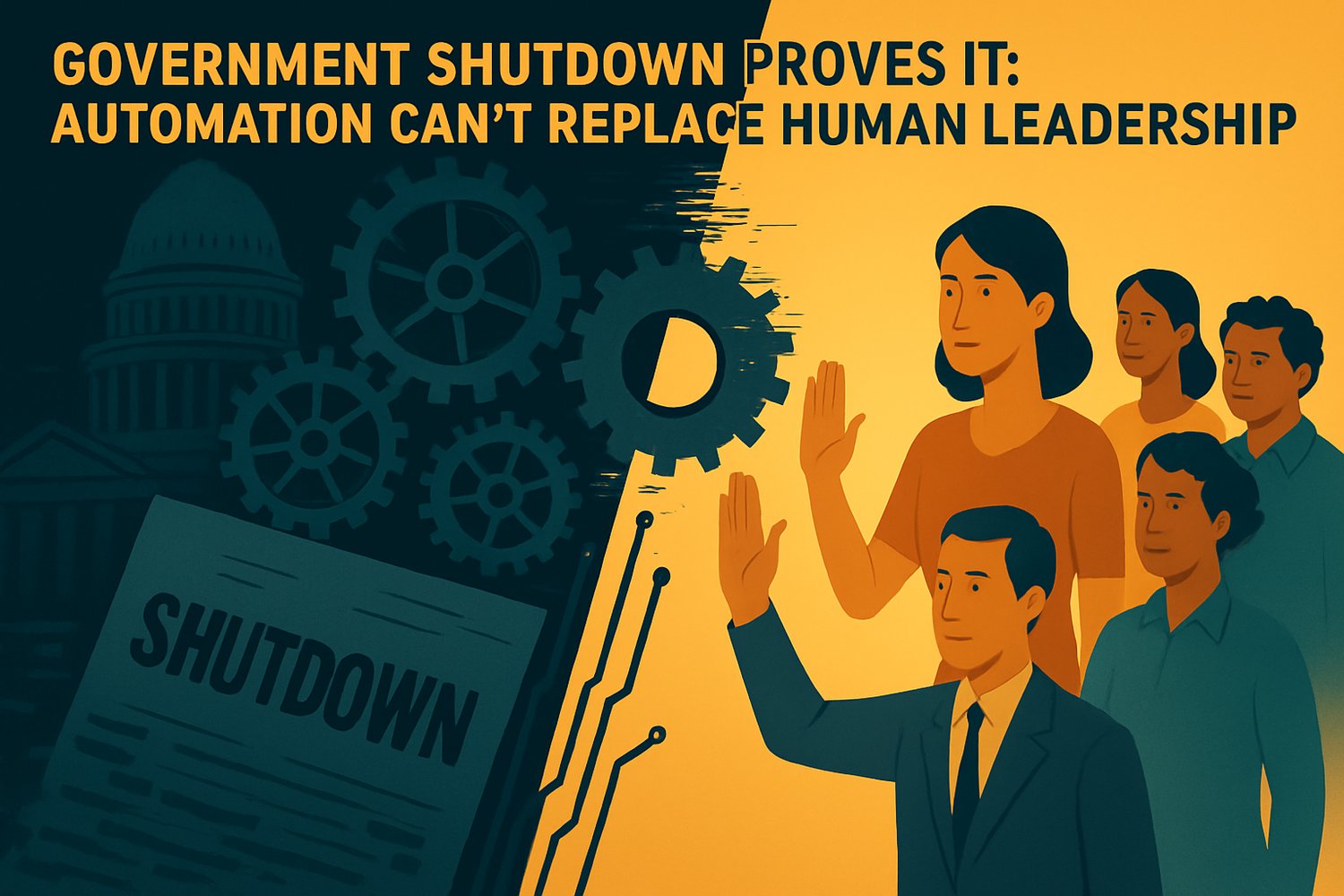
Every few years, the U.S. government provides a stark reminder of how fragile our most complex systems are. The latest shutdown isn’t just a political standoff; it’s a real-time stress test of what happens when leadership vanishes. Budgets freeze, agencies lock their doors, and the critical functions that keep the country safe and healthy grind to a halt. Suddenly, all the talk about “AI efficiency” and “seamless automation” sounds dangerously naive.
The truth is simple: When the people go home, the systems stop working.
The Myth of the Self-Running Machine
We have spent the last decade convincing ourselves that technology can fill any gap humans leave behind. Automation will streamline it. AI will monitor it. The cloud will scale it. But when a shutdown hits, the myth of the self-sufficient system shatters.
This week, CISA, the government’s front-line cyber defense agency, furloughed most of its staff, leaving a skeleton crew to monitor national infrastructure. The Department of Health and Human Services lost nearly half its workforce overnight. NASA sent home over 80 percent of its people. Even the Department of Justice had to pause programs that protect survivors of domestic violence.
These systems didn’t collapse because the servers failed or an algorithm broke. They collapsed because the humans who make judgment calls, prioritize actions, and adapt to chaos were gone. Machines don't improvise; they only execute. In a crisis, that’s not a feature: it’s a fatal flaw.
Automation Without Judgment Is Just Noise
Automation is brilliant at following orders but terrible at understanding context. An automated system can execute its tasks perfectly while the world burns around it.
When cybersecurity analysts are furloughed, AI models continue to log thousands of alerts, but no one is there to interpret them, connect the dots, or identify the signal in the noise. When policy teams go home, automated compliance tools keep generating reports, but no one is left to decide what they mean or what action to take.
We tell ourselves that “the system” can handle it. But the system is merely a digital reflection of us, our logic, our rules, and our processes. Without human oversight, it becomes brittle, predictable, and dangerously vulnerable.
Leadership Is the Real Continuity Plan
During a shutdown, you can see the cracks form precisely where leadership was holding things together. This isn’t just about top-down authority; it’s about presence, guidance, and the confidence that inspires action.
When leadership goes dark, decisions stall. Teams hesitate. Fear of making a mistake replaces the initiative to solve a problem.
The silence from the top spreads faster than any cyber threat, whispering a single, paralyzing message: “Wait and see.”
That is how complex systems truly die, not from a catastrophic technical failure, but from slow, creeping human hesitation. Machines don't step up when things fall apart. People do. Leadership is the only continuity plan that has ever truly worked.
Resilience Isn’t About Backups; It’s About People
In technology, we glorify redundancy: mirrored servers, failover clusters, backup generators. But true resilience isn’t about having copies; it’s about having capacity. It's about empowering people who can adapt, improvise, and take initiative when the script is thrown out.
If CISA’s staff hadn’t been gutted, its experts would be rebalancing workloads, adjusting alert priorities, and cross-checking critical systems. If HHS hadn’t lost half its team, those professionals would be rerouting operations to protect patient safety.
That’s not code; that’s instinct. It’s judgment. It’s leadership.
Automation cannot fill this gap because automation doesn’t care. Resilience is born from humans who do.
Leading in the Dark
The true test for any organization, government or private, isn’t how it operates when everything is working. It’s how it leads when everything stops.
Ask yourself: If our funding froze tomorrow and half the team went offline, what would happen? Our automated systems might keep running, but who would be there to interpret the data? Who would make the critical judgment calls that a machine can’t?
Leaders who plan for that darkness, who build cultures where people are empowered to act, not just execute, are the ones whose systems will survive.
Because “resilient” doesn’t mean unbreakable; it means adaptable. It means human.
The Human Operating System
When the lights finally come back on, the temptation is to pretend it’s all back to normal. But stability without adaptability is just denial. The shutdown didn’t just expose gaps in funding; it exposed our dangerously fragile dependence on automation as a substitute for leadership.
The lesson isn’t that AI and automation are flawed, but that they are tools, not replacements. They cannot replicate judgment, empathy, or courage. When the next crisis hits, our salvation won’t come from better algorithms or more efficient servers. It will come from the people who show up, make the tough calls, and lead through the chaos.
We don't need systems that can run without us. We need leaders who can run the show when the systems can't.
By: Brad W. Beatty
When everything stops, the human spirit keeps moving.
Dragon Flash: The Skipping Stones of Time
A Novel by Brad W. Beatty, Coming soon.
Comments ()