

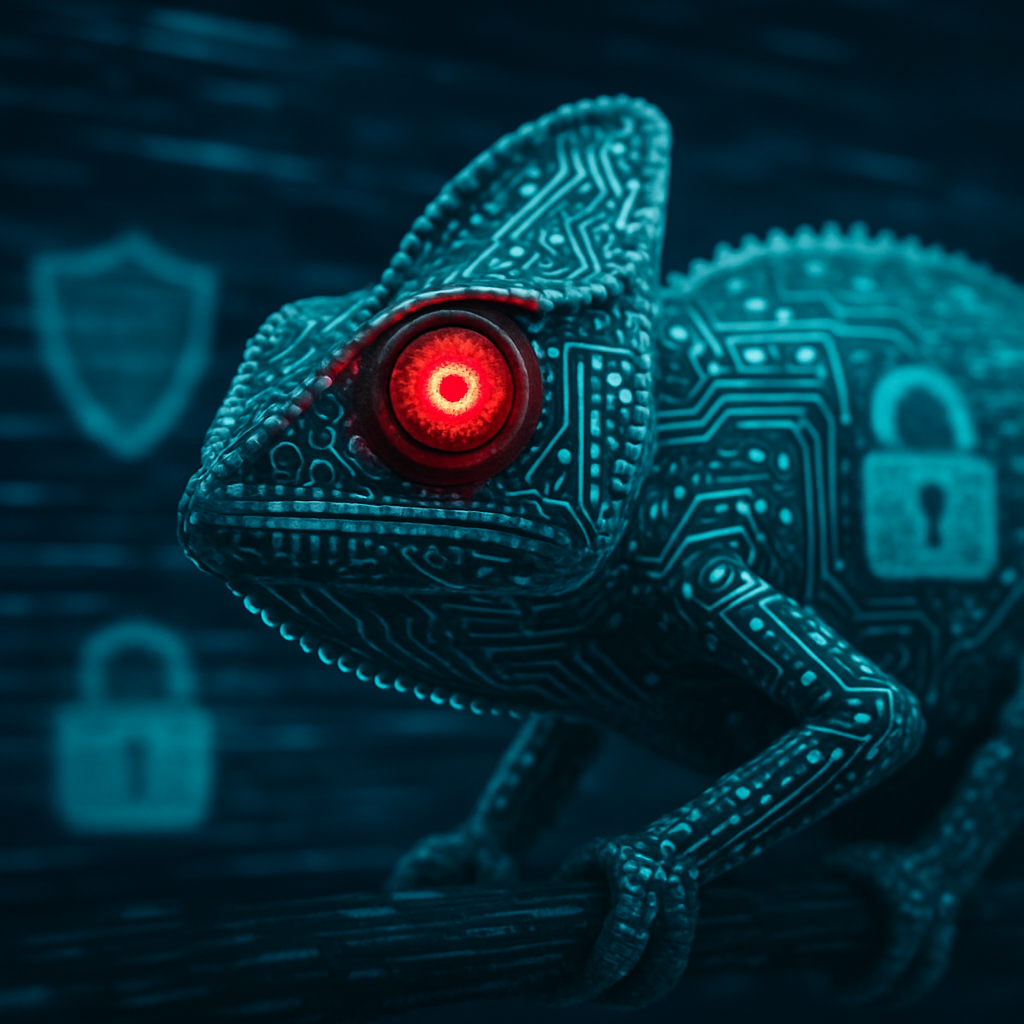
Imagine if every time you looked at a criminal's mugshot, they had a completely different face. New hair, new build, new fingerprints. Now imagine trying to stop them from sneaking into your home or business when their appearance changes every few minutes.
That’s exactly what polymorphic malware is doing—only it doesn’t need a disguise kit. It uses artificial intelligence to mutate itself faster than traditional defenses can keep up.
What Is Polymorphic Malware?
At its core, polymorphic malware is malicious code that constantly rewrites parts of itself to avoid detection. We're not talking about random scrambling. We're talking about AI-guided adaptation, where the malware can analyze its environment, learn how it's being detected, and evolve in real time.
This isn’t science fiction. Threat actors are already using machine learning to generate new payloads, rotate encryption techniques, and adjust behavior to mimic legitimate software. It's like a malware version of a chameleon that also happens to be a chess grandmaster.
Why Traditional Security Struggles
Most antivirus software and endpoint protection systems rely on signatures and behavioral heuristics. That means they’re trained to recognize patterns—the digital fingerprints of known threats.
But when the malware can constantly regenerate those fingerprints, every new variant looks like something “new.” Even behavior-based detection can be thrown off when AI helps the malware simulate safe, system-approved processes.
It's like training a guard dog to bark at intruders... and then the intruder learns to meow like a cat.
Real-World Examples
We've already seen early forms of this with Emotet and TrickBot, which altered their structure frequently to bypass antivirus scans. But newer strains like BlackMamba and WormGPT-fueled payloads are taking it to another level. Some are even leveraging publicly available large language models to write or refactor their code dynamically.
And yes, that means even your defenses may be training the thing trying to break in.
How to Detect the Undetectable
So what now? If the malware keeps changing, how do we ever stop it?
- Focus on intent, not just identity.
- Instead of relying solely on what the malware looks like, start analyzing what it tries to do. Behavioral analytics, memory scanning, and anomaly detection platforms can help flag suspicious activity regardless of its signature.
- Implement zero trust principles.
- If your environment treats every user, device, and process as potentially hostile until proven otherwise, you're less likely to be caught off guard when a trusted process goes rogue.
- Use threat intel with ML-enhanced correlation.
- Feed your SIEM or XDR with up-to-date threat intelligence and use tools that can correlate indicators of compromise across environments. Even if the malware mutates, its goals and patterns often remain consistent.
- Monitor your EDR for “low and slow” behavior.
- Polymorphic malware often avoids noisy, fast-moving behavior. Look for unusual lateral movements, privilege escalations, and unexpected outbound traffic.
- Train your humans, not just your machines.
- Phishing is still the number one delivery vector. Your team is your last line of defense. If they know what to look for, the shape-shifting malware has a much harder time finding a foothold.
Where Do We go From Here
Polymorphic malware isn't just another blip on the cybersecurity radar. It's a sign that the age of static defenses is ending. The threats are learning and adapting—and so must we.
If you're still relying on signature-based detection alone, you're playing checkers in a world that just turned into chess... with AI as your opponent.
The good news? Humans still write the rules. But only if we choose to stay informed, adapt, and rethink what defense really means in an age of intelligent, evolving threats.
By Brad W. Beatty | @SecRebellion
Comments ()