

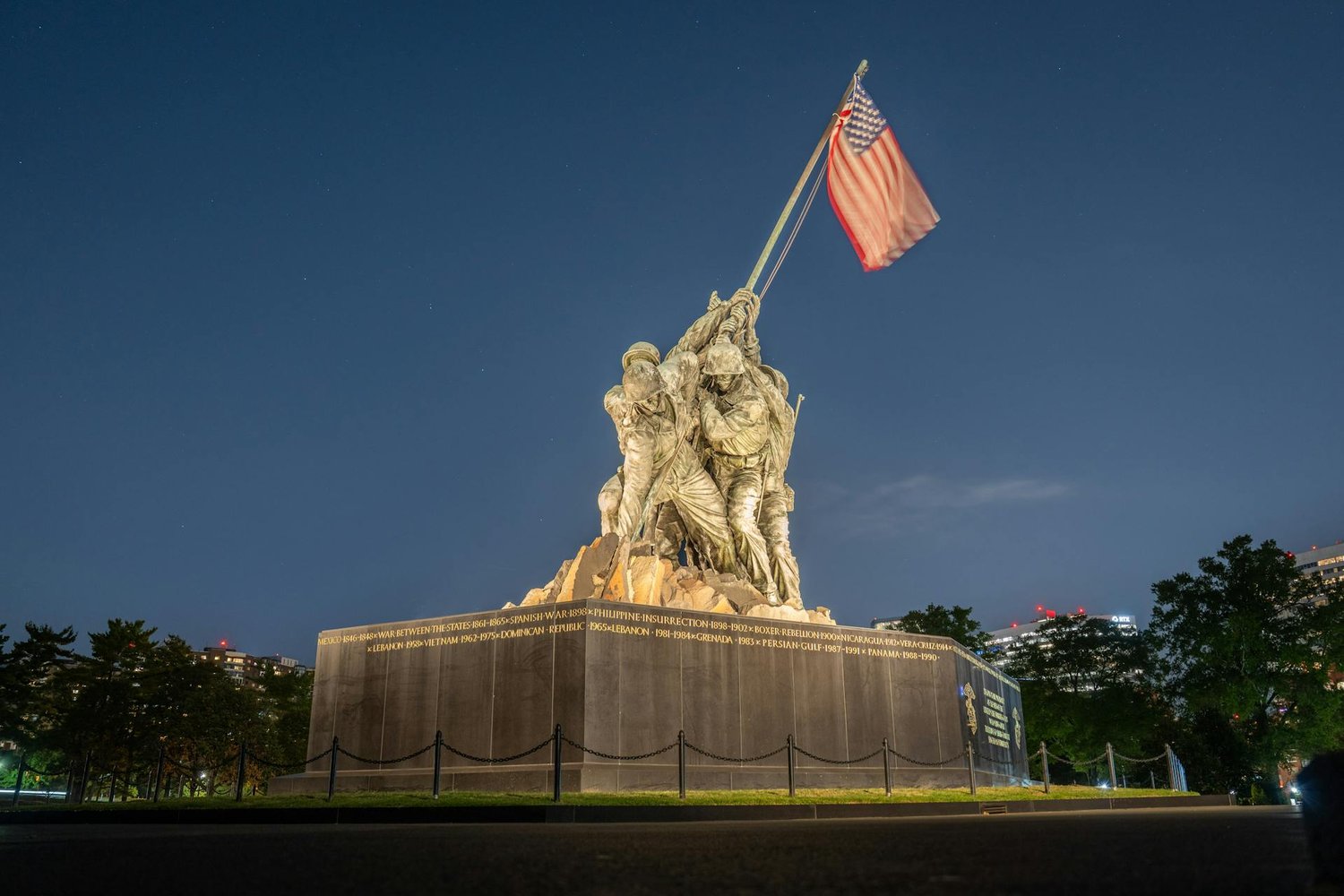
Most people, when they think of the Marine Corps, think of one thing. And while that one thing exists, it is far from the whole story — and perhaps not even the most important part of it. The version I want to share is about a young man who stepped off a bus at age seventeen and, without fully understanding what was happening, began one of the most extraordinary human educations available on this planet. That is the story I want to share.
The Marine Corps doesn’t recruit people. It selects them. And once selected, it throws them into the same crucible regardless of where they came from, what they believed, or who they were before they arrived. On day one, the person standing next to you might be a kid from the Mississippi Delta who grew up fishing on the same pond his grandfather fished. The person on your other side might be from a city so large it has more people than some countries. Within weeks, both of them become essential to your survival. There is no faster way to truly know a human being.
A World in Uniform
What most people don’t appreciate about military service is the sheer diversity of personality it assembles under one roof. I have known men who were poets in disguise — who could quote Hemingway from memory and then, in the same breath, fix a diesel engine with their bare hands and a piece of wire. I have served alongside the loudest human beings I will ever meet in my life and alongside others who could go an entire week speaking fewer than fifty words, yet communicate everything necessary through posture, expression, and a single glance across a dark room.
You learn, quickly, that personality is not cosmetic. It is structural. It is load-bearing. The man who jokes through every difficult moment isn’t avoiding reality — he is managing it, holding it at a distance so the rest of the team can function. The quiet one isn’t cold — he is conserving. He is watching the angles everyone else has forgotten to watch. Being immersed in that spectrum of humanity reshapes how you see people forever. You stop reducing them to first impressions. You start reading deeper.
“You stop reducing people to first impressions. You start reading deeper — the body, the breath, the pause before the word.”
The Education of the Road
Service took me to places I had no business being at that age. Standing in a market in one part of the world, surrounded by colors and sounds and smells that had no equivalent in my previous life, I understood for the first time that my understanding of normal was just one chapter of a very long book. Across different cultures, I watched how people use their hands when they speak — and how much they say without speaking at all.
Body language became a language I studied the way others study French. In some cultures, sustained eye contact signals respect and directness. In others, it signals aggression or social intrusion. A smile doesn’t mean the same thing everywhere. Proximity, touch, the pace of a conversation — all of it carries meaning, and all of it varies wildly depending on where in the world you’re standing. The Marine Corps made me a student of human beings by necessity. You cannot operate effectively alongside people whose signals you cannot read. So you learn to read them. You learn to slow down and observe before you react. That skill, it turns out, doesn’t retire when you do.
There is something profoundly humbling about traveling to places where your values, your assumptions, and your reference points are completely irrelevant. It doesn’t break you. It expands you. You come home with a wider frame — a longer view of what it means to live well, to treat people well, to understand that there are a thousand ways to move through a life with dignity.
Brothers for Life
People use the word “friend” casually, and I understand why. But I want to be precise about something: the bonds forged in military service are a different category of relationship. They are not built on shared interests or proximity or convenience. They are built in the fire. They are built at the exact moment when everything is going wrong and the person next to you doesn’t leave.
There are men I served with decades ago whom I have not seen in years, and who would still, without question, show up if I called. Not because of obligation. Not because of nostalgia. Because of something that happened between us that can’t be undone — a mutual witness to each other’s truest selves. I have seen these men pushed to their absolute limits. I have been pushed there alongside them. I have watched them be kind in moments when kindness took more courage than anything else. I have laughed with them until I couldn’t breathe, in the most absurd circumstances imaginable, because sometimes laughter is the only architecture left standing.
These are not people who would give you their last dollar. These are people who would give you something worth considerably more than money. That knowledge — that there are people on this earth for whom your life genuinely matters — is not something you take for granted once you’ve experienced it.
“I have seen these men pushed to their absolute limits. I have been there alongside them. And I have watched them be kind in moments when kindness took more courage than anything else.”
Twenty-Four Hours of Everything
One of the stranger gifts of that life is what it does to your emotional range. On a given day — a single, twenty-four-hour day — you might experience genuine unease and genuine hilarity, deep boredom and sudden, electric aliveness, the particular ache of missing home and the specific exhilaration of being exactly where you are. Sadness and laughter can exist within hours of each other. Not because you are broken, but because the situation demands all of you, all the time.
Most people spend years trying to feel more. They read books about it, go to workshops about it. Marines don’t seek the full spectrum of emotion — it simply arrives. And after enough time living that way, you develop a kind of emotional fluency that is hard to describe. You become less afraid of your own feelings because you’ve already moved through them all. You know that difficult moments pass. You know that sadness, as heavy as it feels, eventually gives way to something else. You know that joy is not a destination — it flares up, often without warning, in the least expected places.
What Seventeen Knows
Perhaps the most unusual thing about enlisting young is this: you are asked to reckon with mortality before your brain has fully formed. At seventeen, at eighteen, most people are thinking about the weekend. A young Marine is quietly absorbing the reality that life is finite, that time is not guaranteed, and that the world is far larger and more serious than anything a classroom could have conveyed. That is not an abstraction. You know it. You sit with it. And then — because there is nothing else to do — you get up and move forward anyway.
I have thought about death more carefully, more honestly, and more often than most people twice my age were asked to at the time I was first asked. And I believe — genuinely believe — that this is not a trauma but a kind of clarity. When you’ve looked at the hard limit of life and chosen to show up anyway, you stop wasting time on things that don’t matter. You stop postponing what’s important. You stop assuming there’s always more time. That relationship with mortality, that early and intimate understanding of impermanence, has shaped every significant decision I’ve made since I first walked through those gates as a teenager who thought he knew what he was getting himself into.
He didn’t. But he became someone who did. And for that, I am more grateful than I have words for.
— ★ —
The Marine Corps is many things to many people. To me, it was a masterclass in the human condition — messy, beautiful, terrifying, and ultimately irreplaceable.