

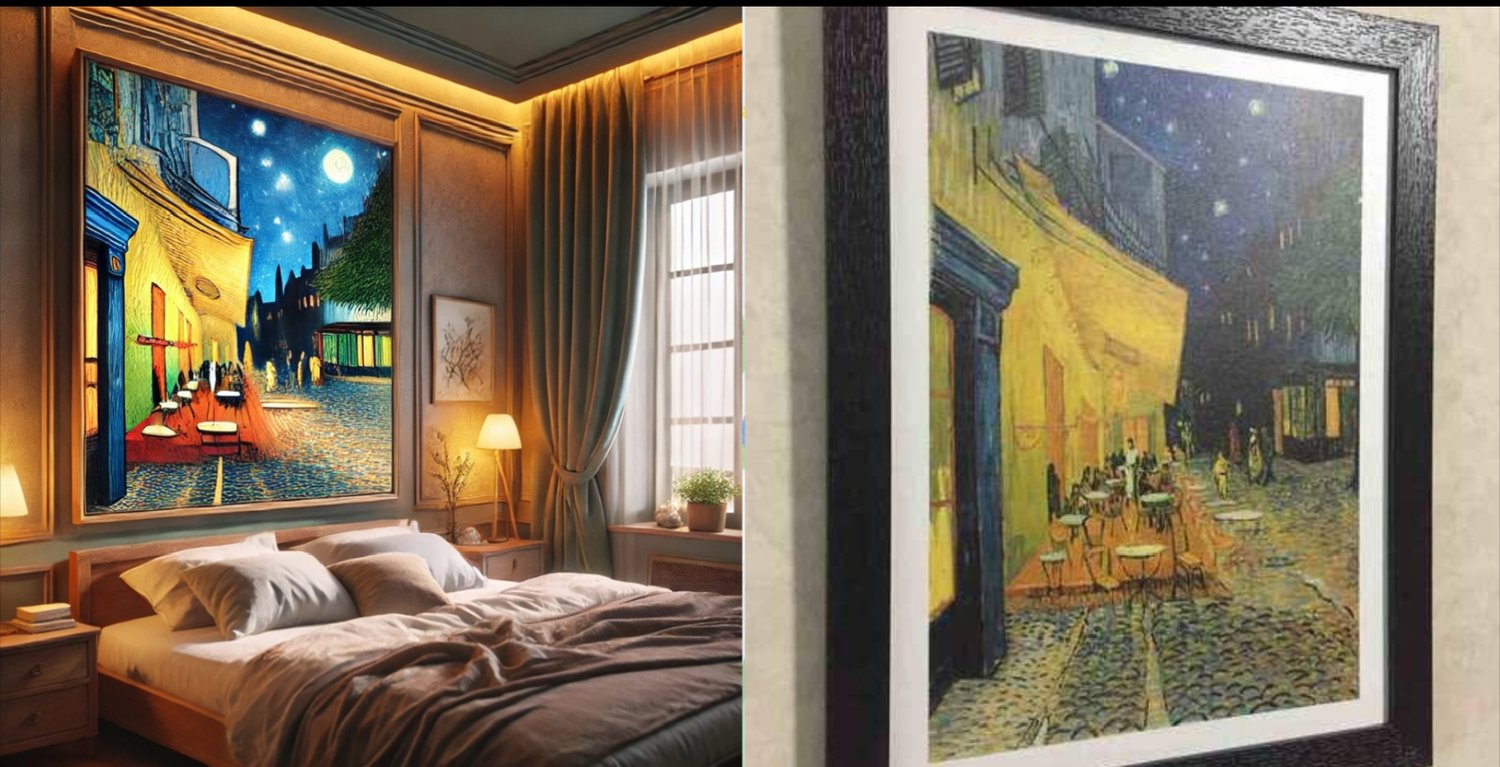
The original painting was created in 1888 and depicts a night scene of a café in Arles, France, illuminated by warm yellow light, with a cobblestone street under a starry sky.
It's one of Van Gogh’s most famous works, showcasing his signature bold colors and expressive brushstrokes.
Café Terrace at Night is one of Vincent van Gogh’s most iconic paintings, completed in 1888 while he was in Arles, France. Here are some interesting details about it:
1. Location & Inspiration
Van Gogh painted this scene from a real-life café in Place du Forum, Arles. The café still exists today and has been renamed Café Van Gogh in his honor.
2. Unique Use of Color
Unlike many night scenes painted at the time, Van Gogh did not use black for the night sky. Instead, he used deep blues and purples, contrasting them with the warm yellow and orange glow of the café's light. This technique enhances the painting’s vibrancy.
3. The Starry Sky
The painting features a star-filled sky, foreshadowing Van Gogh’s later masterpiece, The Starry Night. Astronomers have analyzed the positions of the stars and determined that the scene was painted around September 16, 1888.
4. Nocturnal Painting Without Black
Van Gogh described his approach in a letter to his sister, stating that he wanted to create a "night scene without using black" by relying on color contrasts instead. This was groundbreaking for its time.
5. Hidden Religious Themes?
Some art historians believe Van Gogh may have subtly referenced The Last Supper in the painting. The café has twelve seated figures (symbolizing the apostles), and a central figure bathed in light (representing Jesus). The dark doorway in the background could symbolize Judas. However, Van Gogh never confirmed this theory.
6. Artistic Style
The painting is a blend of Post-Impressionism and Expressionism, with bold colors, thick brushstrokes, and
a dreamlike atmosphere.