

Every person procrastinates at some point.
Sometimes it looks harmless.
You tell yourself:
- “I’ll start tomorrow.”
- “I still have time.”
- “I work better under pressure.”
- “Let me just relax first.”
At first, these thoughts feel normal. Reasonable, even.
But procrastination rarely stays small.
What begins as delaying one task slowly becomes a habit. That habit starts affecting your stress levels, your confidence, your opportunities, your productivity, and eventually your future.
The dangerous thing about procrastination is that it usually doesn’t destroy your life overnight. Instead, it works quietly. Gradually. Repeatedly.
A missed opportunity here.
A delayed dream there.
An unfinished goal.
A growing sense of frustration.
Over time, the life you imagined for yourself starts feeling farther away, not because you’re incapable, but because action keeps being postponed.
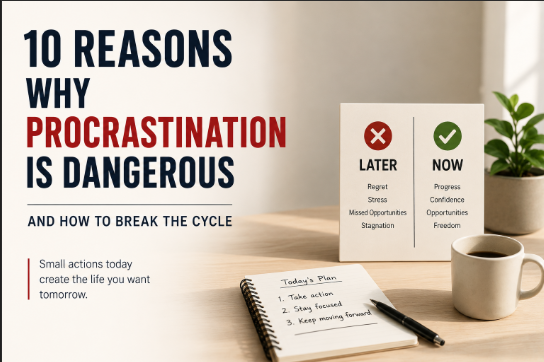
This article explores 10 powerful reasons why procrastination is dangerous, along with practical ways to finally break the cycle and regain control of your time, focus, and direction.
What Is Procrastination, Really?
Procrastination is more than laziness.
In many cases, people procrastinate because:
- They feel overwhelmed
- They fear failure
- They want perfection
- They lack structure
- They feel mentally exhausted
- They don’t know where to start
The problem is that procrastination gives temporary comfort while creating long-term discomfort.
You feel relief now by avoiding the task, but later, you pay for that delay through stress, panic, guilt, and lost opportunities.
1. Procrastination Creates Constant Stress
One of the biggest misconceptions about procrastination is that delaying work reduces pressure.
In reality, it increases it.
When something important remains unfinished, your mind continues carrying it in the background. Even when you’re relaxing, part of your brain is reminding you:
“You still haven’t done it.”
You’re lying in bed scrolling through your phone, trying to relax after a long day. But you remember there’s an important assignment, presentation, business proposal, or email you still haven’t completed.
You try to ignore it.
But the thought keeps returning.
Instead of enjoying your rest, you experience low-level anxiety the entire time.
That’s the hidden psychological cost of procrastination.
The task doesn’t disappear. It follows you mentally.
2. It Turns Small Tasks Into Big Problems
Most tasks are easier at the beginning.
Procrastination changes that.
The longer you avoid something, the more mentally overwhelming it becomes.
You decide not to reply to a few messages or emails immediately because you’re tired or busy.
A day passes. Then another.
Suddenly there are dozens of unread messages. Now responding feels stressful because the task has grown emotionally larger than it actually is.
This is how procrastination traps people:
- Small delay
- Increased pressure
- More avoidance
- Bigger stress
- Even more delay
3. It Lowers the Quality of Your Work
Good work requires time:
- Time to think
- Time to revise
- Time to improve
- Time to correct mistakes
When procrastination steals that time, quality suffers.
You had two weeks to prepare a presentation, but you delayed until the final night.
Now you’re rushing:
- Copying information quickly
- Skipping revisions
- Ignoring details
- Hoping it’s “good enough”
When it’s finally done, you know deep down that it doesn’t represent your real potential.
That’s one of the most frustrating consequences of procrastination:
You begin producing below your actual capability.
4. It Damages Your Reputation
People may not always remember every detail of your work, but they remember reliability.
Consistency builds trust.
Procrastination weakens it.
At work or school, you’re known as the person who always finishes tasks at the last minute.
Even if you eventually complete them, people begin associating you with:
- Pressure
- Delays
- Stress
- Unpredictability
Meanwhile, someone else who consistently prepares early becomes trusted with greater opportunities.
In many environments, reliability matters just as much as talent.
5. It Keeps You Stuck While Others Move Forward
The world rewards execution.
Ideas are valuable, but action is what creates results.
You’ve been wanting to:
- Start a business
- Launch a YouTube channel
- Write a book
- Learn a skill
- Apply for opportunities
But you keep waiting:
- Waiting for motivation
- Waiting for confidence
- Waiting for perfect timing
Meanwhile, someone else starts before feeling fully ready.
They make mistakes.
They learn.
They improve.
And eventually, they succeed.
Not because they were more talented, but because they acted sooner.
6. It Increases Your Chances of Failure
When you procrastinate, you reduce your preparation time.
Less preparation means:
- More mistakes
- More pressure
- Less confidence
- Lower performance
A student waits until the night before exams to study.
While reviewing, they realize there are important concepts they don’t understand. But now there’s no time left to properly learn them.
The failure didn’t happen because the student lacked intelligence.
It happened because procrastination removed the time needed to improve.
7. It Slowly Destroys Your Confidence
Confidence is built through self-trust.
And self-trust grows when you consistently follow through on your commitments.
Procrastination does the opposite.
You repeatedly tell yourself:
- “I’ll wake up earlier.”
- “I’ll start exercising.”
- “I’ll work on my goals tonight.”
But the action never happens consistently.
After enough repetition, something dangerous happens:
You stop believing yourself.
That loss of self-trust affects every area of life.
8. It Kills Momentum
Momentum is powerful.
Once you’re consistently moving forward, continuing becomes easier.
But procrastination interrupts that flow.
You begin studying consistently for several days. You feel productive and motivated.
Then one day you skip.
That one missed day turns into several.
Now restarting feels difficult again, even though continuing would have been easier.
This is why consistency matters more than intensity.
Small daily progress is stronger than occasional bursts of motivation.
9. It Wastes Time Quietly
Most people don’t lose time dramatically.
They lose it gradually.
Five minutes here.
Twenty minutes there.
An hour scrolling social media.
Another evening saying “I’ll do it tomorrow.”
You check your phone briefly before starting work.
Suddenly:
- One video becomes ten
- Ten minutes become an hour
- Your energy decreases
- Your focus disappears
By the time you’re ready to work, you feel mentally drained.
Procrastination often disguises itself as harmless distraction.
10. It Disconnects You From Your Goals
Your future is shaped by repeated daily actions.
Not intentions.
Not wishes.
Not plans alone.
You dream about:
- Financial freedom
- Career success
- Personal growth
- Better health
- A better life
But your daily habits don’t support those goals consistently.
Eventually, the distance between where you are and where you want to be becomes painful.
The longer procrastination continues, the wider that gap grows.
How to Break the Cycle of Procrastination
The good news is this:
Procrastination is not permanent.
It’s a behavioral pattern, and patterns can be changed.
The key is not relying purely on motivation. Motivation is temporary.
You need systems that make action easier.
1. Break Big Tasks Into Small Steps
Large tasks create mental resistance.
Smaller tasks feel manageable.
Instead of saying:
“I need to build my business.”
Break it into:
- Register the business name
- Create a logo
- Contact one supplier
- Design a simple website
- Make one sales post
Small actions create momentum.
2. Stop Saying “Later”
“Later” is one of procrastination’s favorite words because it has no structure.
Replace vague intentions with specific scheduling.
Instead of:
“I’ll study later.”
Say:
“I’ll study from 7 PM to 8 PM.”
Specific time creates accountability.
3. Use the 5-Minute Rule
Starting is usually harder than continuing.
Tell yourself:
“I’ll only do this for five minutes.”
Relatable Situation
You don’t feel like working, but you begin anyway.
After five minutes, your resistance decreases—and you continue longer than expected.
Action often creates motivation.
4. Remove Distractions Intentionally
Your environment affects your behavior more than you think.
Relatable Situation
You try to focus while:
- Notifications keep appearing
- Social media is open
- The TV is running
- Your phone is beside you
Focus becomes difficult.
Successful productivity often comes from removing distractions—not increasing effort.
5. Plan Your Day Ahead of Time
When you wake up without direction, procrastination fills the gap.
You spend the morning deciding what to do instead of actually doing anything productive.
Planning ahead removes unnecessary decision-making.
6. Create Accountability
People tend to follow through more when someone else expects results.
When you work alone, it’s easier to delay.
But when:
- A client expects delivery
- A coach checks progress
- A partner depends on you
You’re more likely to act.
Accountability creates pressure in a productive way.
7. Reward Progress
Your brain responds to positive reinforcement.
After completing important work, you:
- Take a short break
- Watch something enjoyable
- Spend time relaxing
This creates a healthier relationship with productivity.
8. Stop Waiting for Perfect Conditions
Perfectionism fuels procrastination.
Many people delay because they want:
- Perfect timing
- Perfect ideas
- Perfect confidence
But progress rarely begins perfectly.
Someone delays starting a business because everything isn’t “ready.”
Another person starts small, learns through experience, and improves over time.
Action beats perfection.
9. Change Your Identity
Your habits are connected to how you see yourself.
Instead of saying:
“I’m lazy.”
Start saying:
“I’m becoming someone who takes action consistently.”
Identity shapes behavior.
10. Track Your Progress
Visible progress increases motivation.
When you see completed tasks, study hours, workouts, or business growth, you feel encouraged to continue. At NTKay website, you will find varieties of free downloadable e-books and template that could help you plan and keep track.
Progress creates momentum.
Final Thoughts
Procrastination is dangerous not because of one delayed task, but because of repeated delayed action over time.
Every day you postpone:
- You delay progress
- You delay growth
- You delay opportunities
- You delay the life you want
The difference between successful people and stuck people is often simpler than most imagine.
It’s not always intelligence.
It’s not always talent.
It’s not always resources.
Very often, it’s execution.
The people who move forward are usually the people who act consistently, even when they don’t feel like it.
You do not need to change your entire life overnight.
Start small.
Start imperfectly.
Start before you feel fully ready.
But most importantly:
Start.
Comments ()