
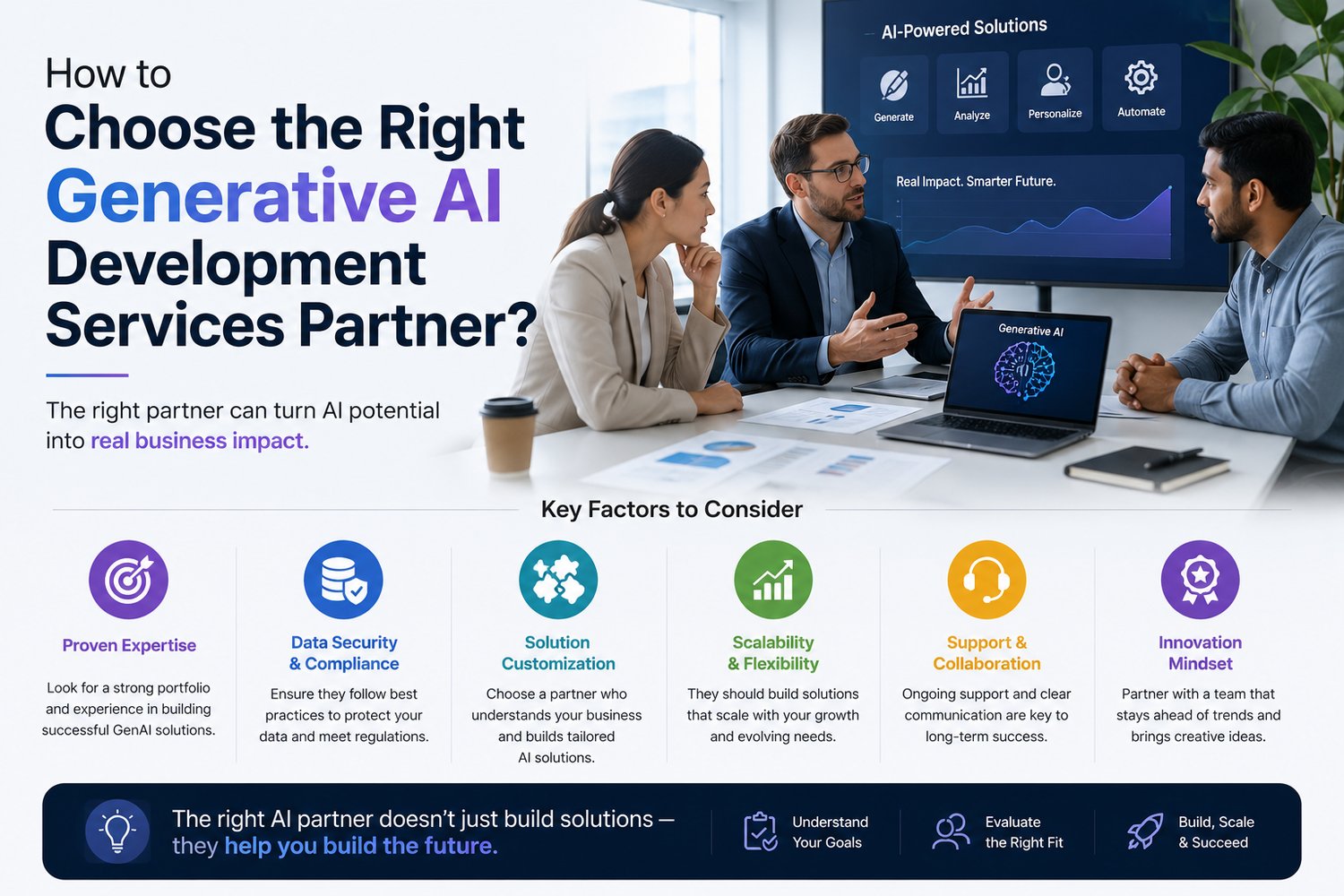
They show a slick demo, use all the right phrases, and speak confidently about agents, copilots, and automation. The real test comes later, when the project needs clean data handling, working integrations, and a team that can deal with messy business rules without falling apart. That is where generative ai development services partners separate themselves.

The right partner does more than build a prototype. They help you ship something that works inside your actual systems, with your data, and under your security rules. That is the standard that matters.
What should you look for first?
Start with proof, not promises. A solid Generative AI Development Services partner should be able to show live deployments, not just a slide deck with mockups. Ask what went to production, what failed in testing, and what changed after launch. Partners with real delivery experience usually talk about latency, retrieval quality, data boundaries, and user adoption because those are the things that break projects in the real world.
You should also ask for case studies with numbers attached. Not “improved efficiency,” but how long a workflow took before and after, how many users adopted it, or how much support load dropped. That level of detail tells you the team has measured outcomes, not just activity.
Can they work with your industry?
A general AI team can build a demo for almost anything. The better question is whether they understand the rules and habits of your industry. A healthcare partner needs to think about patient data, audit trails, and clinical language. A fintech partner needs to know about fraud patterns, compliance review, and low tolerance for wrong answers.
That difference shows up fast during discovery. Good teams ask about your edge cases early. They want sample documents, approval flows, exception handling, and the places where humans still need to review outputs. If they skip that and jump straight to model choice, they may be more interested in selling a framework than solving your problem.
How deep is their technical stack?
A useful partner should know the full path from data to deployment. That means data engineering, model selection, prompt design, retrieval methods, testing, MLOps, and integration with your existing apps. If they only talk about the model and ignore the plumbing, the project will likely stall once it meets real systems.
Ask what cloud tools they actually use, how they monitor performance, and how they handle versioning. A serious partner can explain how they manage evaluation sets, rollbacks, and output checks once the system is live. That matters because Generative AI Development Services are rarely “set it and forget it.” They usually need tuning after the first wave of users starts giving feedback.
Do they think about security early?
Security should not be a final review step. It needs to show up in the first few calls. A good vendor should be clear about data residency, access control, audit logs, and whether your data can be used to train anything outside your environment. If they get vague here, that is a warning sign.
This is especially true for regulated industries and internal knowledge systems. One team I saw had a polished assistant ready to launch, then discovered it was pulling from documents that had never been cleared for broad employee access. That kind of mistake is avoidable, but only if the partner asks the right questions before building.
How do they handle proofs of concept?
A demo is not a proof of concept. A real PoC uses your data, your use case, and a clear scorecard. The partner should agree on success metrics before any build starts. Accuracy, response time, cost per request, and failure rate are all more useful than vague comments about “good results.”
The best teams keep PoCs tight. They test one workflow, one user group, and one success path first. That makes it easier to spot where the system fails. It also stops the project from turning into a long experiment with no decision point. When Generative AI Development Services are being sold well, the PoC is used to answer one question: Should this move forward or not?
What do they do after launch?
A partner worth hiring does not disappear after go-live. They should have a plan for monitoring, feedback loops, model updates, and incident handling. Generative systems drift. User behavior changes. Documents change. Prompts that worked in week one can get noisy by week six.
Ask how they track quality over time. Do they sample outputs? Do they log failures? Do they have a way to flag hallucinations, stale answers, or bad retrievals? These are basic questions, but many vendors only think about them after the first complaint from users. That is usually too late.
How do you judge communication?
Technical skill matters, but communication is what keeps the project moving. A strong partner gives straight answers, admits trade-offs, and says when something is risky. That sounds simple, but it is one of the easiest ways to tell whether you are dealing with adults or sales talk.
Pay attention to how they respond when you ask hard questions. If they promise perfect accuracy, instant timelines, and low cost all at once, they are probably overselling. Real teams talk about constraints. They explain what can be done now, what needs more data, and what should wait until the system has user feedback. That honesty saves time later.
What should the contract actually cover?
The paper matters because AI projects tend to drift. Your contract should spell out ownership of data, model outputs, documentation, security responsibilities, and what happens if the project needs to change direction. It should also cover support after launch, not just build time.
You should know who owns the prompts, the retrieval setup, the evaluation harness, and the integration code. If those things are left vague, it becomes messy the moment you switch vendors or expand the use case. Good Generative AI Development Services partners are usually comfortable with this conversation because they expect a project to grow beyond the first version.
What red flags show up early?
A few signs usually save teams from bad hires. Be careful if the partner talks only in buzzwords and gives no concrete example of a live system. Be careful if they avoid discussing security or say compliance can be dealt with later. Be careful if they cannot explain how they test output quality before launch.
Another warning sign is a team that says yes to everything. Good partners push back when the use case is messy or the timeline is too tight. That does not mean they are difficult. It usually means they understand what it takes to make the system work in production.
What makes the right partner worth it?
The right partner lowers the amount of guesswork. They help you narrow the use case, choose the right model path, set realistic expectations, and avoid rework. That can save months. It can also keep a project from turning into a half-built internal tool no one uses.
The best Generative AI Development Services teams think like builders, not presenters. They care about fit, failure modes, and what happens after the first demo. That is the kind of partner that usually gets a system into real use.