
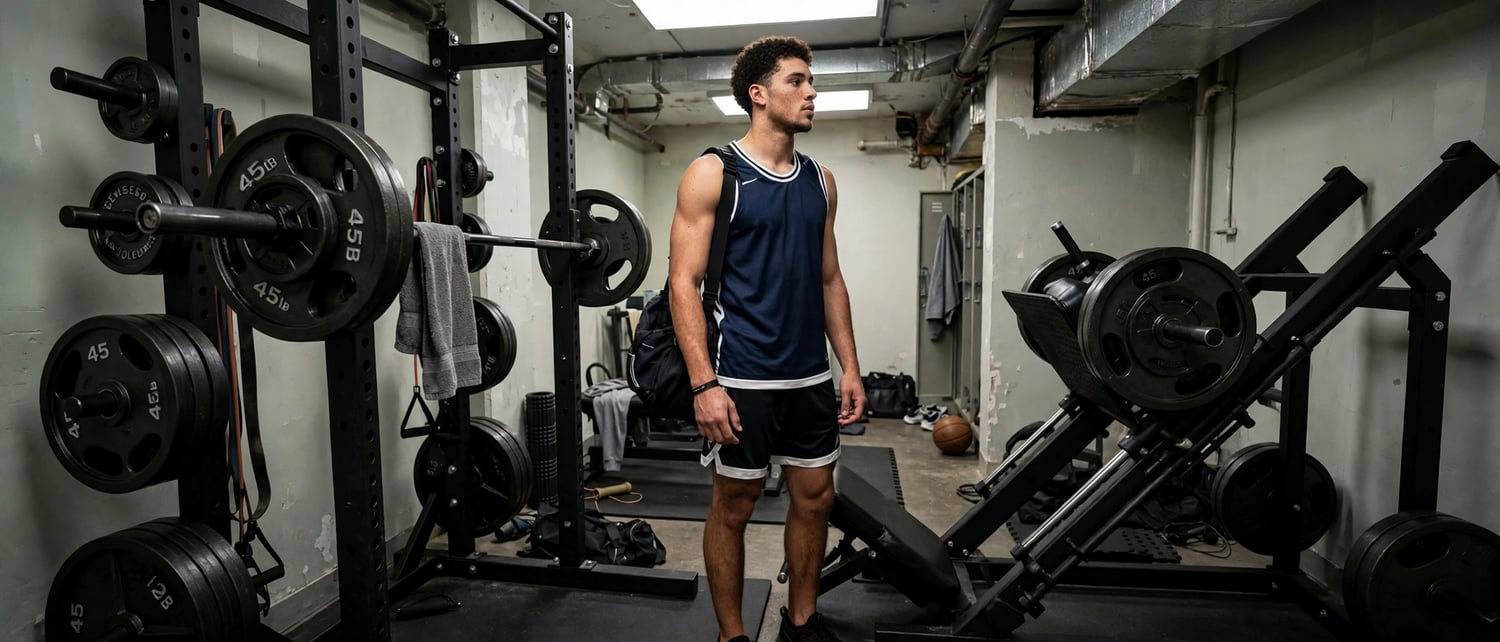
When I was working with the men's basketball team at Murray State, we didn't have a lot of space to work with.
That's small-school / small-room reality. You don't get to run the perfect program. You run the program that fits the room, the equipment, and the number of athletes you have to get through it.
So for our main lower-body lift, I gave them a choice. You could squat, or you could leg press. Either one was fine with me. Pick the one you were going to do, get good at it, and we'd build from there.
But I told them one thing up front:
Pick one, and stick with it. Don't switch it up in-season.
One young man had been leg pressing for a number of weeks. He was in a groove. His body had adapted to it. Then one session, the leg press was taken, and he didn't want to wait for it to open up.
So he squatted instead.
Just for that session. No big deal, right?
And here's the part that fooled him — he squatted with ease. The workout itself went fine. He handled the weight, got through the session, and probably walked out thinking I had been making too big a deal out of it.
Then the soreness hit.
He was extremely sore for the next week. Not sore for a day. Not a little stiff the next morning. A full week of it, in the middle of a basketball season — which I'm sure interrupted his practice, because that's exactly what that kind of soreness does. It changes how you move, how you cut, how you get up and down the floor. You don't get quality reps when every step is a reminder of a workout you did three days ago.
I knew the consequences were coming. He had to learn it the hard way.
**Similar Is Not the Same**
This is the part a lot of coaches miss.
Squats and leg press both train the legs. On paper, they look interchangeable. In real life, to an athlete's body in the middle of a season, they are not the same exercise.
A new exercise is a new stimulus — different positions, different demands, different soreness — even when it works the same muscles. Your body adapts to what you *actually do*, week after week. The first time you change it, you pay for it. And in-season, you don't pay for it in the weight room.
You pay for it in practice.
**In-Season, Lifting Is Not the Main Event**
That's the lesson underneath the story, and it's the one I think a lot of coaches still need to learn:
In-season, lifting is not your main focus.
Your job in-season is to keep your athletes strong and healthy so they can practice, and so they can get better at their skill. Practice is the main event. Games are the main event. The weight room exists to support that — not compete with it.
The minute a workout steals a week of good practice from a player, that workout didn't help him, no matter how good it looked on paper.
**So Change This, Not That**
That doesn't mean in-season training is frozen. It means you change the right things.
Change the sets. Change the reps. Change the volume. Change the intensity. Light week, heavy week, travel week, bye week — adjust all of that as the season demands it.
What you don't change is the exercises themselves.
Lock the menu in before the season starts, let your athletes adapt to it, and then spend the whole season getting the most out of it instead of restarting the soreness cycle every time somebody gets bored, or impatient, or doesn't want to wait his turn.
Save the new exercises for the off-season, when you have time to introduce them, progress them, and be sore without it costing anybody practice.
**The Bottom Line**
He didn't get hurt. He didn't do anything crazy. He just swapped one leg exercise for another because he didn't want to wait — and it cost him a week.
That's how small this decision looks, and how big the consequences can be.
In-season, consistency isn't boring. Consistency is what keeps your athletes available. And available athletes get better at their sport.
Pick your exercises. Stick with them. Keep them strong, keep them healthy, and let them go practice.