

If you have just started learning Japanese, chances are you have already run into a massive roadblock: Japanese particles.
Unlike English, where word order does the heavy lifting, Japanese relies on small, single-syllable suffixes attached to words to show their grammatical role in a sentence. It sounds intimidating, but think of them as the glue holding your Japanese sentences together.
If you are struggling to figure out when to use wa (は) versus ga (が), or wondering why some places use ni (に) while others use de (で), you are in the right place. In this guide, we will break down the core beginner particles and show you how to finally master them with ease!

Why Japanese Particles Feel So Confusing (And How to Fix It)
When English speakers start studying Japanese, they often try to translate particles directly into English prepositions or articles. Unfortunately, this doesn't work.
For example, both ni and de can sometimes translate to "in" or "at" in English, but they mean completely different things in Japanese context. Trying to memorize dry grammar rules from a textbook often leads to burnout and second-guessing every sentence you write.
The secret to conquering Japanese grammar isn't memorizing more lists—it is understanding how native speakers perceive relationships between words.
The Big 5 Beginner Particles Decoded
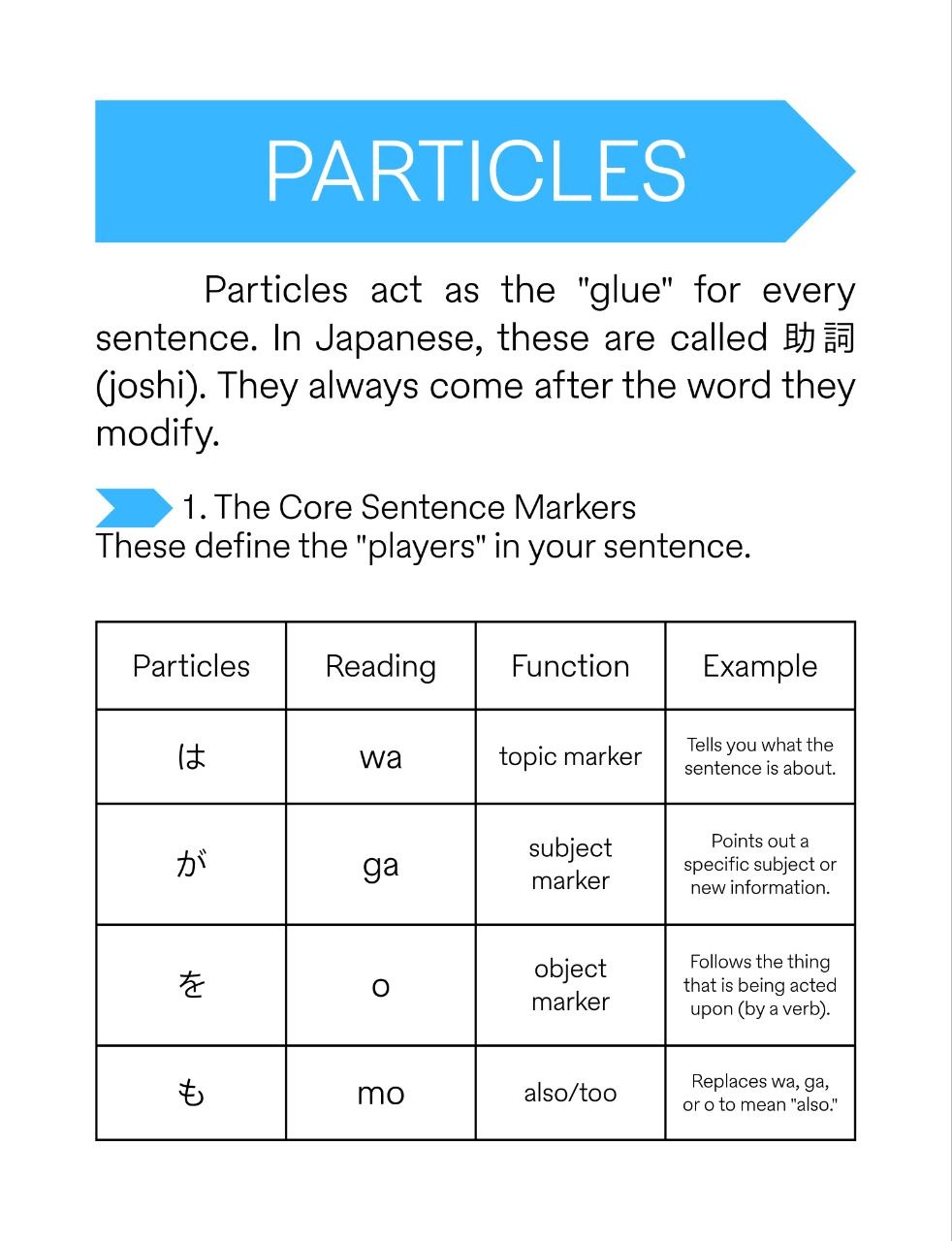
To help you build a solid foundation, here is a quick breakdown of the essential particles every beginner needs to know:
1. The Topic Marker: Wa (は)
- What it does: Marks the main topic of the sentence (what you are talking about).
- Example: Watashi wa gakusei desu. (As for me, I am a student.)
- Pro-Tip: Remember that even though it is spelled with the hiragana he (は), it is always pronounced wa when used as a particle.
2. The Subject Marker: Ga (が)
- What it does: Highlights the specific subject performing an action or possessing a trait, often introducing new information or emphasis.
- Example: Ame ga furimasu. (It is raining / Rain falls.)
3. The Direct Object Marker: O (を)
- What it does: Marks the direct object receiving the action of the verb.
- Example: Ringo o tabemasu. (I eat an apple.)
- Pro-Tip: Pronounced simply as o, it is rarely used outside of its grammatical particle role in modern Japanese.
4. The Destination / Time Marker: Ni (に)
- What it does: Points to a destination, a target of movement, or a specific point in time.
- Example: Tokyo ni ikimasu. (I am going to Tokyo.)
5. The Location of Action Marker: De (で)
- What it does: Indicates where an action takes place, or the means/tool used to do something.
- Example: Uchi de tabemasu. (I eat at home.)
Stop Struggling and Master Japanese Grammar Today
Understanding the theory is just the first step. To truly speak and write natural Japanese, you need clear explanations, practical examples, and bite-sized exercises that actually stick.
If you want to fast-track your Japanese learning and stop guessing your particles, check out our complete beginner-friendly guide:
Our comprehensive downloadable PDF is designed specifically for absolute beginners who want to master Wa, Ga, O, Ni, De, and more without the confusion. It includes:
- Clear, plain-English explanations that cut through confusing grammar jargon.
- Real-world examples you can start using immediately in conversations.
- Practice exercises to test your knowledge and build absolute confidence.
Grab your digital copy today on Payhip and take the frustration out of learning Japanese!