
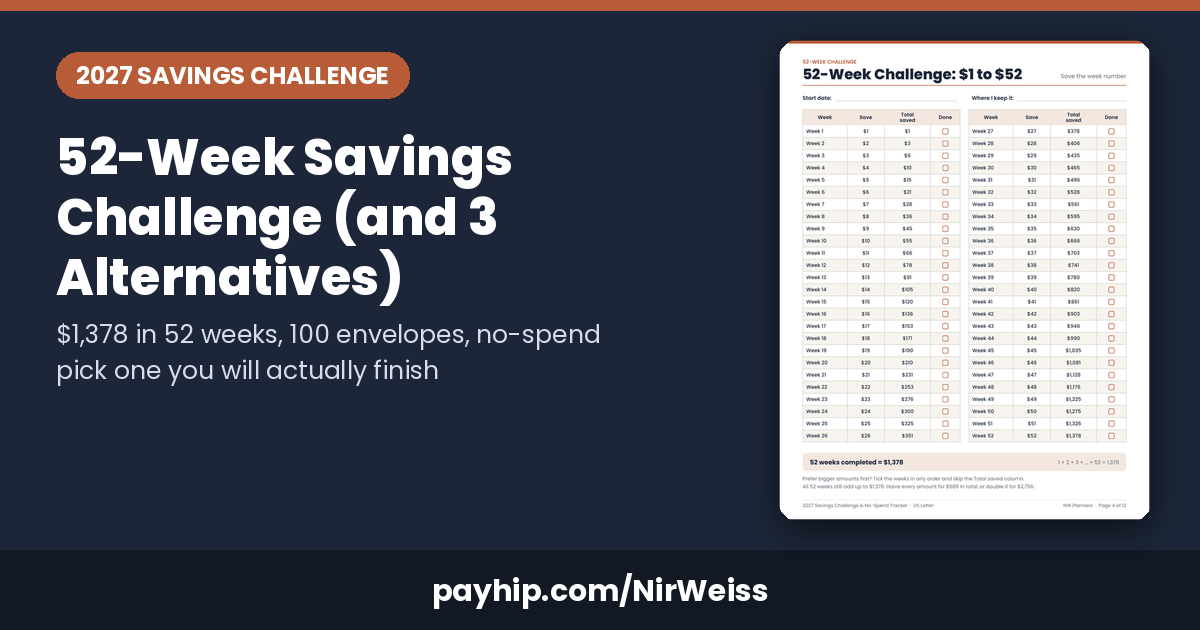
Savings challenges are popular every January for a simple reason: they turn "save more" into something you can tick off. The catch is that most people pick the first challenge they see, find out in month three that it doesn't fit their pay or their bills, and quietly stop.
This post walks through the classic 52-week challenge, a reverse version, the 100-envelope challenge and a no-spend challenge, then shows how to pick the one that fits your income and paydays. All amounts are in dollars, but read $1 as one unit of your own currency. Numbers are examples, not targets.
1. The classic 52-week challenge ($1 to $52)
The rule: in week 1 you save $1, in week 2 you save $2, and so on, until week 52 when you save $52. By the end of the year you've put aside $1,378 (1 + 2 + 3 + ... + 52 = 1,378).
Why it works: the first months are almost painless, so you build the habit before the amounts get noticeable. It averages $26.50 a week.
Where it gets hard: the end of the year. Weeks 49 to 52 alone add up to $202, and that lands in December, right when holiday spending peaks. That's the point where a lot of people drop out.
Want it smaller or bigger? Halve every amount for $689 in total, or double it for $2,756.
Want to try it? Download the free printable 52-week savings challenge for 2027, with every week's running total already filled in: https://payhip.com/b/tV9Co
2. The reverse 52-week challenge ($52 down to $1)
Same 52 numbers, opposite order: save $52 in week 1 and $1 in the last week. The total is still $1,378.
This version front-loads the effort into January and February, when motivation is highest and holiday spending is behind you. December becomes the easy part. If you know you tend to fade by autumn, reverse is usually the better pick.
A flexible middle ground: keep the 52 amounts but tick them off in any order. Save a bigger number in a good week and a small one in a tight week. You still end on $1,378, as long as every week gets ticked.
3. The 100-envelope challenge ($5,050)
Picture 100 envelopes numbered 1 to 100. Each time you save, you pick an envelope (at random, or whichever fits that week) and put in that amount. Fill all 100 and you've saved $5,050.
That is a much bigger goal than the 52-week challenge, and the pace matters a lot:
- One envelope a day takes 100 days and averages about $50 a day. That's a lot for most budgets.
- Two envelopes a week takes 50 weeks, averaging about $101 a week.
- The half version (save half of each number) totals $2,525.
It's a good fit if you have a specific larger goal, like an emergency fund or a car repair cushion, and enough room in your budget. If the daily version scares you, stretch it out rather than skip it.
4. The no-spend challenge
This one doesn't ask you to save a set amount. Instead, you pick days on which you buy nothing beyond essentials.
Two common formats:
- 30-day no-spend challenge: for one month, no non-essential spending at all. Before you start, write down what's allowed (rent, bills, groceries, fuel, medicine) and what's off for the month (takeaway, clothes, apps, "just browsing" orders).
- No-spend days: set a number of no-spend days per week or month, say two a week, and mark each one you hit.
The money you don't spend only counts if it actually moves. At the end of each week, transfer what you think you kept to savings, even an estimate. A no-spend challenge is also good at showing you your triggers: note what you nearly bought and why.
How to pick the right one for you
Start with your budget, not the challenge. Look at what is realistically left each month after bills and essentials, then match:
- Tight or uneven month to month: a no-spend challenge, or the 52-week challenge at half amounts. Both work without a fixed monthly commitment.
- Steady income, modest room: the reverse 52-week challenge. The largest month is January (weeks 1 to 4 add up to $202), and it only gets easier.
- Steady income, more room, a clear goal: the 100-envelope challenge, paced over the year.
Then match it to your paydays:
- Paid weekly: save each week's amount on payday.
- Paid every two weeks: combine two weeks into one transfer. In the classic version, weeks 1 and 2 are $3; weeks 51 and 52 are $103.
- Paid monthly: add up that month's weeks and move it in one go. In the classic version, the first four weeks are $10 and the last four are $202. Plan for that gap.
- Irregular income: use the any-order version. Take big numbers in good months, small ones in slow months.
One honest check before you start: if you have high-interest debt and no buffer at all, a small emergency fund and a debt plan might matter more than a challenge. If that's you, the free Debt Snowball Lite spreadsheet helps you see a payoff order: https://payhip.com/b/XYQxV
Tips to actually finish
- Pick a savings day. Tie it to payday, not to "whenever I remember".
- Use a separate place for the money. A separate savings account or pot is easier to leave alone than cash in a drawer.
- Automate if you can. A scheduled transfer for the average weekly amount, then a top-up now and then, takes willpower out of it.
- Keep the tracker visible. Coloring in a box or an envelope is a small reward, and a printed page on the fridge is hard to forget.
- Give it a name. "Emergency fund" or "summer trip" is easier to stick to than "savings".
- Check monthly. Five minutes: what you planned, what you saved, what's next.
What to do if you miss a week
You will probably miss one. It's not the end of the challenge. Options:
- Catch up next payday if the missed amount is small.
- Spread it out. Split the missed amount over the next three or four weeks.
- Swap it. In the any-order version, tick a smaller number now and leave the bigger one for later.
- Shrink the challenge. If you keep missing, switch to half amounts. A finished half challenge beats an abandoned full one.
What doesn't help is restarting from week 1 every time you slip. Keep going from where you are.
Want a printable to do this with?
You can run any of these on a blank sheet of paper. If you'd like a ready layout, I made the 2027 Savings Challenge & No-Spend Tracker, a printable PDF with the 52-week challenge (with running totals and a fill-in version), a 100-envelope grid, 30-day and 365-day no-spend trackers, a savings thermometer and jar, and a spending trigger log, in US Letter and A4, $3: https://payhip.com/b/x8O01
If you're saving for several bigger expenses at once (car, holidays, gifts), the 2027 Sinking Funds & Savings Goals Tracker ($7) plans the monthly amount for each one in a spreadsheet: https://payhip.com/b/3WrD5
Or browse all NW Planners templates: https://payhip.com/NirWeiss
General information, not financial advice. Disclosure: I make and sell the NW Planners products linked above. This post was written with AI assistance and edited by me.