
Just got engaged? Congratulations. Before you sign any venue contract or fall in love with a dress, take an evening to set up a budget. It's not the fun part, but it makes every later decision easier, because you'll know what you can say yes to.
Here's a simple 6-step method you can run with a notebook, any spreadsheet or the template linked at the end. To make it concrete, I'll follow a made-up couple through each step.
The example couple: Dana and Sam are fictional. All of their numbers are round, made-up figures chosen to keep the math easy. They are not estimates of what a wedding costs where you live.
Step 1: Set the total and decide who contributes
Start with one number: the most you're willing to spend on the whole wedding. Not the number you hope it will come in at, the ceiling.
Then work out where the money comes from:
- What you have saved already.
- What you can save each month between now and the date.
- What family members have offered, if anyone has.
Have the family conversation early and get specific. "We'd like to help" is lovely, but "we can give 5,000 by next spring" is something you can plan around. If a contribution comes with expectations (a bigger guest list, a certain venue), it's better to know now.
Dana and Sam settle on a total of 20,000. They'll cover 12,000 themselves (3,000 already saved, plus 9,000 over the next 15 months, which is 600 a month). Dana's parents offer 5,000 and Sam's parents offer 3,000.
Step 2: Let the guest count drive the plan
The guest list is the biggest lever you have. Food, drinks, venue size, chairs, invitations and favors all scale with the number of people.
A useful number is your cost per guest: what you can spend on food, drinks and venue, divided by the number of guests. Get a rough guest count first (an A-list of people you can't imagine the day without, and a B-list of nice-to-haves), then ask venues and caterers for per-person prices.
If the quotes don't fit, you have two choices: fewer guests, or a cheaper option per guest. Seeing it as one number makes that trade-off much clearer.
In the example, Dana and Sam plan for 100 guests. Their venue and catering budget is 9,000, so they can spend about 90 per guest. That's the figure they bring to every venue visit.
Step 3: Split the total into categories
Before splitting anything, take your contingency off the top (more on that in step 5). Then divide what's left into categories.
Here's a very rough starting guide. Treat these as rough only. Prices vary a lot by country, city, season and the kind of wedding you want, so adjust freely:
- Venue and catering: roughly 40 to 50%
- Photography and video: roughly 10 to 15%
- Attire, hair and makeup: roughly 5 to 10%
- Music and entertainment: roughly 5 to 10%
- Flowers and decor: roughly 5 to 10%
- Rings: varies widely
- Stationery, favors, transport and everything else: whatever is left
Pick your top two or three priorities and give them more. If photos matter most to you and flowers don't, shift the money. The guide is a starting point, not a rule.
Dana and Sam keep 2,000 as a buffer and split the other 18,000 like this: venue and catering 9,000, photo and video 2,000, attire, hair and makeup 1,500, music 1,500, flowers and decor 1,500, rings 1,200, stationery and favors 500, transport and other 800. That adds up to 18,000.
Step 4: Track every vendor, deposit and due date
Once you start booking, the budget turns into a list of commitments. For each vendor, keep one line with:
- Vendor name and category
- Total quoted price
- Deposit amount and the date you paid it
- Remaining balance
- When the balance is due
- Notes (what's included, cancellation terms, contact person)
Keep all of it in one place. Quotes scattered across email threads, screenshots and chat messages are how payments get missed and extras slip in unnoticed.
Compare each signed contract with its category budget right away. If the photographer comes in 300 over, decide now where that 300 comes from, not the week before the wedding.
Step 5: Build a payment schedule and a buffer
Wedding costs don't arrive evenly. Many vendors ask for a deposit at booking, and some want more payments before the date. Put every due date into a month-by-month schedule so you can see which months are heavy.
Then check the schedule against your savings plan. If a big payment lands before you've saved enough, you can ask the vendor for a different schedule, move money from a lighter month, or ask a family member to send their contribution earlier.
In the example, the venue wants 2,000 at booking, 4,000 three months before the date and the last 3,000 two weeks before. Dana and Sam add all three to their schedule and check that the money will be there each time.
Add a contingency buffer of around 5 to 10% of the total. Something always comes up: an extra table, a last-minute alteration, a delivery fee nobody mentioned. Dana and Sam's 2,000 buffer is 10% of their total. If they don't use it, it goes toward the honeymoon.
A sinking fund is a simple way to save toward the date: divide what you still need by the number of months left, and set that amount aside each month in a separate account or pot.
Step 6: Review once a month
Set a recurring date, for example the first Sunday of each month, and spend 20 minutes on:
- Payments made this month and what's coming up next month.
- Each category: still on budget, or over?
- Savings so far against the plan.
- Any new costs or changes to the guest count.
When something goes over, rebalance right away. Take it from a lower priority or from the buffer, and write down where it came from. The goal is that the total never quietly grows.
Putting it together
Set the total and who contributes, let the guest count and cost per guest guide the big choices, split the money into categories by your priorities, track every vendor and due date in one list, build a payment schedule with a 5 to 10% buffer, and review once a month. The tool matters less than doing it together, as a couple, every month.
Want a ready-made spreadsheet?
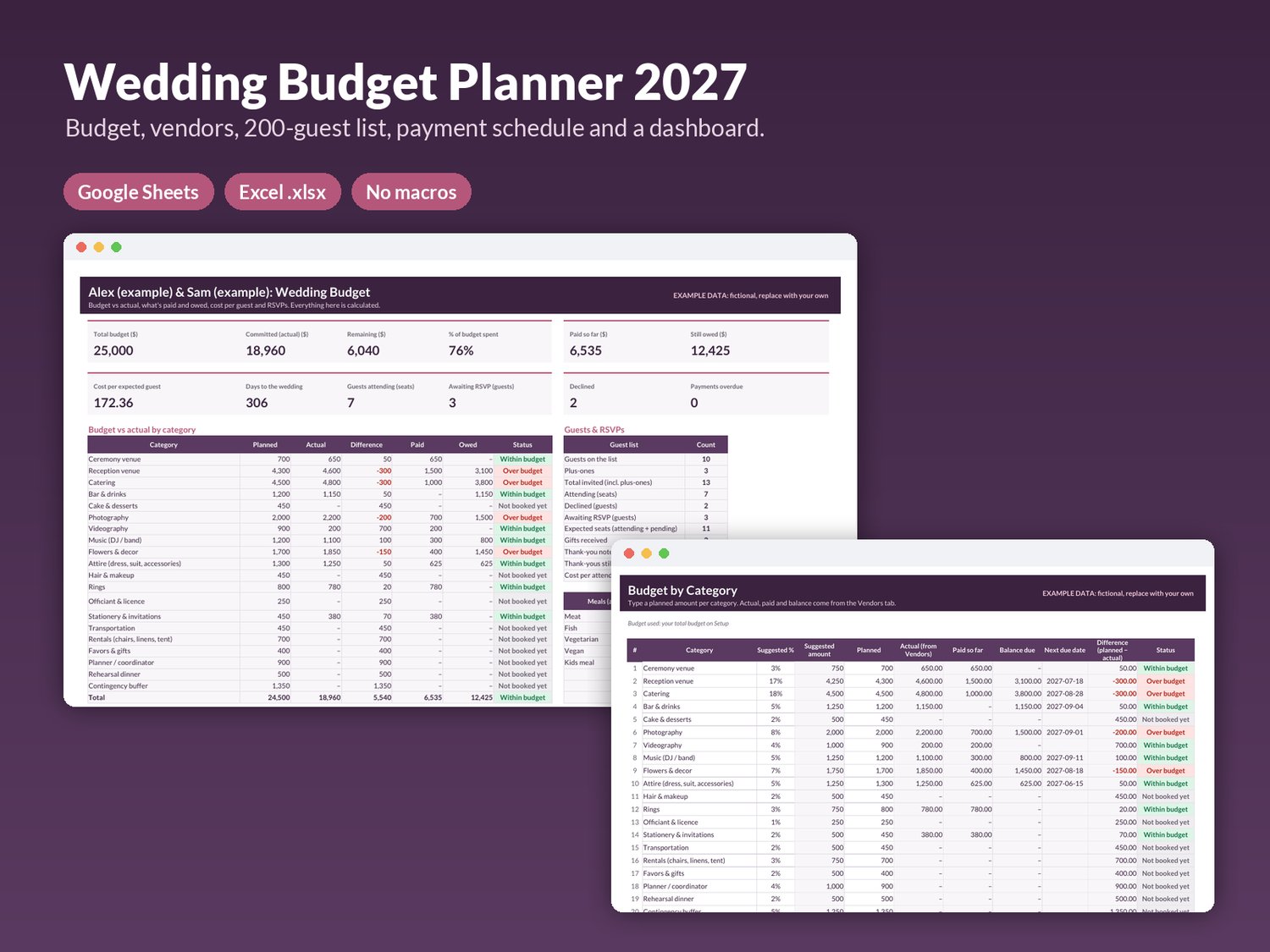
You can do all of this in any spreadsheet. If you'd rather start from a template, I made the Wedding Budget Planner 2027 ($9) for exactly this kind of planning: https://payhip.com/b/fCh4D
To save toward the date month by month, the 2027 Sinking Funds & Savings Goals Tracker ($7) works well alongside it: https://payhip.com/b/3WrD5
More 2027 planners: https://payhip.com/NirWeiss
Dana, Sam and all numbers in this post are fictional. This is general information, not financial advice.
I make and sell budgeting spreadsheets (NW Planners). Written with AI help, edited by me.
Free printable: the Wedding Budget Checklist 2027 gives you a 12-months-out to week-of money checklist and a budget-by-category worksheet. Download it free: https://payhip.com/b/kV1mU