
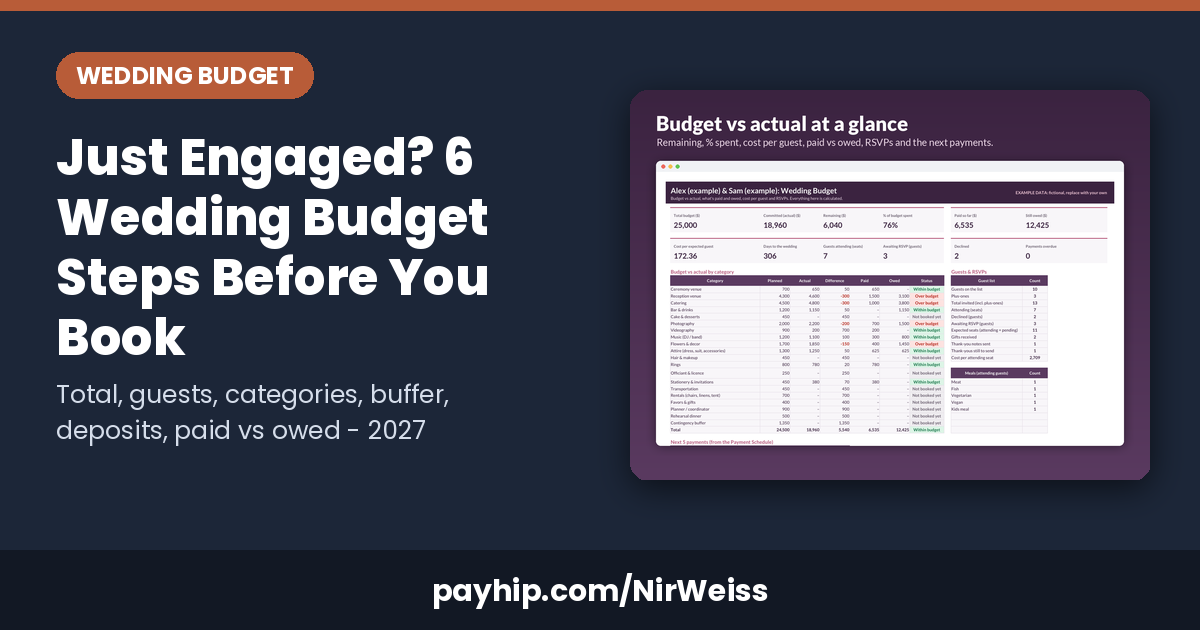
Congratulations! The first few weeks after an engagement are exciting, and they are also when it is easiest to make expensive decisions too fast. These six steps take an evening or two, and they give every later decision a frame to fit into.
Step 1: Agree one debt-free total and where it comes from
Sit down together and agree on a single number: the most you will spend on the wedding without borrowing. Then write down where that money comes from: savings you already have, what you can set aside each month until the date, and any family contributions that have actually been offered (not hoped for). If a family member is contributing, it helps to ask early whether the gift comes with expectations about guests or style, so there are no surprises later.
Write the total and its sources on one page. That number is your ceiling, and everything else in this post works backwards from it.
Step 2: Estimate your guest count first
Guest count drives most of the budget. Catering, drinks, rentals, stationery, favours and even venue size all scale with the number of people. Make a rough list before you look at venues: immediate family, extended family, close friends, colleagues, plus-ones. A realistic range is enough for now.
Once you have a number, divide your total by it. That cost per guest is a quick reality check when you compare quotes: a venue's per-head catering price has to fit inside it with room left for everything else.
Step 3: Split the total by category
Now give every category a share of the total: venue, catering, bar, photography, attire, flowers and decor, music, stationery, rings, transport and so on. Start with rough percentages, then adjust to what matters to you. If photos are your priority, give photography more and trim somewhere else. The point is that the categories add up to your total, not more.
Writing it down this way turns "Can we afford this?" into a clearer question: "Does this quote fit the amount we gave this category?"
Step 4: Keep a 5-10% buffer for unquoted extras
Some costs rarely appear on the first quote: service charges, gratuities, delivery and setup fees, alterations, extra hours, postage, last-minute repairs. Set aside 5 to 10% of your total as its own category and don't assign it to anything yet. If you get to the end without using it, that's a nice outcome. If you do need it, it comes from a planned line instead of from your credit card.
Step 5: List every vendor deposit with its due date
Before you sign anything, start a simple list: vendor, total price, deposit amount, deposit due date, and the dates and amounts of later payments. Read each contract for the cancellation and refund terms and note them too. Deposits are often due at booking, and final balances often fall in the weeks just before the wedding, which is also when other costs cluster. Seeing every payment in date order shows you whether your monthly savings will be there in time.
Step 6: Track paid vs owed after every payment
Every time you pay something, update two numbers for that vendor: paid so far and still owed. Do it the same day, while the receipt is in front of you. A running total of "owed" across all vendors is the most useful number in wedding planning, because it tells you what is still coming, not just what you've already spent. If both of you pay vendors, keep one shared tracker so nothing is paid twice or missed.
Quick questions
- Should we book the venue first? Many couples do, because the venue sets the date and often the guest limit. Just do steps 1 to 3 before the tour, so you know what the venue can cost.
- What if our families' expectations don't match our budget? Share the total and the guest estimate early. A clear number makes those conversations easier than a vague "we're trying to keep it small".
- What if a quote comes in over budget? Ask what can change (date, hours, guest count, package), or move money from a lower-priority category. Try not to dip into the buffer this early.
Free checklist and a planner for these steps
If you want to start on paper, the free Wedding Budget Checklist 2027 has a money timeline from 12 months out to the week of, plus a worksheet to split your budget across 20 categories: https://payhip.com/b/kV1mU
When you're ready to track real numbers, the Wedding Budget Planner 2027 is an Excel spreadsheet (also opens in Google Sheets) with 20 categories of planned vs actual, a vendor tracker, a payment schedule sorted by due date, a guest list with RSVPs, and a dashboard. It's $9: https://payhip.com/b/fCh4D
A planning tool, not financial advice. Prices and contract terms vary, so always read each vendor's agreement before paying a deposit.
Disclosure: I'm the maker of the NW Planners products linked above, and this post was written with AI assistance. Browse the store: https://payhip.com/NirWeiss