

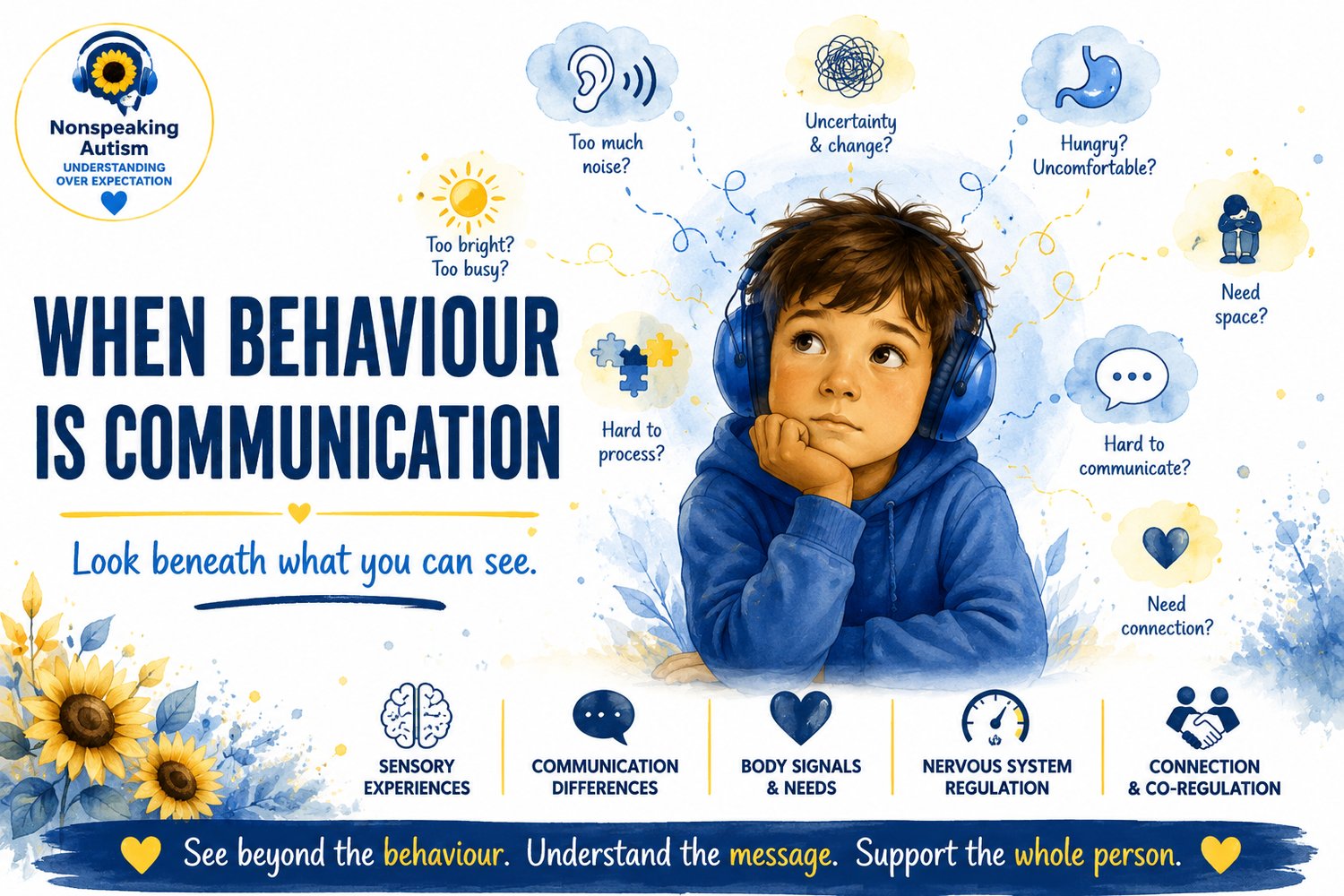
When Behaviour Is Communication: Looking Beneath What We Can See
A child covers their ears and runs from the room.
They push someone away when approached.
They pace, rock, chew, hide, cry, become completely still or suddenly seem unable to cope.
Perhaps they refuse to move when it is time to leave. Perhaps they appear calm all day at school and fall apart the moment they get home.
From the outside, we see behaviour.
But behaviour is only the part we can see.
Underneath it may be sensory overload, uncertainty, pain, fear, exhaustion, difficulty processing language, difficulty communicating a need, or a nervous system trying desperately to regulate itself.
That distinction matters.
What if we changed the question?
When behaviour is difficult, disruptive or unexpected, the natural response is often:
“How do we stop this?”
But there is another question that can tell us much more:
“What might be happening underneath this?”
That doesn't mean every behaviour has one simple explanation. It doesn't.
It means that before trying to change what we can see, we should consider what might be driving it.
Sensory processing can change behaviour
Autistic sensory experiences can include heightened responses, reduced responses and sensory seeking.
Sound, light, touch, movement, smell, taste and internal body sensations can all be experienced differently.
Research has repeatedly linked sensory processing differences in autism with regulation, participation and observable behaviour.
So the child covering their ears in a supermarket may not be “making a fuss”.
The environment may genuinely be too much.
The child constantly jumping, rocking or moving may not simply need to “sit still”.
Movement may be serving an important regulatory function.
The child refusing particular clothing, food, grooming or environments may be responding to sensory experiences that other people cannot see.
The behaviour is visible. The sensory experience isn't.
Communication doesn't always look like words
For nonspeaking and minimally speaking autistic people especially, communication cannot be judged solely by speech.
Communication may happen through AAC, gesture, movement, facial expression, actions, leading another person, body positioning, sounds or changes in behaviour.
And there is an important difference between having something to communicate and being able to communicate it in the form another person expects, at the exact moment they expect it.
A person may know that something is wrong long before they can identify it, organise a response and communicate it.
Sometimes behaviour becomes the clearest information available.
A meltdown is not simply “bad behaviour”
By the time we see screaming, crying, running, dropping to the floor, pushing away or other intense behaviour, there may already have been a long build-up.
Noise.
Uncertainty.
Social demands.
Transitions.
Language to process.
Uncomfortable clothing.
Hunger.
Pain.
Fatigue.
Too much movement — or not enough.
Having to cope for hours.
One more demand can look like the cause when it was actually only the final demand on an already overloaded system.
That is why focusing exclusively on the final behaviour can mean missing everything that happened before it.
Shutdown can be missed completely
Distress isn't always loud.
An overwhelmed autistic person may become quiet, withdrawn, still or less responsive.
And because that behaviour is less disruptive to everyone around them, it can easily be interpreted as:
“They're calm now.”
But quiet does not automatically mean regulated.
Sometimes the most important signs of distress are the ones that make the least noise.
“Refusal” deserves curiosity too
Imagine a child is told:
“Put your shoes on.”
They don't move.
It is easy to conclude:
“They won't.”
But there are many other possibilities.
Did they process the instruction?
Can they initiate the movement?
Are they overwhelmed by the transition the shoes represent?
Is something about the shoes uncomfortable?
Were several instructions given at once?
Do they understand what is happening next?
Are they already dysregulated?
“Won't” and “can't right now” can look remarkably similar from the outside.
That doesn't mean demands disappear or that children should never be taught skills.
It means support becomes more effective when we understand what is making the task difficult.
Look for patterns, not just incidents
Instead of examining one behaviour in isolation, look at what surrounds it.
What happened beforehand?
What was the environment like?
Was it noisy, bright, crowded or unpredictable?
Was there a transition?
Had the person been coping for a long time?
Was communication becoming more difficult?
Was there a change in routine?
Could they be hungry, thirsty, tired, unwell or in pain?
What happened afterwards?
What seemed to help?
Patterns can tell us far more than labels such as “challenging”, “attention-seeking” or “defiant”.
Regulation before correction
When a nervous system is overwhelmed, adding more pressure can add another demand to an already overloaded system.
Sometimes the useful response is not another instruction.
It may be:
- fewer words
- more processing time
- reduced sensory input
- access to AAC or another communication method
- movement
- deep pressure where wanted and appropriate
- a predictable explanation of what happens next
- a quieter environment
- space
- co-regulation
- removing unnecessary demands
- checking for pain or physical discomfort
Support should always be individual. What regulates one autistic person may be uncomfortable or overwhelming for another.
Behaviour still matters
Understanding behaviour as communication does not mean ignoring dangerous behaviour or pretending that everything is acceptable.
Safety matters.
Other people's safety matters too.
But we can maintain boundaries and remain curious about why something happened.
Those ideas are not opposites.
If a child repeatedly reaches the point of crisis, simply stopping the final behaviour does not necessarily prevent the conditions that produced it.
Understanding function gives us more opportunities to intervene before distress reaches that point.
Look beneath the surface
The visible behaviour may be the end of a much longer neurological, sensory, emotional or communicative process.
So perhaps the first question shouldn't always be:
“How do we stop this?”
Perhaps it can be:
“What is this telling us?”
Then:
“What happened before it?”
“What need might be going unmet?”
“What can we change around the person?”
And:
“How can we make communication, regulation and safety easier?”
Because when we look beneath behaviour, we often find information.
And information gives us somewhere better to start.
Explore More
If you'd like to understand a particular area in more depth, explore the Nonspeaking Autism resource collections covering:
Communication & Nonspeaking Autism • Sensory Processing & Regulation • Meltdowns, Shutdowns & Overload • Behaviour as Communication • Eating, Interoception & Body Signals • Transitions, Anxiety & Predictability • Masking, Burnout & Emotional Regulation
Connection over correction. Understanding over expectation.
This article is for educational purposes and is not a substitute for individual medical, therapeutic or professional advice.
© Nonspeaking Autism 💙 2026