
Cashflow forecast for a small business (simple 6-month example)
A business can make a profit over the year and still run out of money in one bad month. A cashflow forecast shows you that month before it happens, so you can act early instead of panicking. You only need a starting balance, your expected income and your expected expenses.
Step 1: Write down your starting cash
Use the real balance of your business account today. In our example: 3,000.
Step 2: Choose a safety buffer
The buffer is the lowest balance you are comfortable with, for example one month of fixed costs. Example: 2,000. Any month that ends below it gets a warning.
Step 3: Fill in income and expenses per month
Be honest: use the date money actually arrives, not the date you send the invoice. If clients pay after 30 days, December work is January cash.
- Month: Jan, Start: 3,000, Income: 4,200, Expenses: 3,600, End: 3,600
- Month: Feb, Start: 3,600, Income: 3,800, Expenses: 3,600, End: 3,800
- Month: Mar, Start: 3,800, Income: 2,500, Expenses: 3,900, End: 2,400
- Month: Apr, Start: 2,400, Income: 2,200, Expenses: 3,600, End: 1,000 (below buffer)
- Month: May, Start: 1,000, Income: 4,600, Expenses: 3,600, End: 2,000
- Month: Jun, Start: 2,000, Income: 5,100, Expenses: 3,700, End: 3,400
End of month = start + income - expenses. The end of one month is the start of the next.
Step 4: Read the warning
Over six months this business earns 22,400 and spends 22,000, so it is 400 ahead. But in April the balance falls to 1,000, half the buffer. One late client payment in April and the account could go negative.
Seeing this in January gives you three months to do something about it.
What you can do about a low month
- Ask for a deposit on larger projects, or invoice in stages.
- Move a planned purchase (a new laptop, a course) from March or April to June.
- Send invoices the day the work is done and follow up on the due date.
- Plan a promotion or extra work for February and March.
- Set money aside in strong months, like June, for the next quiet period.
Do not forget tax
If you pay tax later on this year's profit, that money is not really yours. A simple rule: move a fixed share of every month's profit to a separate account. Example: 30 % of a 1,200 monthly profit is 360 per month, or 4,320 per year. Ask your accountant which share fits your situation.
Update it every month
A forecast is only useful if it is current. Once a month, replace the planned numbers of the past month with the real ones and look at the next three months again.
If you also want to know how many sales you need each month, read our guide on the break-even point.
Want the spreadsheet?
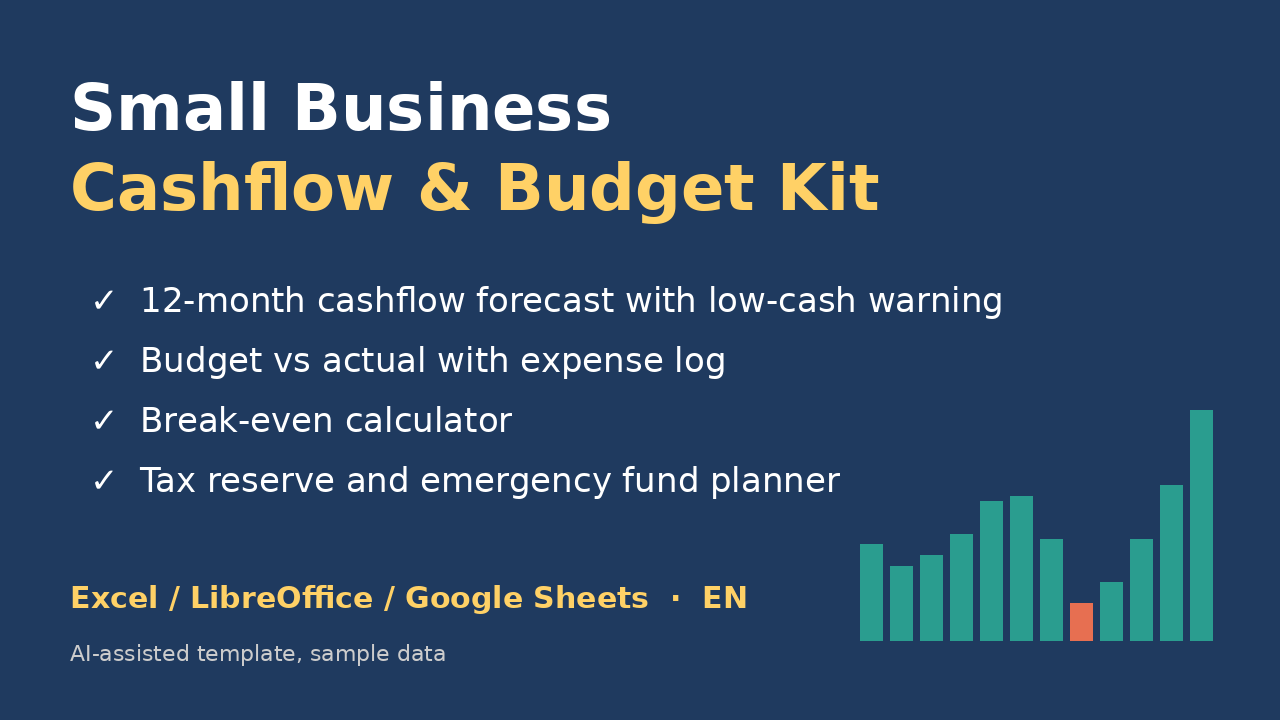
The Small Business Cashflow & Budget Kit (19 EUR) has a 12-month version of this forecast with an automatic LOW warning, a budget vs actual sheet, a break-even calculator and a tax reserve planner. It works in Excel, LibreOffice and Google Sheets.
This guide was written with AI assistance and the numbers were checked by recalculation. It is general planning information, not tax, legal or financial advice.