
Christmas markets and winter craft fairs are the busiest selling days of the year for many makers. They are also the easiest days to lose money without noticing: a stall fee, a long day, a few card payments, and at the end you are not sure whether it was worth it. This checklist walks through the four things to settle before, during and after the fair.
1. Before you book: know your break-even
Before you pay a stall fee, work out how many items you must sell just to cover it.
Example (made-up numbers, use your own): you sell a tree ornament for 12.00. Materials and packaging cost 4.20. Your card reader charges a fee per payment, here assumed at 1.75 % plus 0.10, which is about 0.31 on a 12.00 sale. That leaves 7.49 per ornament. With a 45.00 stall fee you need 7 sales before you earn anything: 6 sales bring in 44.94, just short of the fee.
If you sold 18 ornaments over a 7-hour day, the result is 18 x 7.49 - 45.00 = 89.82, or about 12.83 per hour. Do that sum for every fair you are offered and compare them by profit per hour, not by footfall promises.
2. Price for the stall, not just the shop
- Check that your prices still work after card fees and any commission the organiser takes.
- Round to prices that are quick to pay in cash (10, 12, 15) and keep enough change.
- Offer one easy add-on (a second ornament, a gift bag) rather than many discounts.
- If you personalise items on the spot, price the extra minutes. Time at the fair is still time.
3. Pack the right stock
- Bring more of last year's best sellers and fewer experiments.
- Write a simple stock list: item, quantity packed, price. You will need it at the end of the day.
- Pack for the weather: covers for rain, weights for the gazebo, gloves you can take payments in.
- Prepare a small sign with prices, payment methods and how to order online after the fair.
4. During and after the day: write it down
- Tally sales per item (a sheet of paper is fine) so you know what sold, not just the total.
- After the fair, count remaining stock and compare it with your packing list.
- Note the real numbers: stall fee, travel, sales, hours. Next year you will decide from facts.
Tools that do the sums for you
If you would rather not build the spreadsheet yourself:
- Handmade Pricing Calculator LITE, free: price one product so it covers costs and fees.
- Handmade Seller Pricing & Profit Calculator, 9 EUR: pricing and profit for your whole range.
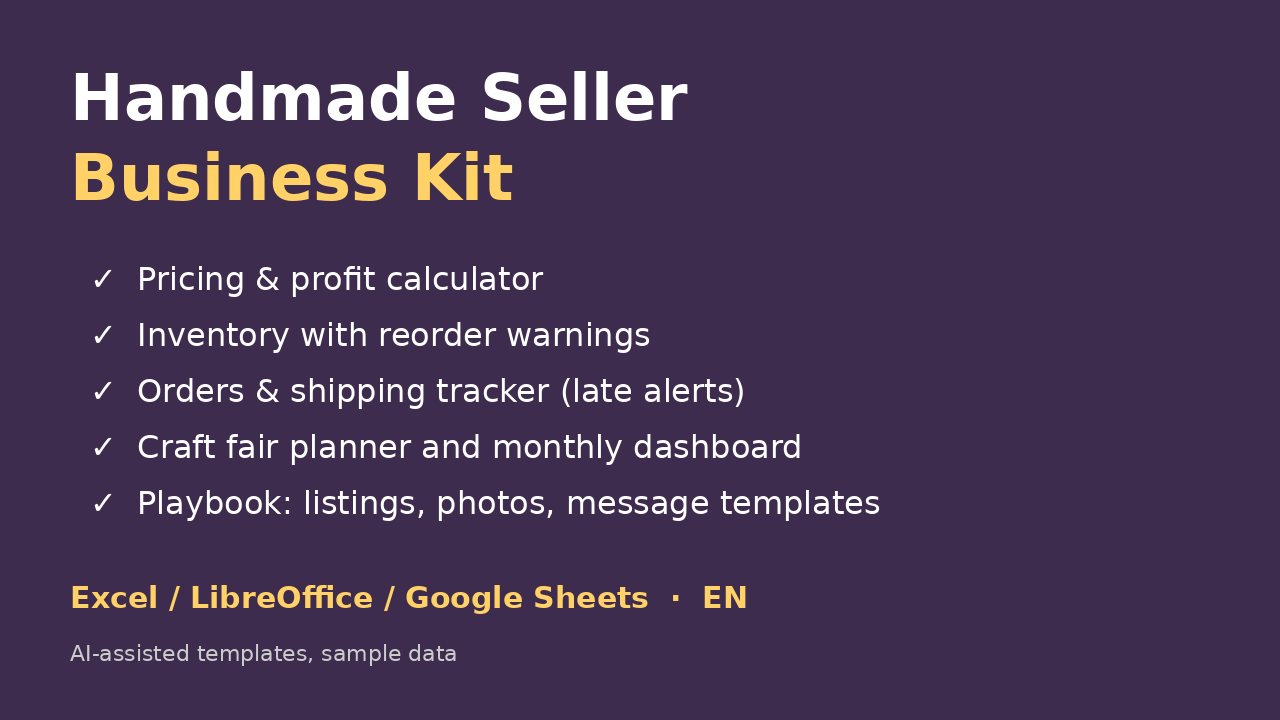
- Handmade Seller Business Kit, 24 EUR: pricing, stock with reorder warnings, orders, a craft fair comparison by profit per hour, a monthly dashboard and a playbook with fair checklists.
- Handmade Seller Complete Bundle, 35 EUR: the Business Kit plus a 12-month cashflow and budget planner.
All work in Excel, LibreOffice and Google Sheets, without macros. Fee values in the files are placeholders: enter the fees your card reader and marketplace actually charge.
This guide was written with AI assistance and checked by a person. It is general information, not tax, legal or financial advice. The example numbers are made up for illustration.