
How to get paid on time as a freelancer (with an EU late payment example)
Late invoices hurt a freelancer more than a low rate. The work is done, the bills keep coming, and the money sits in someone else's account. This guide covers three things: clear payment terms, a simple reminder routine, and what EU law says when a business client pays late.
Step 1: Put the terms on every quote and invoice
Write the due date as a date, not only as "30 days". Add your bank details, the invoice number and what the client should write as payment reference. A client who has to search for any of this will pay later.
Agree the payment term before you start. Under the EU Late Payment Directive (2011/7/EU), payment terms between businesses should not exceed 60 calendar days unless both sides expressly agree a longer term and it is not grossly unfair. If nothing is agreed, the default is 30 days after the client receives the invoice.
Step 2: Track every invoice in one list
You cannot chase what you cannot see. Keep one list with invoice date, due date, amount and status (paid, open, overdue). Check it once a week.
Example with three open invoices:
- Invoice: A, Amount: 1,200, Days overdue: 12
- Invoice: B, Amount: 2,400, Days overdue: 45
- Invoice: C, Amount: 850, Days overdue: 0
Total open: 4,450. Weighted by amount, the money is on average 27.5 days late ((1,200 x 12 + 2,400 x 45) / 4,450). Invoice B is the one to chase first.
Step 3: Use a fixed reminder routine
- Day 1 after the due date: a friendly note with the invoice attached. Most late payments are simply forgotten.
- Day 14: a firm reminder with the amount, the original due date and a new date seven days out.
- Day 30: a final notice that mentions late payment interest and the recovery cost compensation below.
Same wording every time, sent on the same days. It feels less personal and it works better than waiting.
What EU law says about late payment (business clients)
For payments between businesses in the EU, the Late Payment Directive gives the creditor:
- Interest without a reminder, from the day after the agreed due date. The statutory rate is the reference rate (for euro countries the ECB main refinancing rate, fixed on 1 January and 1 July) plus at least 8 percentage points.
- A fixed 40 EUR per unpaid invoice as compensation for recovery costs, plus reasonable further costs.
Worked example for invoice B, with an assumed rate of 10 % a year (2 % reference rate + 8 points; check the current rate in your country):
2,400 x 10 % x 45 / 365 = 29.59 interest 29.59 + 40.00 = 69.59 you could claim on top of the invoice.
You do not have to claim it. Many freelancers mention it in the final notice and waive it if the client pays within a week. Your national law may add details, so check before you rely on it. This applies to business clients, not to private consumers.
Get the tracker
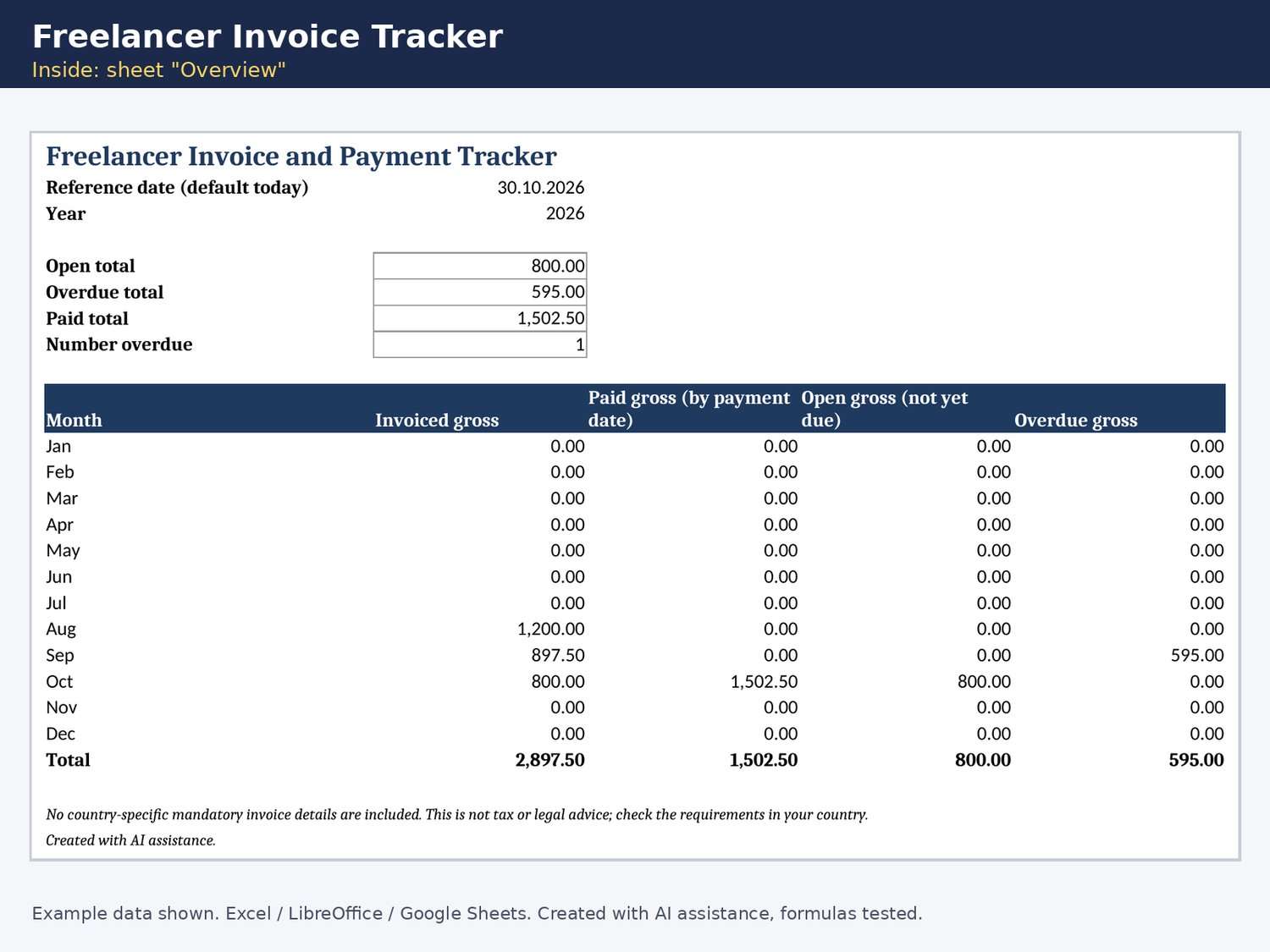
The Freelancer Invoice and Payment Tracker (Excel, EN/DE/FR, 8 EUR) does Step 2 for you: status, days overdue, monthly totals and three reminder texts: https://payhip.com/b/6pXn9
If you also want quote and invoice templates plus eight client emails, from sending a quote to a final payment notice, the Freelancer Business Kit (29 EUR) includes the tracker: https://payhip.com/b/9Qbot
Related guide: How to calculate your freelance hourly rate
This guide was written with AI assistance and checked against the text of Directive 2011/7/EU. It is general information, not legal or tax advice.