
How to price handmade products (a formula that includes fees and profit)
"Materials times two" is the most common pricing rule for handmade items. It is also the reason many makers work for less than minimum wage: it ignores your time, and it ignores the fees the marketplace takes from every sale. Here is a way to price that covers everything.
Step 1: Add up the full cost of one item
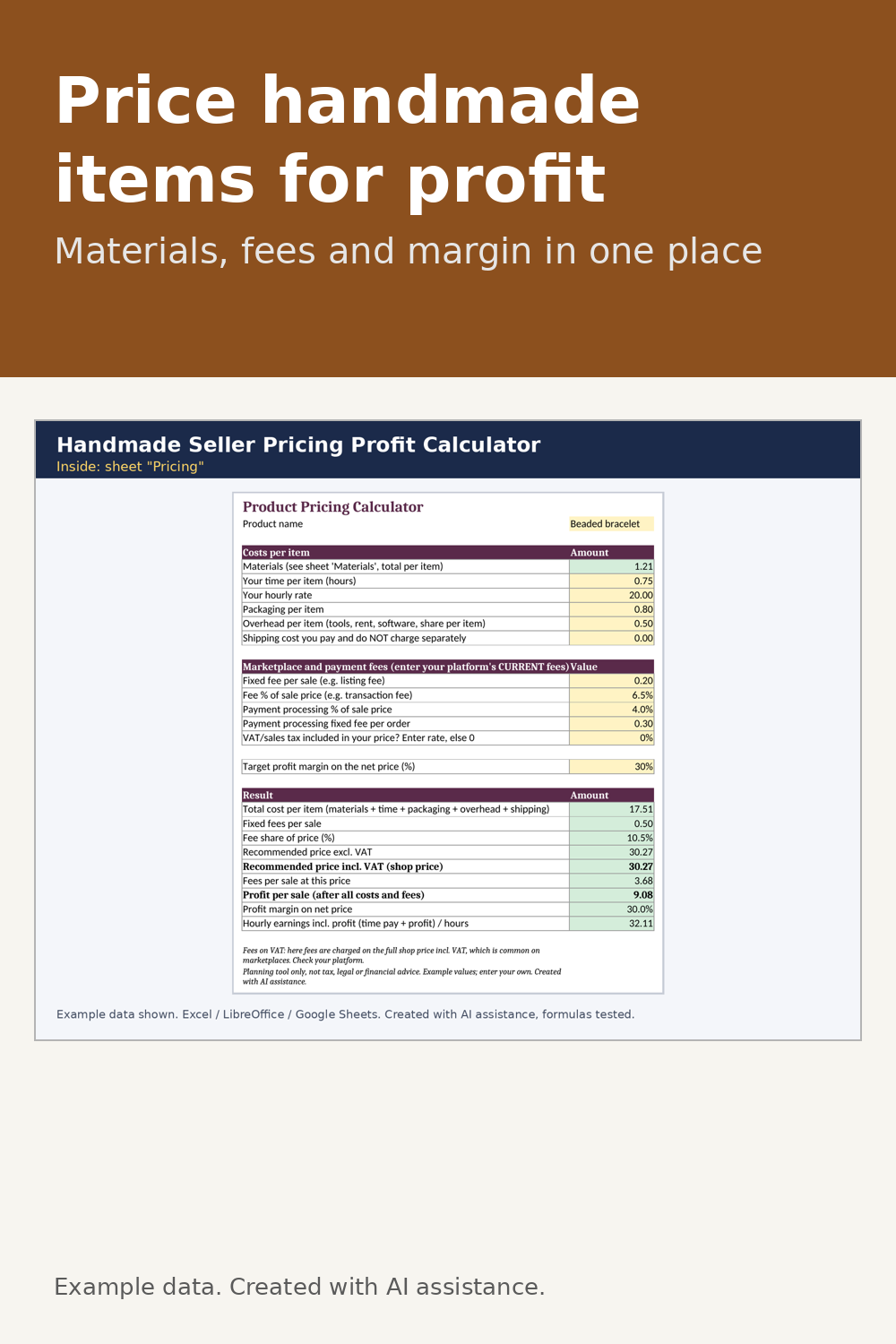
Example, a beaded bracelet:
- Materials: 1.21
- Your time: 0.75 hours x 20 per hour = 15.00
- Packaging: 0.80
- Overhead share (tools, software, rent): 0.50
Total cost per item: 17.51
Yes, your time is a cost. If you leave it out, the "profit" is just your wage.
Step 2: Write down the fees per sale
Look up the current fees of your platform. They change, so check them yourself. In the example:
- Fixed fees per order: 0.20 + 0.30 = 0.50
- Fees as a share of the price: 6.5 % + 4 % = 10.5 %
Step 3: Choose a profit margin
Profit is what pays for growth, bad months and new equipment. The example uses 30 % of the net price.
Step 4: Use the formula
Because fees are a percentage of the price, you cannot just add them on top. Solve for the price instead:
Price = (total cost + fixed fees) / (1 - fee share - profit margin)
(17.51 + 0.50) / (1 - 0.105 - 0.30) = 30.27
Step 5: Check the result
- Fees at 30.27: 0.50 + 10.5 % of 30.27 = 3.68
- Profit: 30.27 - 17.51 - 3.68 = 9.08 (30 % of the price)
- Your real hourly earnings: (15.00 + 9.08) / 0.75 h = 32.11 per hour
If 30.27 feels too high for your market, change the inputs honestly: faster production, cheaper packaging, a different platform, or a product with more value. Do not quietly drop your hourly wage.
If you charge VAT
If VAT is included in your shop price, divide it out first and remember that many platforms charge their fee on the price including VAT. Our calculator has a field for that.
Try it with your own numbers
The free Handmade Pricing Calculator LITE does these steps for you. The full version (9 EUR) adds a materials list, a competitor price check and a 12-month profit planner.
This article was written with AI assistance and the numbers were checked by recalculation. It is general planning information, not tax, legal or financial advice.