

Keywords: NCLEX-RN, NGN, ABG, ROME, hyperkalemia, Winter's formula, dialysis, AKI, CKD, electrolytes, acid-base, fluids, clinical judgment
Table of Contents
1. Four rules turn ABGs into free points
2. ABGs in 4 steps + ROME
3. Hyperkalemia: calcium first
4. Winter's formula
5. Dialysis safety checks
6. Practice Question
7. Inside the Guide
8. Who this guide is for
9. More from Nurse Board Prep Clinical Press
1. Four rules turn ABGs into free points
ABGs and electrolytes are the highest-yield points on the NCLEX — and the ones students fear most. Four rules turn them into free points.
👉 Get the full guide here: https://payhip.com/b/6JNem
2. ABGs in 4 steps + ROME
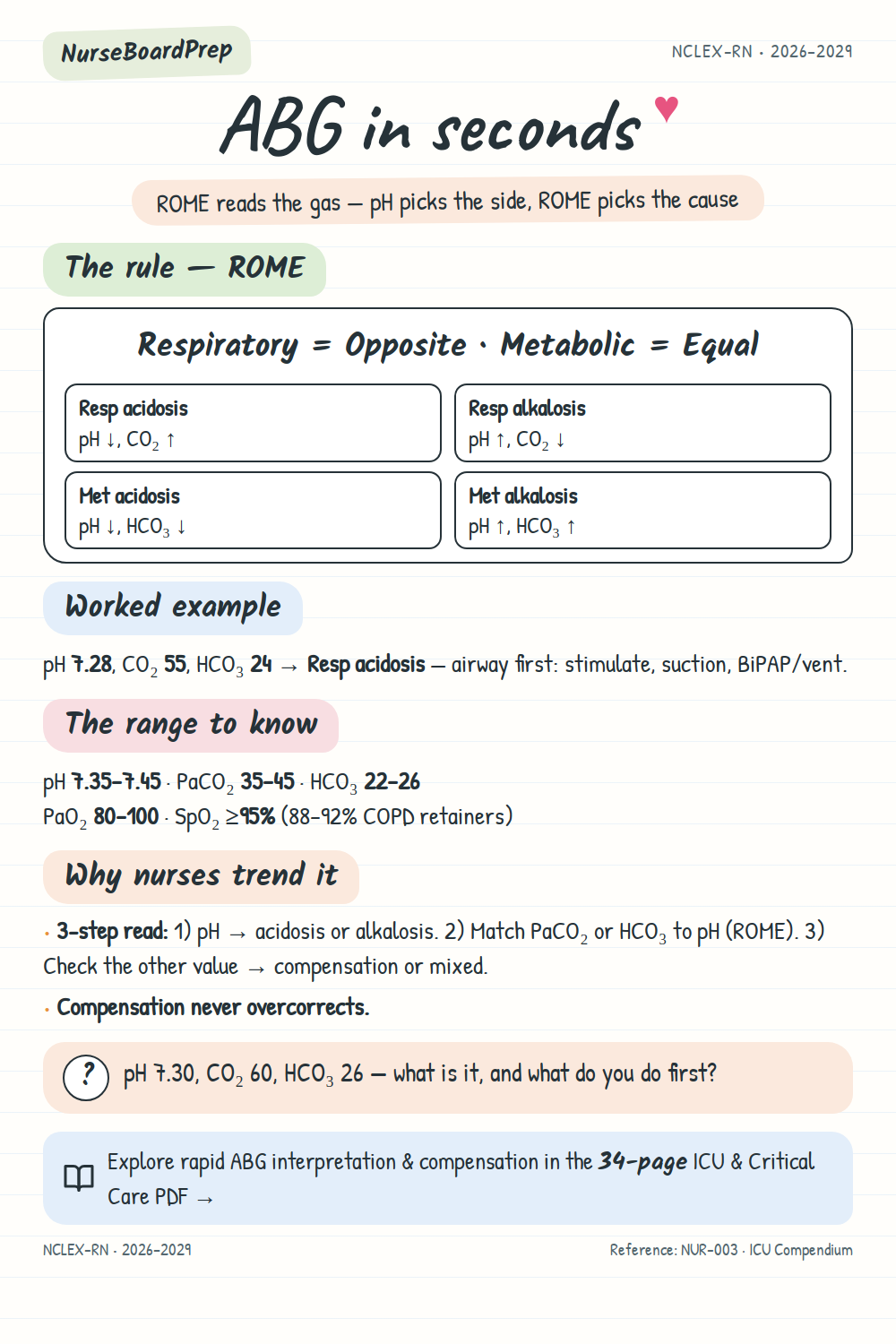
Step 1: look at pH — below 7.35 is acidosis, above 7.45 is alkalosis.
Step 2: look at PaCO2 — the respiratory value moves OPPOSITE the pH in respiratory disorders.
Step 3: look at HCO3 — the metabolic value moves WITH the pH in metabolic disorders.
Step 4: check compensation — is the other value shifting to correct the pH? ROME: Respiratory Opposite, Metabolic Equal.
3. Hyperkalemia: calcium first
ECG changes in order: peaked T waves, then widened QRS, then a sine wave — then asystole. Peaked waves mean act now.
Give calcium first (gluconate or chloride per orders). Calcium stabilizes the cardiac membrane — it does NOT lower potassium.
Then shift potassium into the cells (insulin with glucose, bicarbonate, albuterol per orders), then remove it from the body (diuretics, kayexalate, dialysis).
4. Winter's formula
In metabolic acidosis, expected PaCO2 = (1.5 x HCO3) + 8, plus or minus 2. Example: HCO3 of 12 gives an expected PaCO2 of 26, plus or minus 2.
If the actual PaCO2 matches, compensation is adequate. If it is higher, there is also a respiratory acidosis; if lower, a respiratory alkalosis — a second disorder the exam loves to hide.
👉 Get the full guide here: https://payhip.com/b/6JNem
5. Dialysis safety checks
Before: check weight, vitals, and labs; hold antihypertensives per orders; assess the access — bruit and thrill present, no redness or swelling.
During: watch for hypotension and disequilibrium syndrome (headache, nausea, confusion) — slow or stop per protocol and notify the provider.
After: weigh the patient, recheck vitals, and protect the access arm — no blood pressures, needle sticks, or tight dressings on a fistula or graft arm.
6. Practice Question
In metabolic acidosis, a patient's HCO3 is 12 mEq/L and the actual PaCO2 is 26 mmHg. Using Winter's formula, is compensation adequate?
A. Yes — expected PaCO2 is 26 ± 2, and the actual PaCO2 matches.
B. No — there is also a respiratory acidosis.
C. No — there is also a respiratory alkalosis.
D. Winter's formula cannot be used in metabolic acidosis.
Correct answer: A. Expected PaCO2 = (1.5 × 12) + 8 = 26, plus or minus 2. The actual PaCO2 of 26 matches, so compensation is adequate. If the actual PaCO2 were higher, there would also be a respiratory acidosis; if lower, a respiratory alkalosis.
7. Inside the Guide
The 2026–2029 NCLEX-RN Renal, Urinary, Fluid & Electrolytes & ABG Study Guide from Nurse Board Prep Clinical Press packs 38 full A4 pages: 18 clinical tables including ROME and compensation tables, electrolyte rapid-review tables, and AKI vs CKD comparisons; 9 unfolding NGN clinical cases; and 45 NGN practice questions with full rationales explaining the correct answer and why each wrong option fails.
👉 Get the full guide here: https://payhip.com/b/6JNem
8. Who this guide is for
RN students preparing for the NCLEX-RN, PN students, and med-surg nurses who want a fast, exam-focused renal, electrolyte, and ABG review.
9. More from Nurse Board Prep Clinical Press
Follow us on Pinterest for more renal and ABG pins: https://www.pinterest.com/NurseBoardPrep/ — Board: "2026–2029 NCLEX-RN, Pharmacology & ICU Guides".
— Nurse Board Prep Clinical Press (NBPCP)