

Keywords: NCLEX-RN, NGN, pharmacology, anticoagulants, heparin, warfarin, DOACs, apixaban, rivaroxaban, dabigatran, HIT, aPTT, INR, protamine, vitamin K, andexanet alfa, idarucizumab, clinical judgment
Table of Contents
1. The one anticoagulant rule to memorize
2. The four pairings
3. The trap: HIT
4. Two more rules the exam tests
5. Key Numbers to Memorize
6. Inside the Guide
7. More from Nurse Board Prep Clinical Press
1. The one anticoagulant rule to memorize
If you only memorize one anticoagulant rule before your NCLEX, make it this one: every anticoagulant has its own monitor and its own antidote — and the exam tests the pairing, not the drug alone.
👉 Get the full guide here: https://payhip.com/b/n3OJo
2. The four pairings
Three anticoagulant worlds, four pairings, four questions:
- Heparin = aPTT + protamine. Unfractionated heparin is monitored by aPTT — therapeutic 60-80 seconds (1.5-2.5x control) — and reversed by protamine sulfate. Remember: aPTT 30-40 seconds is NORMAL. The target is 60-80. Confusing the two is one of the exam's favorite traps.
- Warfarin = INR + vitamin K. Warfarin is monitored by PT/INR (2.0-3.0, or 2.5-3.5 for a mechanical mitral valve) and reversed by phytonadione (vitamin K1), plus 4-factor PCC for major bleeding. Warfarin teaching is CONSISTENT vitamin K intake — not zero intake.
- Apixaban / rivaroxaban = andexanet alfa. DOACs have no routine levels to check; you watch kidney function and bleeding. Their reversal is andexanet alfa.
- Dabigatran = idarucizumab. The one DOAC with its own dedicated reversal agent.
3. The trap: HIT
Heparin-induced thrombocytopenia is a clotting disaster disguised as a low platelet count. Day 5-10 of heparin, platelets halved from baseline, plus a new clot — that is HIT until proven otherwise, and the priority action is to stop ALL heparin at once: infusion, flushes, and heparin-coated lines. Do NOT transfuse platelets (they feed the clots) and do NOT start warfarin until platelets recover (early warfarin in HIT causes limb gangrene). Low platelets on heparin? Think CLOT, not bleed.
👉 Get the full guide here: https://payhip.com/b/n3OJo
4. Two more rules the exam tests
- Protamine needs an order. Protamine is reserved for serious bleeding or overdose — never automatic, even when the aPTT is high.
- DOAC doses must not be skipped. Missed DOAC doses leave the patient unprotected within a day. There is no easy lab to "check" the level, so adherence IS the monitoring.
5. Key Numbers to Memorize
Heparin — Monitor: aPTT. Therapeutic target: 60–80 seconds (1.5–2.5x control); normal aPTT 30–40. Antidote: Protamine sulfate.
Warfarin — Monitor: PT/INR. Target: INR 2.0–3.0 (2.5–3.5 mechanical mitral valve). Antidote: Vitamin K (phytonadione) + 4-factor PCC for major bleeding.
Apixaban / rivaroxaban — No routine levels; watch kidney function and bleeding. Antidote: Andexanet alfa.
Dabigatran — No routine levels. Antidote: Idarucizumab.
HIT watch — Platelets: Day 5–10 of heparin, platelets halved from baseline + new clot. Action: Stop ALL heparin at once.
6. Inside the Guide
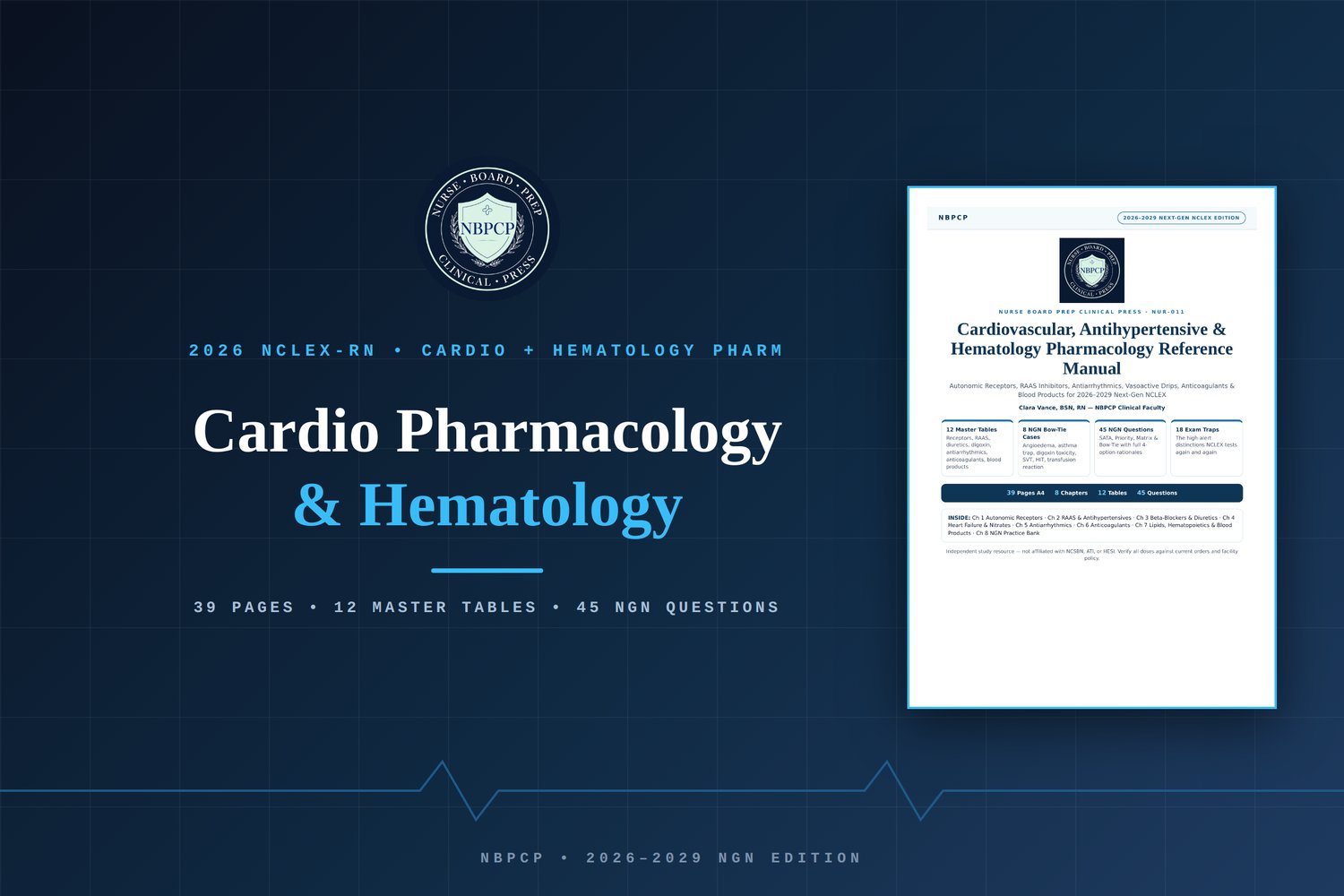
The Cardiovascular, Antihypertensive & Hematology Pharmacology Reference Manual from Nurse Board Prep Clinical Press packs 39 full A4 pages: 8 chapters, 16 tables including all 12 master tables (antihypertensives, heart failure, anticoagulants, antiplatelets, diuretics, and more), 8 NGN Bow-Tie unfolding cases, 18 NCLEX Exam Trap boxes, 45 NGN practice questions with full rationales explaining the correct answer and why each wrong option is wrong, and 28 memory strips.
👉 Get the full guide here: https://payhip.com/b/n3OJo
7. More from Nurse Board Prep Clinical Press
— Nurse Board Prep Clinical Press (NBPCP)