

Keywords: NCLEX-RN, NGN, clinical judgment, prioritization, ABCs, airway breathing circulation, acute vs chronic, delegation, DKA potassium rule, who to see first, Maslow, unstable vs stable
Table of Contents
1. The moment that decides the exam
2. Rule 1 — Acute Beats Chronic, Always
3. Rule 2 — The DKA Potassium Rule (The Question 85 Trap)
4. Rule 3 — Delegate by Stability, Not by Task
5. Key Numbers to Memorize
6. NGN Question Breakdown
7. Inside the Guide
8. More from Nurse Board Prep Clinical Press
1. The moment that decides the exam
Every Next-Gen NCLEX candidate meets the same moment: four patients, one nurse, and a question that asks who you see FIRST. The exam is not testing what you memorized. It is testing how you think under pressure. These three rules carry more questions than any single drug list.
Get the full guide here: https://payhip.com/b/kpUOQ
2. Rule 1 — Acute Beats Chronic, Always
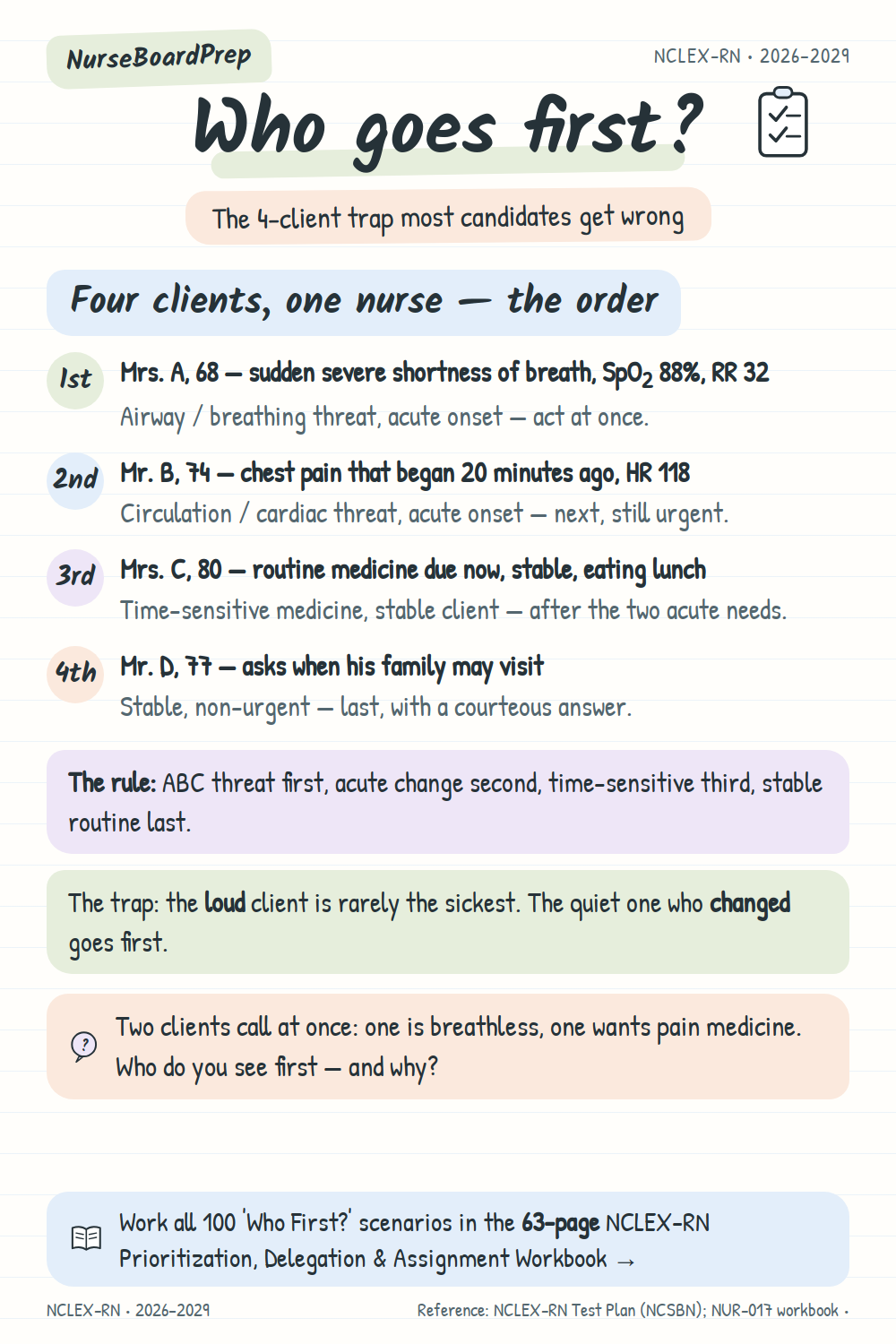
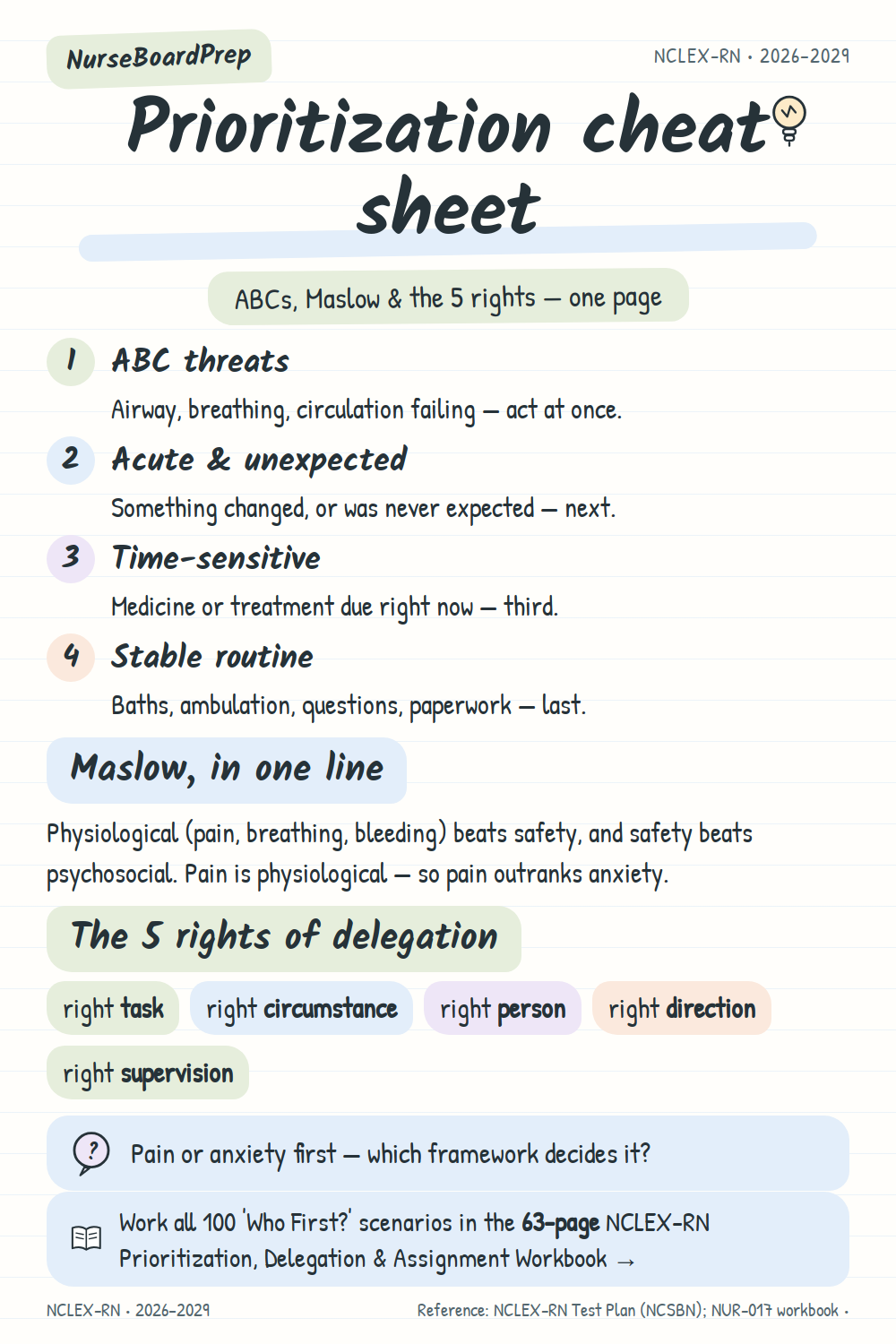
A patient who is deteriorating right now outranks a patient who is stable, even if the stable patient's diagnosis sounds more serious. A fresh post-operative bleed beats a chronic condition that is controlled. When two patients are both unstable, the one with the threatened airway, breathing, or circulation goes first.
That is the ABC order at work: airway first, then breathing, then circulation. A new airway problem beats everything else on the list, because a blocked airway kills in minutes while the other problems give you time.
3. Rule 2 — The DKA Potassium Rule (The Question 85 Trap)
A patient in diabetic ketoacidosis with a potassium of 2.9 mEq/L is the classic trap. Insulin drives potassium INTO the cells, so giving insulin when potassium is already low can push the patient into a lethal arrhythmia. The rule is absolute: hold insulin when potassium is below 3.3 mEq/L, replace potassium first, and notify the provider. Students who rush to "treat the glucose" fail this question. The glucose can wait. The potassium cannot.
4. Rule 3 — Delegate by Stability, Not by Task
The RN keeps unstable patients, fresh assessments, and clinical judgment. Stable patients with predictable outcomes can go to the LPN. Routine, non-clinical tasks go to unlicensed assistive personnel. The question is never "who is free" — it is "whose condition can change without warning."
Get the full guide here: https://payhip.com/b/kpUOQ
5. Key Numbers to Memorize
K+ below 3.3 mEq/L — Hold insulin in DKA, replace potassium first.
K+ 2.9 mEq/L — The classic trap value in the DKA question.
Glucose 486 mg/dL — High, but it waits, the potassium cannot wait.
6. NGN Question Breakdown
A patient in DKA has a blood glucose of 486 mg/dL, potassium 2.9 mEq/L, and an insulin infusion order. What is the nurse's FIRST action?
A. Start the insulin infusion as ordered.
B. Hold the insulin infusion and notify the provider for potassium replacement.
C. Administer sodium bicarbonate IV.
D. Encourage oral fluids.
Correct answer: B. Insulin shifts potassium intracellularly, so starting it at a potassium of 2.9 risks a fatal arrhythmia. Option A is the trap — it treats the number, not the patient. Option C does not address the immediate danger. Option D is unsafe in a deteriorating DKA patient and does nothing for potassium.
7. Inside the Guide
These rules, with full rationales for every option, are built into the 2026–2029 Next-Gen NCLEX-RN Clinical Judgment, Pharmacology & Prioritization Bible (39 pages) — the complete desk reference for prioritization, pharmacology, and clinical judgment.
Get the full guide here: https://payhip.com/b/kpUOQ
8. More from Nurse Board Prep Clinical Press
Follow us on Pinterest for more prioritization and clinical judgment pins: https://www.pinterest.com/NurseBoardPrep/ — Board: "Next-Gen NCLEX RN Bible 2026-2029".
— Nurse Board Prep Clinical Press (NBPCP)