

Keywords: NCLEX-RN, NGN, neurocritical care, intracranial pressure, ICP, CPP, cerebral perfusion pressure, Cushing's triad, Glasgow Coma Scale, GCS, stroke, tPA, clinical judgment
Table of Contents
1. The one neuro rule to memorize
2. Earliest vs. late: the distinction the exam tests
3. The CPP rule
4. Two more neuro rules the exam tests
5. Practice Question
6. Inside the Guide
7. More from Nurse Board Prep Clinical Press
1. The one neuro rule to memorize
If you only memorize one neuro rule before your NCLEX, make it this one: consciousness changes first, Cushing's triad last — and by the time the triad appears, herniation is near.
Get the full guide here: https://payhip.com/b/TnEDW
2. Earliest vs. late: the distinction the exam tests
Normal ICP is 5-15 mmHg; sustained ICP above 20 mmHg gets treated. But the numbers are not what the exam tests — the TIMING is.
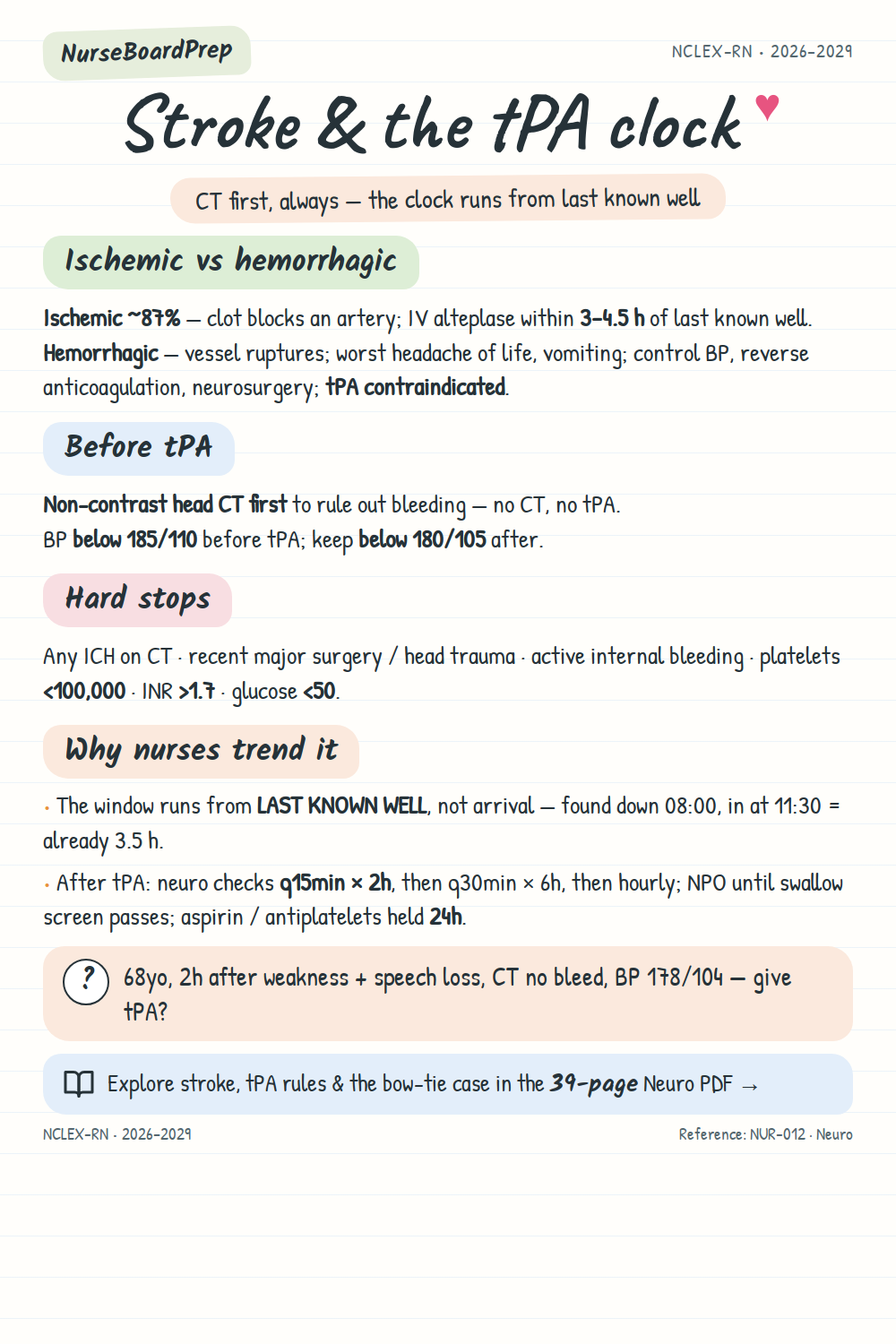
- Earliest sign of rising ICP: a change in level of consciousness. Restlessness, confusion, irritability, then lethargy. NCLEX stems hide it in plain language: "the patient is more restless than an hour ago." That sentence IS the early sign. Headache and vomiting are common and non-specific — they are not the answer.
- Late signs: Cushing's triad and a fixed, dilated pupil. Cushing's triad is systolic hypertension with a widened pulse pressure, plus bradycardia, plus irregular (Cheyne-Stokes) respirations. If the stem shows it, the patient is already in danger — the answer is urgent escalation, not routine monitoring. And the bradycardia here is pressure on the brainstem, not a heart problem: don't treat the pulse, treat the pressure.
3. The CPP rule
CPP is what actually perfuses the brain. CPP = MAP - ICP. Keep it at 60-70 mmHg or above. Worked example: MAP 93, ICP 22 → CPP 71 (acceptable). MAP 80, ICP 25 → CPP 55 (too low — raise the MAP, lower the ICP). Guard CPP with the MAP, and lower ICP without dropping perfusion. Osmotic therapy — mannitol 0.25-1 g/kg IV via filter, or 3% hypertonic saline — draws water out of brain tissue while you protect that number.
Get the full guide here: https://payhip.com/b/TnEDW
4. Two more neuro rules the exam tests
- GCS 8 or below means intubate. A Glasgow Coma Scale of 8 or less cannot protect the airway — that cutoff is tested exactly.
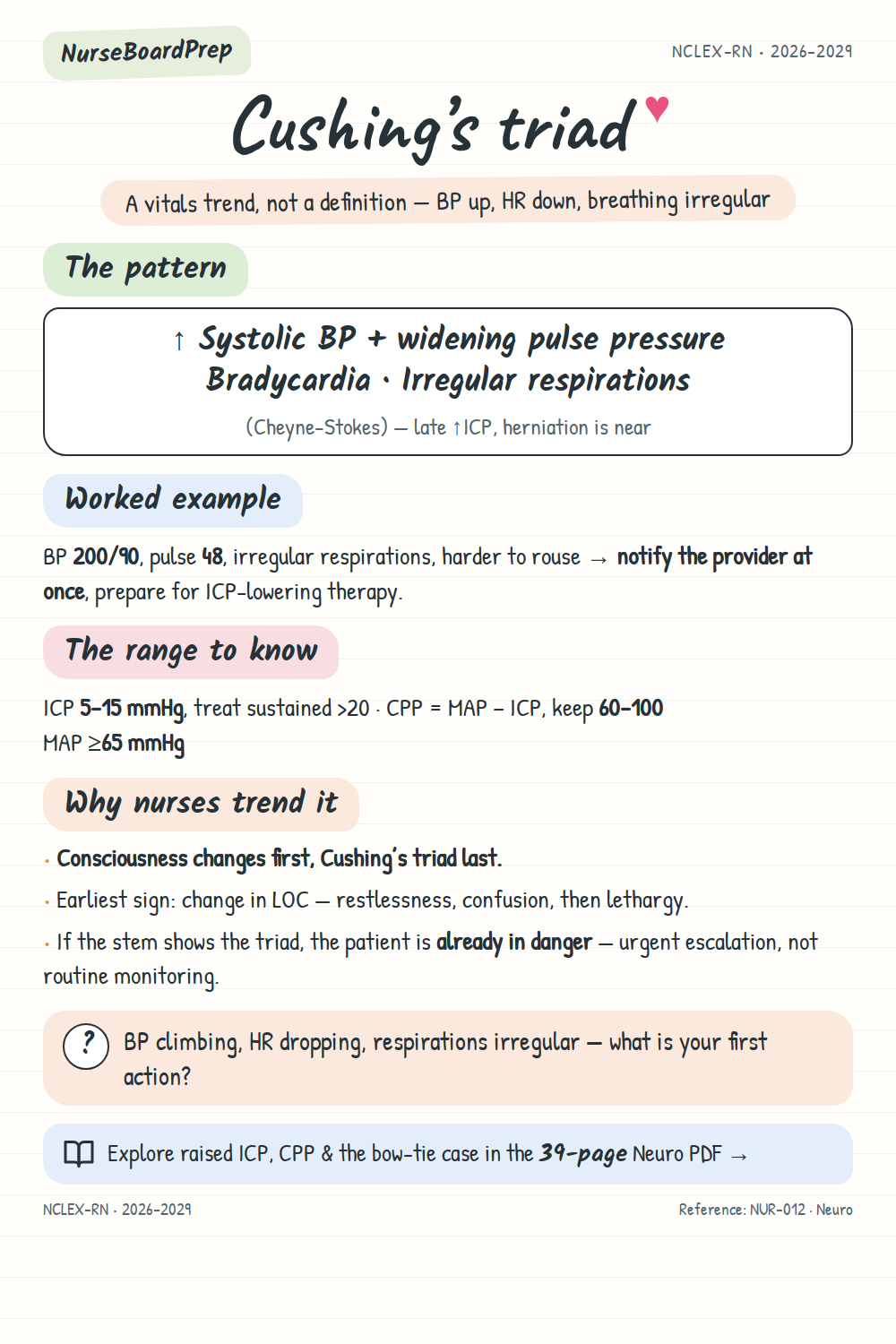
- tPA is ischemic only, post-CT only, 4.5 hours only. Hemorrhagic stroke never gets tPA, and no CT means no tPA. All three conditions, every time.
5. Practice Question
A patient has a MAP of 93 mmHg and an ICP of 22 mmHg. A second patient has a MAP of 80 mmHg and an ICP of 25 mmHg. Which patient has an acceptable CPP, and what is wrong with the other?
A. First patient CPP 71 (acceptable); second patient CPP 55 (too low).
B. First patient CPP 55 (too low); second patient CPP 71 (acceptable).
C. Both patients have acceptable CPP.
D. Both patients have CPP that is too low.
Correct answer: A. CPP = MAP − ICP. First patient: 93 − 22 = 71, which is acceptable (keep CPP at 60–70 mmHg or above). Second patient: 80 − 25 = 55, which is too low — raise the MAP, lower the ICP.
6. Inside the Guide
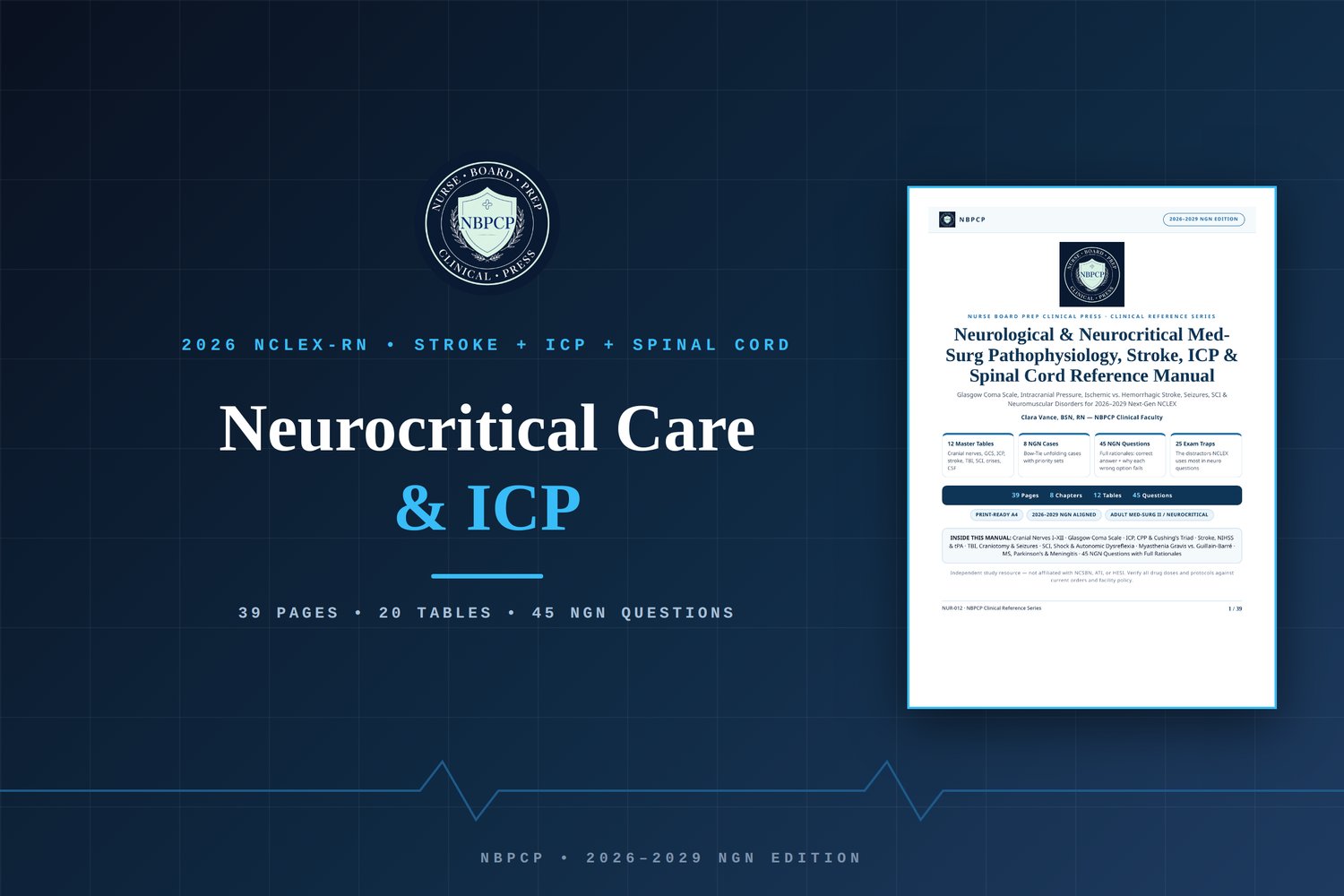
The Neurological & Neurocritical Med-Surg Pathophysiology, Stroke, ICP & Spinal Cord Reference Manual from Nurse Board Prep Clinical Press packs 39 full A4 pages: 8 chapters, 20 tables including all 12 master tables (cranial nerves, GCS, ICP and CPP, stroke and NIHSS, seizures, spinal cord injury, and more), 8 NGN Bow-Tie unfolding cases, 25 NCLEX Exam Trap boxes, 45 NGN practice questions with full rationales explaining the correct answer and why each wrong option is wrong, and 21 memory strips.
Get the full guide here: https://payhip.com/b/TnEDW
7. More from Nurse Board Prep Clinical Press
Follow us on Pinterest for more neurocritical care pins: https://www.pinterest.com/NurseBoardPrep/ — Board: "ICU Hemodynamics & Shock Guide".
— Nurse Board Prep Clinical Press (NBPCP)