

Keywords: NCLEX anatomy physiology study bible, A&P I II NCLEX-RN, ABG ROME NCLEX, MAP formula NCLEX, Cushing triad NCLEX, DKA vs HHS NCLEX, left vs right heart failure NCLEX, shock types NCLEX
The hook: anatomy is not a separate exam section — it is the foundation under every question
The NCLEX does not ask you to recite the nephron. It asks you what a urine output of 15 mL/hour means after a blood pressure of 88/52. It does not ask you to name the cranial nerves — it asks you why a patient who cannot smile evenly, has a weak arm and slurred speech needs help right now. Every physiological question is really the same question in disguise: what is normal here, what changed, and what does that change mean for this client? This article gives you that rule and one worked case — the 11 chapters, the look-alike comparisons and the red-flag map live inside the book.
The core rule (the only rule you need to start)
Ask three things about every finding:
- What is normal? — the reference range, the expected finding, the baseline.
- What changed? — the value, the trend, the new symptom.
- What does the change mean? — which system failed, and how urgently?
That is the whole fork. Normal, changed, meaning — in that order, every time.
One example — try it before you read on
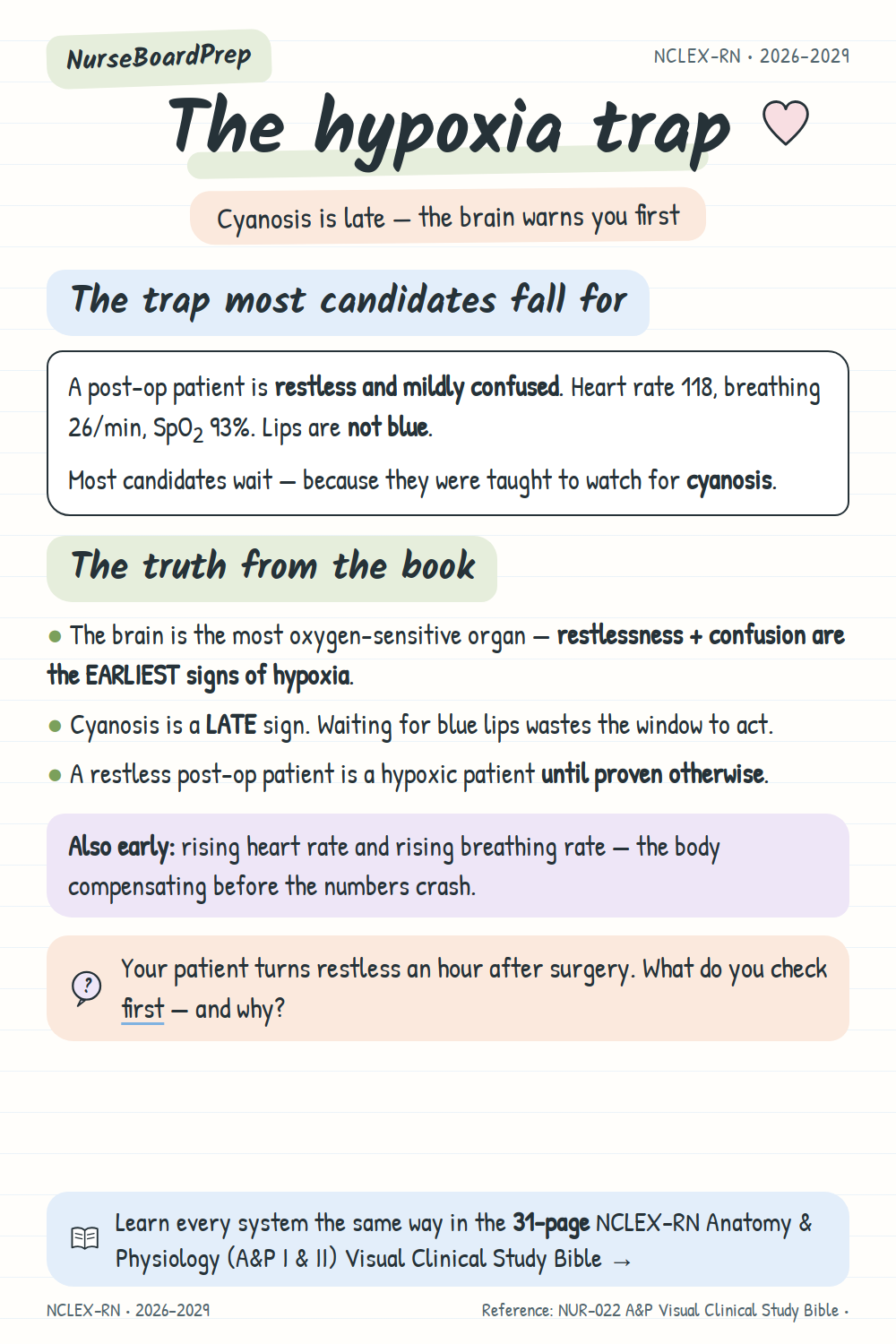
A post-op patient is restless and mildly confused. Heart rate 118, breathing 26/min, oxygen saturation 93%. Lips are not blue. Most candidates wait — because they were taught to watch for cyanosis. The book's answer: the brain is the most oxygen-sensitive organ, so restlessness and confusion are the earliest signs of hypoxia. Cyanosis is a late sign, and waiting for blue lips wastes the window to act. A restless post-op patient is a hypoxic patient until proven otherwise.
What the full book holds (the rest lives here, not in this article)
- The look-alike comparisons — DI vs. SIADH, DKA vs. HHS, left vs. right heart failure, respiratory vs. metabolic acidosis, B12 vs. folate deficiency, epidural vs. subdural hematoma.
- The red-flag map — the never-miss finding for every system, and the first move for each.
- The 12-question mixed review — with answers that point back to the chapter to re-read.
- The master lab-values table — every adult reference range in one place.
All of it lives only inside the 31-page Anatomy & Physiology (A&P I & II) Visual Clinical Study Bible.
Where the Full Method Lives
The pin gives you the rule in seconds. The full method — all 11 systems with structure, physiology, NCLEX cues, look-alikes, red flags and worked cases — is inside the 31-page book only.
It is the same book the pin's facts come from: homeostasis, fluids and acid-base, cardiovascular, respiratory, renal, neurological, endocrine, GI, musculoskeletal, immune and hematologic systems, plus shock and sepsis integration, in one print-ready PDF.