

Keywords: ABG interpretation ROME method; ROME Respiratory Opposite Metabolic Equal; pH 7.35-7.45; PaCO2 35-45; HCO3 22-26; PaO2 80-100; respiratory acidosis; respiratory alkalosis; metabolic acidosis; metabolic alkalosis
Table of Contents
• What ROME Means
Worked Example: pH 7.28, CO2 55, HCO3 24
Key Numbers to Know
Practice Question
Where the Full Method Lives
Find This Pin on Pinterest
Arterial blood gases show up on the NCLEX-RN as numbers on a page — and the question is almost always the same: what is the disorder, and what do you do first? The fastest way to read any ABG is ROME. This article gives you the rule and one worked example — the full method lives inside the ICU & Critical Care PDF.
Get the full 34-page ICU & Critical Care PDF here: https://payhip.com/b/UY5vH
What ROME Means
ROME stands for Respiratory = Opposite, Metabolic = Equal.
In a respiratory disorder, pH and PaCO2 move in opposite directions.
In a metabolic disorder, pH and HCO3 move in the same direction — they rise together or fall together.
That one line is the whole method. Once you know which value is moving with the pH, you know the cause.
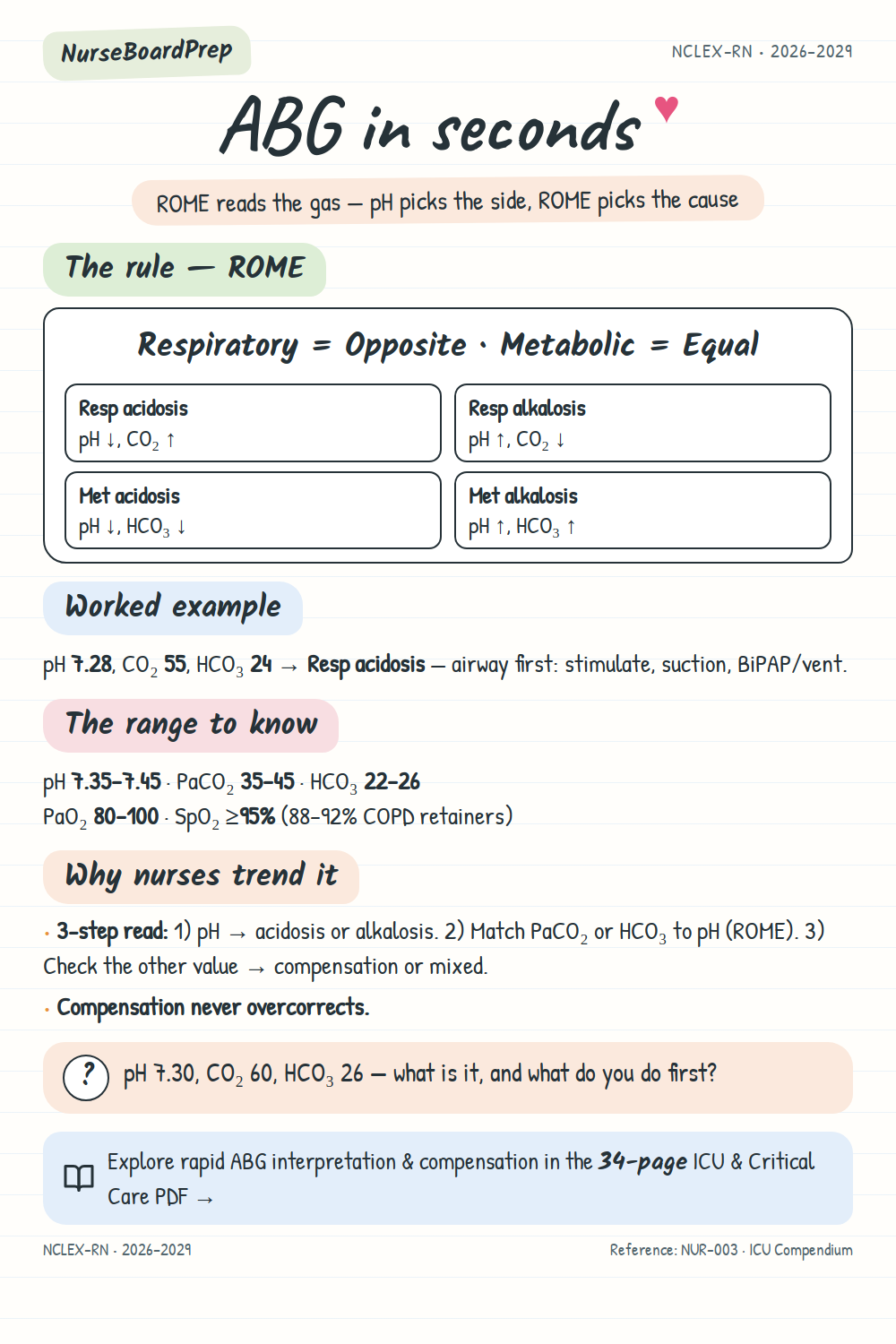
Worked Example: pH 7.28, CO2 55, HCO3 24
Step 1: pH 7.28 is below 7.35 — this is acidosis.
Step 2: CO2 is 55, above the normal 35–45. The pH fell and the CO2 rose — they moved in opposite directions. That is respiratory acidosis. The HCO3 of 24 sits inside the normal 22–26 range, so there is no metabolic driver here.
Step 3: The HCO3 has not shifted, so this is an uncompensated respiratory acidosis.
Answer: respiratory acidosis — airway first. Stimulate the patient, suction as needed, and prepare for BiPAP or ventilator support.
Get the full 34-page ICU & Critical Care PDF here: https://payhip.com/b/UY5vH
Key Numbers to Know
pH — 7.35–7.45 — Below 7.35 = acidosis; above 7.45 = alkalosis
PaCO2 — 35–45 mmHg — The respiratory value — moves opposite to pH in respiratory disorders
HCO3 — 22–26 mEq/L — The metabolic value — moves with pH in metabolic disorders
PaO2 — 80–100 mmHg — Oxygenation — low PaO2 means hypoxemia
SpO2 — 95% or higher (88–92% for COPD retainers) — The saturation target — lower for chronic CO2 retainers
Two rules to carry with the table: the 3-step read is 1) pH — acidosis or alkalosis, 2) match PaCO2 or HCO3 to pH (ROME), 3) check the other value — compensation or mixed disorder. And compensation never overcorrects — if the pH has crossed to the other side, think mixed disorder.
Practice Question
pH 7.30, CO2 60, HCO3 26 — what is it, and what do you do first?
Work it with the same 3 steps. The answer — and the full practice drills — are inside the PDF.
Where the Full Method Lives
The pin gives you ROME in seconds. The full method — the complete ROME matrix, the normal-values tables, the four acid-base patterns, compensation rules, ventilator alarms and weaning, and the practice drills — is inside the 34-page ICU & Critical Care PDF only.
Get the full 34-page ICU & Critical Care PDF here: https://payhip.com/b/UY5vH
It is the same book the pin's facts come from: the rapid ABG interpretation chapter, the normal-values tables, and the worked examples, in one print-ready PDF.
Find This Pin on Pinterest
See the pin for this article on Pinterest: Nurse Board Prep on Pinterest — https://www.pinterest.com/NurseBoardPrep/ — board: "ICU Hemodynamics & Shock Guide". Queue pin id: pin-newstyle-abg. Pin URL to be added once the pin publishes.