

Keywords: Cushing's triad late sign raised ICP; ICP 5-15 treat over 20; CPP = MAP - ICP; Monro-Kellie; herniation; blown pupil
Table of Contents
The Triad, Piece by Piece
Bow-Tie Case: BP 200/90, Pulse 48, Irregular Respirations
Key Numbers to Know
Practice Question
What's Inside the PDF (Not in This Article)
Where the Full Case Lives
Find This Pin on Pinterest
Cushing's triad is a vitals trend, not a definition. Exam stems do not ask you to recite it — they show you a blood pressure climbing, a heart rate dropping, and respirations turning irregular, and they ask what you do first. This article gives you the pattern and one worked case — the numbers, the early-vs-late cues, and the full case live inside the Neuro PDF.
Get the full 39-page Neuro PDF here: https://payhip.com/b/TnEDW
The Triad, Piece by Piece
Cushing's triad has three parts, and all three must be read together:
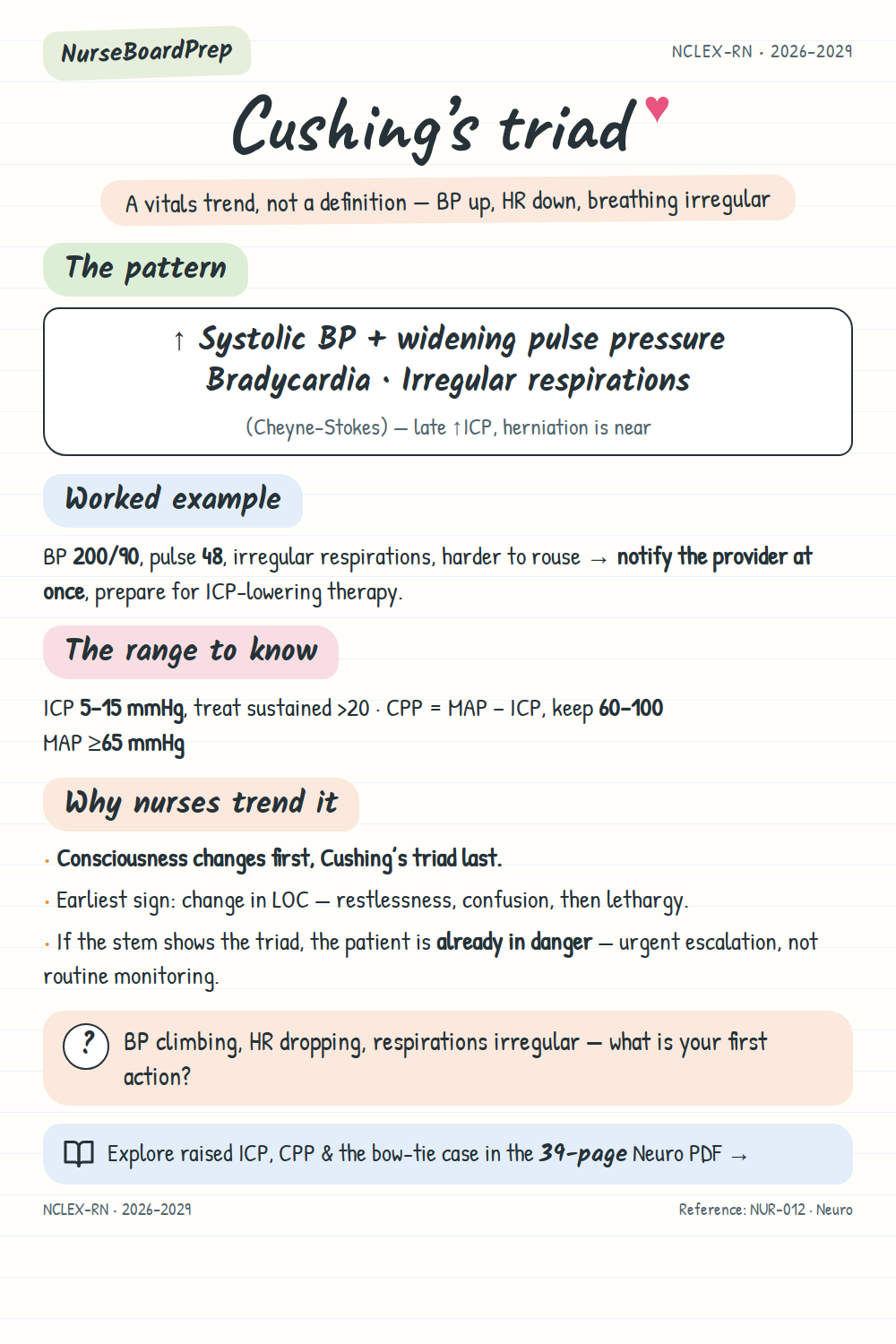
Part 1: Systolic hypertension with widening pulse pressure — the systolic pressure climbs and the gap between systolic and diastolic widens.
Part 2: Bradycardia — the heart rate drops. Here the bradycardia comes from pressure on the brainstem, not from a heart problem.
Part 3: Irregular respirations — Cheyne-Stokes breathing, an irregular pattern that replaces the normal steady rhythm.
It is a late sign of raised intracranial pressure. By the time the triad appears, herniation is near. And the earliest sign is not the triad at all — it is a change in level of consciousness: restlessness, confusion, irritability, then lethargy. The book says it in one line: consciousness changes first, Cushing's triad last.
Bow-Tie Case: BP 200/90, Pulse 48, Irregular Respirations
A patient with a severe head injury now shows blood pressure 200/90, pulse 48, and irregular respirations. The nurse notes the patient is harder to rouse than one hour ago.
The priority set:
Action: notify the provider at once and prepare for ICP-lowering therapy.
Condition: herniation risk from raised ICP.
Watch: level of consciousness trend.
The exam trap in this case is the timing: Cushing's triad is a late sign. If the stem shows it, the patient is already in danger — the answer is urgent escalation, not routine monitoring.
Get the full 39-page Neuro PDF here: https://payhip.com/b/TnEDW
Key Numbers to Know
ICP — 5–15 mmHg — Normal range — treat sustained ICP over 20 mmHg
CPP — CPP = MAP minus ICP, keep 60–100 — Cerebral perfusion pressure — the brain's blood supply
MAP — 65 mmHg or higher — Mean arterial pressure floor — below this, the brain starves
The Monro-Kellie doctrine explains why these numbers move together: the skull is a fixed box, so when one volume inside it grows, pressure rises — and perfusion falls.
Practice Question
Blood pressure is climbing, heart rate is dropping, respirations are irregular — what is your first action?
The answer — and the full bow-tie case with its priority set — is inside the PDF.
What's Inside the PDF (Not in This Article)
The Monro-Kellie doctrine — why pressure rises in a fixed box.
The early-vs-late cues table — what to catch first, and what means danger.
The numbers to know — ICP, CPP, and MAP with worked examples.
The osmotic agents — mannitol and 3% hypertonic saline, with what to watch.
All four live only inside the 39-page Neuro PDF.
Where the Full Case Lives
The pin gives you the triad in seconds. The full chapter — the Monro-Kellie doctrine, the early-vs-late cues table, the CPP worked examples, the osmotic agents, and the bow-tie case with its priority set — is inside the 39-page Neuro PDF only.
Get the full 39-page Neuro PDF here: https://payhip.com/b/TnEDW
It is the same book the pin's facts come from: Chapter 2, intracranial regulation, and the rising-ICP bow-tie case, in one print-ready PDF.
Find This Pin on Pinterest
See the pin for this article on Pinterest: Nurse Board Prep on Pinterest — https://www.pinterest.com/NurseBoardPrep/ — board: "NGN Case Studies & Bow-Tie". Queue pin id: pin-newstyle-cushing. Pin URL to be added once the pin publishes.