

Keywords: defib vs cardioversion NCLEX; shockable vs non-shockable rhythms; synchronized cardioversion; V-fib pulseless V-tach defibrillate; asystole PEA never shock; epi 1 mg IV q3-5 min; R-on-T
Table of Contents
The Hook: One Question Decides Everything
The Core Rule
One Example — Try It Before You Read On
Exam Trap Box: Pulse Before Paddles
What the Full PDF Holds
Find This Pin on Pinterest
The Hook: One Question Decides Everything
The monitor is screaming. The rhythm looks terrible. And the single question that decides what you do next is not "what rhythm is it?" — it is "is there a pulse?"
Get that question wrong and everything after it is wrong. Get it right and the whole arrest algorithm falls into place.
Get the full algorithm in the 39-page NCLEX-RN Bible PDF: https://payhip.com/b/kpUOQ
The Core Rule
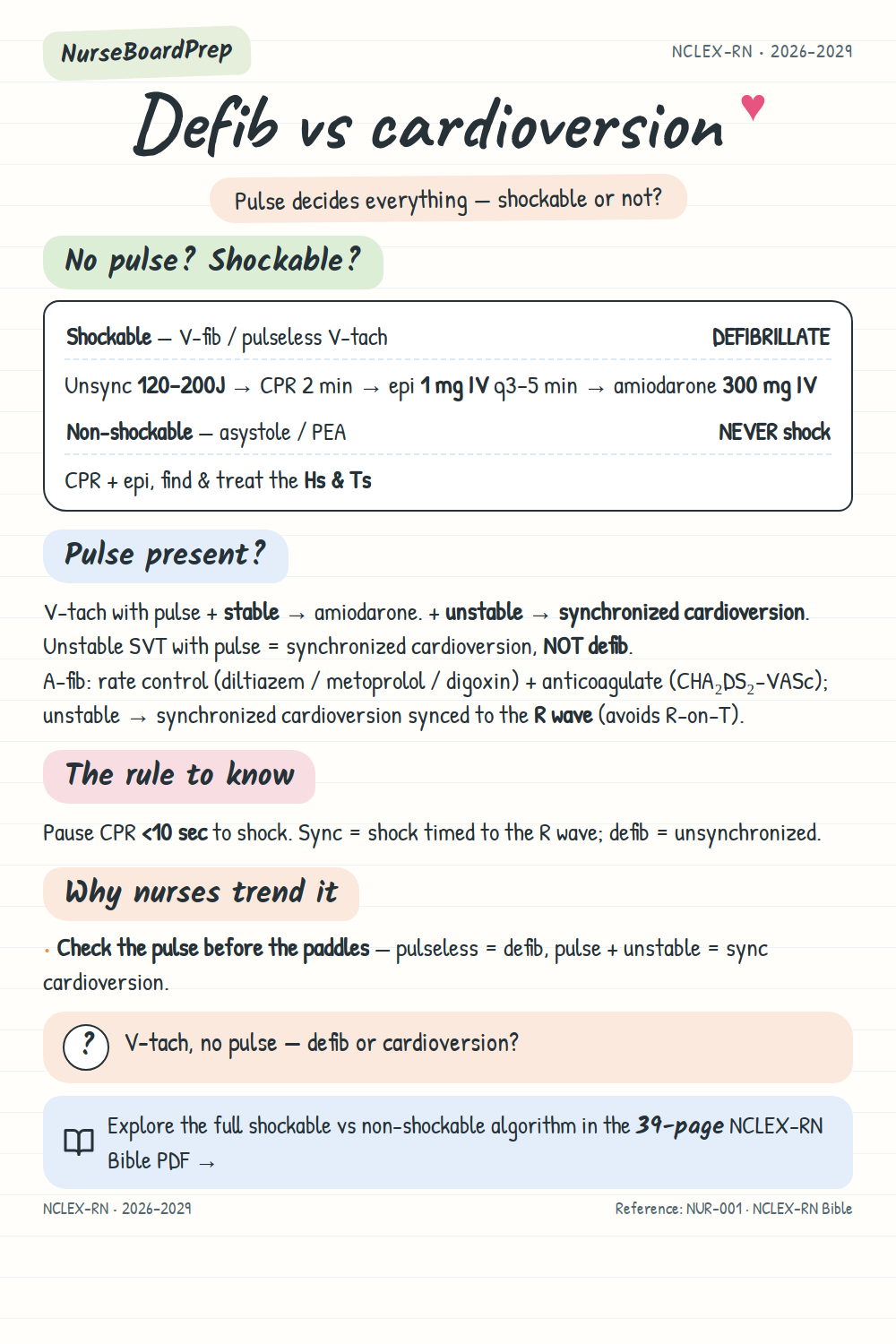
No pulse + shockable (V-fib / pulseless V-tach) — DEFIBRILLATE, unsynchronized, 120–200J.
No pulse + non-shockable (asystole / PEA) — NEVER shock. CPR + epi, and find the Hs & Ts.
Pulse present + unstable — synchronized cardioversion — not defib. The shock is timed to the R wave so it never lands on a T wave.
That is the whole fork in the road. Pulse first, rhythm second, shock type third.
One Example — Try It Before You Read On
V-tach on the monitor. No pulse. What do you do?
Defibrillate — unsynchronized, 120–200J — then CPR for 2 minutes, epi 1 mg IV every 3–5 minutes, amiodarone 300 mg IV. The same patient with a pulse and unstable vitals gets a completely different shock: synchronized cardioversion. Same machine, same paddles, opposite decision — and the pulse is what tells you which one.
The full shockable vs non-shockable algorithm, drug doses, Hs & Ts and the A-fib rate-control rules are inside the 39-page NCLEX-RN Bible PDF: https://payhip.com/b/kpUOQ
Exam Trap Box: Pulse Before Paddles
Check the pulse before the paddles — pulseless = defib, pulse + unstable = sync cardioversion.
Pause CPR less than 10 sec to shock. Long pauses kill the rhythm you are trying to save.
Sync = shock timed to the R wave; defib = unsynchronized. Sync avoids R-on-T.
V-tach with pulse + stable — amiodarone. + unstable — synchronized cardioversion.
Unstable SVT with pulse = synchronized cardioversion, NOT defib.
A-fib: rate control (diltiazem / metoprolol / digoxin) + anticoagulate (CHA2DS2-VASc); unstable — synchronized cardioversion synced to the R wave.
What the Full PDF Holds
The complete arrest and tachycardia algorithms from Module 17 — every rhythm, every dose, every trap the exam sets with a pulse check — worked through step by step, in the same 39-page Bible that carries the other 27 modules.
Get the 39-page NCLEX-RN Bible PDF here: https://payhip.com/b/kpUOQ
Find This Pin on Pinterest
See the pin for this article on Pinterest: Nurse Board Prep on Pinterest — https://www.pinterest.com/NurseBoardPrep/ — board: "EKG Telemetry & ACLS Strips". Queue pin id: pin-newstyle-batch2-defib. Pin URL to be added once the pin publishes.