

Keywords: NCLEX delirium vs dementia, CAM confusion assessment method, Beers Criteria NCLEX, gerontological nursing NCLEX, fall prevention older adults, hypoactive delirium, Lewy body dementia NCLEX
👉 Get the full 44-page Gerontological Nursing workbook here: https://payhip.com/b/PH2RS
The hook: she was fine yesterday — and confused today
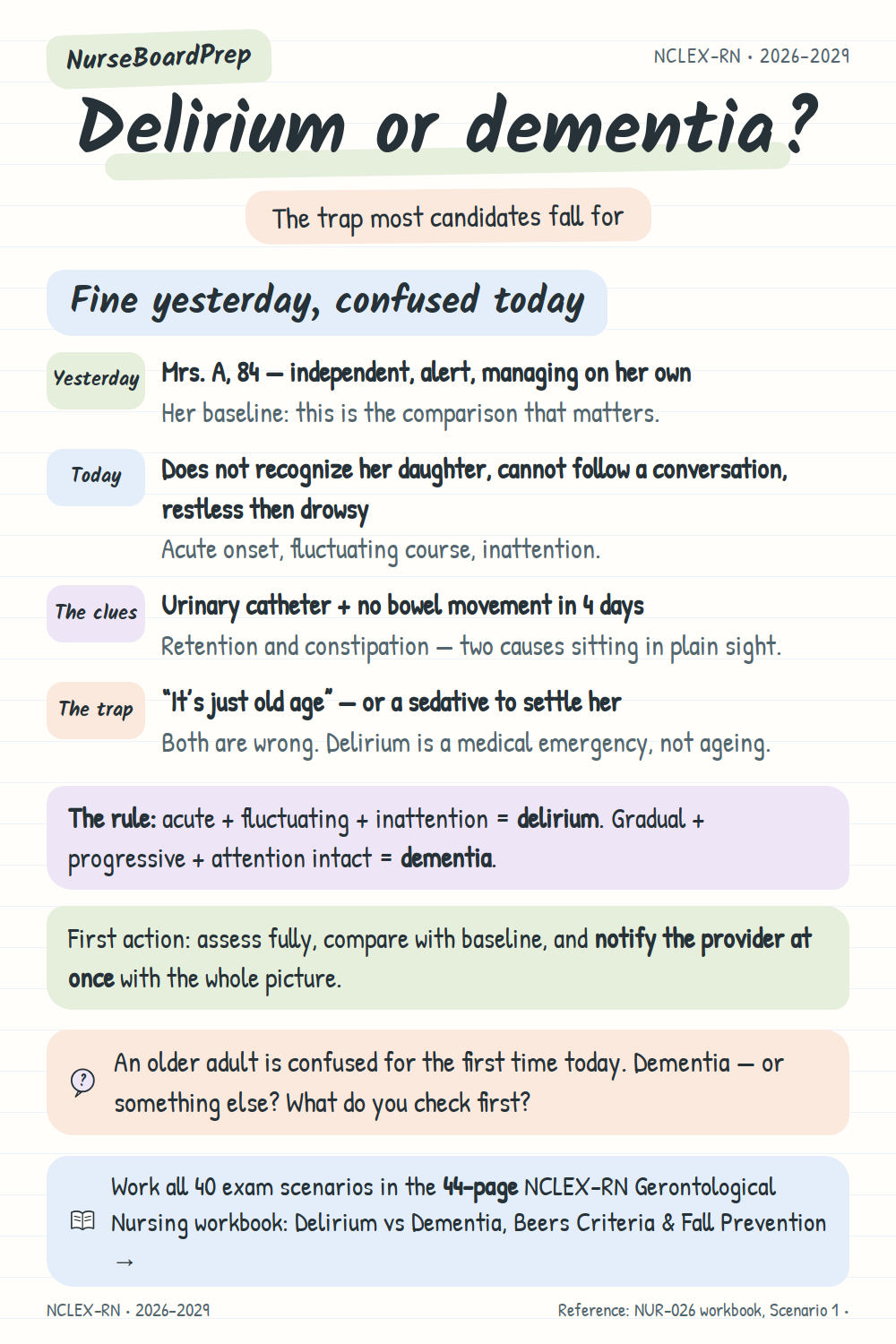
An 84-year-old was independent and alert yesterday. This morning she does not recognize her daughter, cannot follow a conversation, and keeps picking at the bed covers. Is it dementia? Is it "just old age"? No — and that one wrong call is the trap the NCLEX sets again and again. New confusion in an older adult is delirium until proven otherwise, and delirium has a cause that needs finding today, not tomorrow. This article gives you the deciding rule and one worked case — the 40 scenarios, the Beers Criteria tables, and the fall-prevention checklist live inside the workbook.
The core rule (the only rule you need to start)
Ask two questions: when did it start, and can she focus?.
- Acute onset + fluctuating course + inattention = delirium. Hours to days, better and worse in the same day, cannot focus or follow a conversation. The cause is medical — infection, a new drug, retention, constipation, dehydration, low oxygen, low glucose. Find it and treat it, and the confusion usually clears.
- Gradual onset + progressive course + attention intact early = dementia. Months to years, steady decline, memory fails first (Alzheimer's), or steps after strokes (vascular), or hallucinations with parkinsonism (Lewy body), or behavior change first (frontotemporal). Consciousness stays clear until very late.
- The CAM confirms delirium: features 1 (acute onset, fluctuating) and 2 (inattention), plus either 3 (disorganized thinking) or 4 (altered consciousness).
That is the whole fork. Yesterday she was fine? Delirium. Getting worse for months? Dementia.
One example — try it before you read on
Mrs. A, 84, was independent yesterday. Today she is confused, restless, then drowsy, then restless again. She has a urinary catheter and has not had a bowel movement in four days. What do you do first?
Assess her fully, compare with her baseline, and notify the provider at once with the whole picture — because the catheter (retention, infection) and four days without a bowel movement (constipation, impaction) are two likely causes sitting in plain sight. The wrong answers are always the same shape: "it's just old age," "give her a sedative," or "recheck tomorrow." A sedative worsens delirium. Waiting lets the cause get worse.
What the full workbook holds (the rest lives here, not in this article)
- The DELIRIUM cause mnemonic — drugs, electrolytes, low oxygen, infection, retention, intracranial, undernutrition, metabolic — and the HELP prevention model.
- The dementia types table — Alzheimer's, vascular, Lewy body, frontotemporal — with the exam clues that tell them apart, plus stages, communication, and caregiver support.
- The Beers Criteria high-risk classes — benzodiazepines, Z-drugs, first-generation antihistamines, anticholinergics, NSAIDs, long-acting sulfonylureas — and what to watch for with each.
- The fall-prevention checklist — Morse Fall Scale, Hendrich II, Timed Up and Go, post-fall care, and environmental safety.
- 40 exam-style scenarios with a 40-row answer key and 3 quick-reference pages.
All of it lives only inside the 44-page Gerontological Nursing workbook.
Where the Full Method Lives
The pin gives you the rule in seconds. The full method — the eight teaching chapters, the delirium vs. dementia table, the CAM, the Beers Criteria tables, the fall-prevention checklist, and all 40 exam-style scenarios — is inside the 44-page workbook only.
It is the same book the pin's facts come from: ageing, delirium, dementia, Beers Criteria, falls, medication management, elder abuse, advance directives, and exam application, in one print-ready PDF.