

Keywords: EKG strip 6-step method; rate regularity P waves PR interval QRS; 300 method; 6-second method; small box 0.04s large box 0.20s; PR 0.12-0.20
Table of Contents
The 6 Steps
Worked Example: The PR Interval That Keeps Growing
Key Numbers to Know
What's Inside the PDF (Not in This Article)
Where the Full Analysis Lives
Find This Pin on Pinterest
Every EKG strip is read the same way. Same order, every strip, every time. That is the whole secret of rhythm interpretation: a fixed sequence that stops you from naming a rhythm before you have actually looked at it. This article gives you the 6 steps and one worked example — the grid timing, the waveform tables, and the telemetry cases live inside the EKG & Telemetry PDF.
Get the full 32-page EKG & Telemetry PDF here: https://payhip.com/b/Msxlo
The 6 Steps
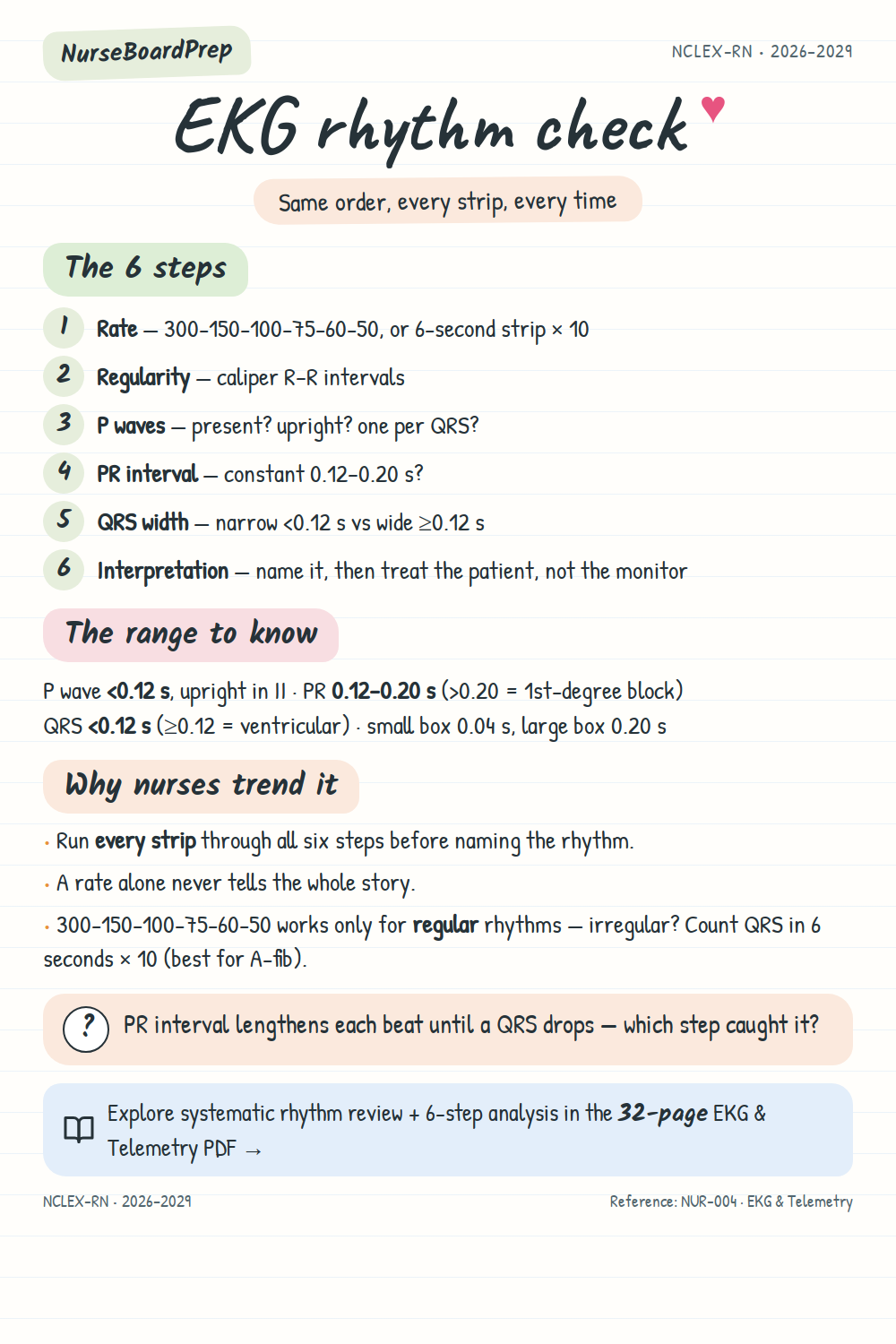
Step 1: Rate — how fast is the heart going?
Step 2: Regularity — are the R–R intervals even?
Step 3: P waves — present? Upright? One per QRS?
Step 4: PR interval — constant, 0.12–0.20 seconds?
Step 5: QRS width — narrow under 0.12 seconds, or wide?
Step 6: Interpretation — name the rhythm, then treat the patient, not the monitor.
Run every strip through all six steps before naming the rhythm. A rate alone never tells the whole story.
Worked Example: The PR Interval That Keeps Growing
The PR interval lengthens with each beat until a QRS drops. Which step caught it?
Step 4 — the PR interval. The PR interval is the value changing from beat to beat, so the PR interval step is the one that catches it. That is exactly why the steps run in a fixed order: each step checks one thing, and the changing value tells you where the problem lives.
Get the full 32-page EKG & Telemetry PDF here: https://payhip.com/b/Msxlo
Key Numbers to Know
P wave — under 0.12 s, upright in lead II — Absent or abnormal P waves change the rhythm
PR interval — 0.12–0.20 s — over 0.20 s = 1st-degree block
QRS width — under 0.12 s — 0.12 s or over = ventricular origin
Small box — 0.04 s — The grid ruler behind every measurement
Large box — 0.20 s — 5 small boxes = 1 large box
Two ways to get the rate: the 300-150-100-75-60-50 method (works only for regular rhythms) and the 6-second method — count QRS in 6 seconds times 10 (best for A-fib, the classic irregular rhythm).
What's Inside the PDF (Not in This Article)
ECG grid timing — the ruler behind every measurement (small box 0.04 s, large box 0.20 s).
Normal waveform values — P wave, PR interval, and QRS tables with abnormal flags.
Two ways to get the rate — the 300-150-100-75-60-50 method and the 6-second method.
15 telemetry cases with line-by-line answer keys.
All four live only inside the 32-page EKG & Telemetry PDF.
Where the Full Analysis Lives
The pin gives you the 6 steps in seconds. The full method — the grid timing, the waveform tables, the 6-step analysis, and the telemetry case bank — is inside the 32-page EKG & Telemetry PDF only.
Get the full 32-page EKG & Telemetry PDF here: https://payhip.com/b/Msxlo
It is the same book the pin's facts come from: Module 1, the 6-step strip analysis, and the telemetry case bank, in one print-ready PDF.
Find This Pin on Pinterest
See the pin for this article on Pinterest: Nurse Board Prep on Pinterest — https://www.pinterest.com/NurseBoardPrep/ — board: "EKG Telemetry & ACLS Strips". Queue pin id: pin-newstyle-ekg. Pin URL to be added once the pin publishes.