

Keywords: NCLEX oncology neutropenia ANC, febrile neutropenia NCLEX, chemotherapy safety extravasation, tumor lysis syndrome labs, blood transfusion reactions TRALI TACO, NCLEX-RN oncology questions
The hook: a fever that looks harmless — and is an emergency
A client finishes chemotherapy, goes home feeling fine, and calls ten days later with a fever of 101.5°F. She feels unwell, but not terrible. Nothing looks dramatic. And yet this is one of the most dangerous calls in oncology nursing — because the number that decides it is not the temperature. It is the ANC. This article gives you the rule and one worked case — the 14 NGN-style questions, the reaction tables and the red-flag quick reference live inside the guide.
The core rule (the only rule you need to start)
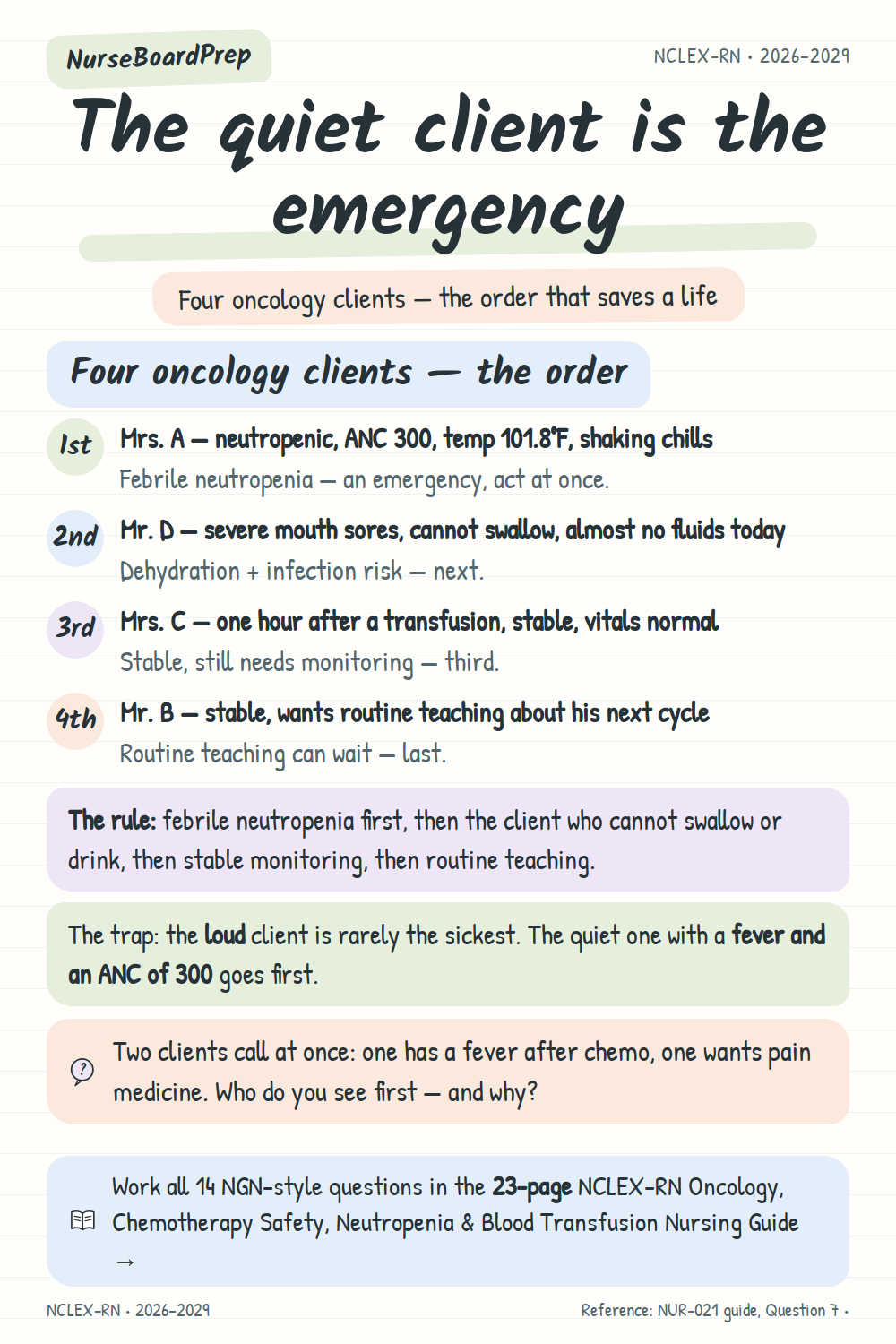
Fever + ANC below 500 = emergency. The nadir comes about 7–14 days after chemotherapy.
- ANC (absolute neutrophil count) = WBC × (% segmented neutrophils + % bands) ÷ 100. Below 500 cells/mm³ is severe neutropenia — the client has almost no defense against bacterial infection.
- The nadir is the lowest point of the blood counts, about 7–14 days after chemotherapy. The client who feels fine on day 3 can be in the most danger on day 10.
- Febrile neutropenia = ANC below 500 (or below 1,000 and falling) plus a single temperature of 38.3°C (101°F) or higher. Assess fully, notify the provider at once, and anticipate cultures and orders. Never wait for the fever to settle.
That is the whole fork. Check the ANC, check the day, and a fever after chemo is never "just a fever."
One example — try it before you read on
Mrs. K, 54, is on day 10 after chemotherapy. Temperature 101.5°F (38.6°C), shaking chills, heart rate 118, feels unwell. Latest labs: ANC 400 cells/mm³. What should the nurse do first?
Assess her fully, notify the provider at once, and anticipate cultures and orders. Day 10 is the nadir window, the ANC is 400, and she has a fever with chills and a fast heart rate — infection in a client with almost no neutrophils can become sepsis in hours. A blanket and a recheck in two hours would waste the window that matters.
What the full guide holds (the rest lives here, not in this article)
- The chemotherapy safety section — PPE and safe handling, administration checks, spill protocol, and extravasation: stop, do not flush, notify at once.
- The tumor lysis pattern — potassium, phosphate and uric acid up, calcium down — and who is at risk in the first 72 hours.
- The transfusion sections — blood products, the before/during/after procedure, and the reaction table including TRALI vs. TACO, with the universal first response.
- The 14-question answer key and the red-flag quick reference — one page to keep.
All of it lives only inside the 23-page Oncology, Chemotherapy Safety, Neutropenia & Blood Transfusion Nursing Guide.
Where the Full Method Lives
The pin gives you the rule in seconds. The full method — the ANC worked example, the nadir, tumor lysis, bleeding precautions, blood products, the transfusion procedure and every reaction, and all 14 NGN-style questions — is inside the 23-page guide only.
It is the same book the pin's facts come from: oncology, chemotherapy safety, neutropenia and blood transfusion, in one print-ready PDF.